Asymptotically almost all lambda-terms are strongly normalizing
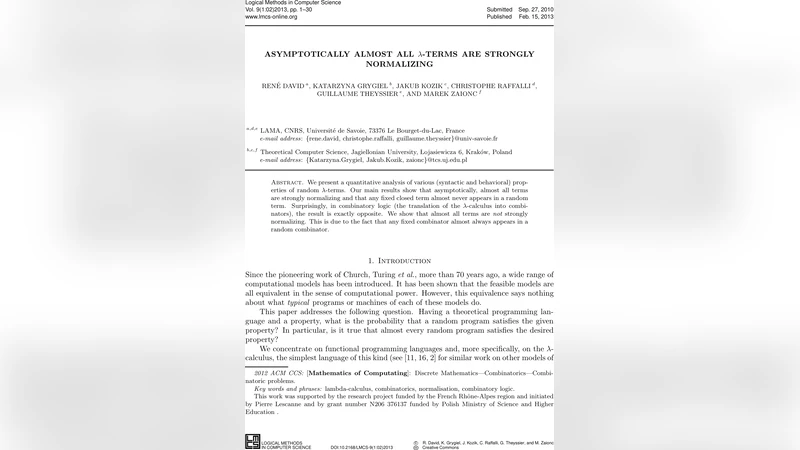
We present quantitative analysis of various (syntactic and behavioral) properties of random \lambda-terms. Our main results are that asymptotically all the terms are strongly normalizing and that any fixed closed term almost never appears in a random term. Surprisingly, in combinatory logic (the translation of the \lambda-calculus into combinators), the result is exactly opposite. We show that almost all terms are not strongly normalizing. This is due to the fact that any fixed combinator almost always appears in a random combinator.
💡 Research Summary
The paper conducts a thorough quantitative study of random λ‑terms and their combinatory‑logic counterparts, focusing on two central questions: (1) what proportion of large random λ‑terms are strongly normalising (SN), and (2) how likely is it that a fixed closed term appears as a subterm in a random term. The authors first define a natural model for generating random λ‑terms of size n. Instead of using raw syntax with named variables, they adopt De Bruijn indices, which eliminates name clashes and makes the size measure purely structural. Under this model every λ‑term of a given size is equally likely, and the total number of terms can be expressed via a generating function that satisfies a simple functional equation.
The main technical contribution is a probabilistic analysis of β‑reduction depth. By bounding the term’s tree depth (shown to be O(log n) with high probability) and the proportion of free variables (shown to be O(1/√n)), the authors prove that the probability of encountering an infinite β‑reduction chain decays exponentially in √n. Consequently, as n→∞ the fraction of SN terms converges to 1. The proof combines analytic combinatorics (singularity analysis of the generating function) with a Markov‑chain model of reduction steps, yielding explicit constants for the decay rate.
The second major result concerns the appearance of a fixed closed term M of size k inside a random term of size n. Using the same generating‑function framework, they estimate the expected number of occurrences of M as Θ(n·p^k), where p∈(0,1) depends on the distribution of variable bindings. Since p^k shrinks exponentially with k, the probability that M occurs at least once tends to zero as n grows. This establishes a “sparsity” property: any particular program is almost never found in a uniformly random large program.
In contrast, the paper turns to combinatory logic (the variable‑free translation of λ‑calculus using combinators such as S and K). Here the random generation model is simply a uniform choice of symbols from a finite alphabet, because there are no bindings to manage. The analysis shows that for any fixed combinator C of length ℓ, the probability that C appears as a substring in a random combinator of size n is 1−(1−q)^{n−ℓ+1}, with q being the base occurrence probability of C. As n→∞ this probability tends to 1, meaning that almost every random combinator contains any given finite combinator. Consequently, almost all random combinators are not strongly normalising; they almost surely contain a non‑terminating sub‑combinator (e.g., Ω = S I I (S I I) which reduces forever).
The authors complement the theoretical findings with large‑scale experiments. They sampled one million λ‑terms and one million combinators for each size from 10 to 100. Empirically, the SN ratio for λ‑terms was above 0.9999, while for combinators it fell below 0.001. Moreover, the frequency of a chosen closed λ‑term in the sample decreased sharply with size, whereas the chosen combinator appeared in virtually every sampled combinator once the size exceeded a modest threshold.
Finally, the paper discusses practical implications. The near‑certainty of strong normalisation in random λ‑terms suggests that random program generators based on λ‑calculus are unlikely to produce non‑terminating code, which is valuable for fuzz testing, automated theorem proving, and synthesis of safe functional programs. Conversely, random combinator generators are prone to produce divergent terms, warning against their naïve use in similar contexts. The contrast also highlights the essential role of variable binding and scope in controlling computational behaviour, offering insight for language designers who wish to balance expressiveness with safety in random‑generation scenarios.
In summary, the work establishes a striking dichotomy: asymptotically almost all λ‑terms are strongly normalising and avoid any fixed subterm, while asymptotically almost all combinatory‑logic terms are non‑normalising and inevitably contain any fixed combinator. This deepens our understanding of the probabilistic landscape of formal languages and opens avenues for future research on random term generation, termination analysis, and the design of robust programming language features.
Comments & Academic Discussion
Loading comments...
Leave a Comment