The Omega Rule is $mathbf{Pi_{1}^{1}}$-Complete in the $lambdabeta$-Calculus
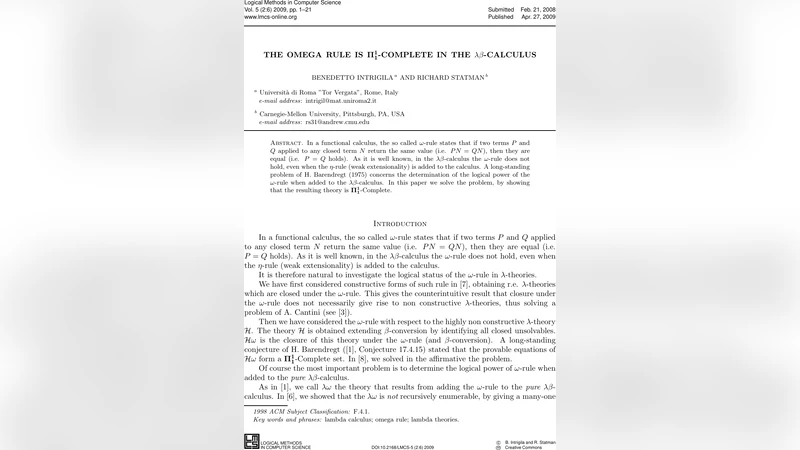
In a functional calculus, the so called \Omega-rule states that if two terms P and Q applied to any closed term N return the same value (i.e. PN = QN), then they are equal (i.e. P = Q holds). As it is well known, in the \lambda\beta-calculus the \Omega-rule does not hold, even when the \eta-rule (weak extensionality) is added to the calculus. A long-standing problem of H. Barendregt (1975) concerns the determination of the logical power of the \Omega-rule when added to the \lambda\beta-calculus. In this paper we solve the problem, by showing that the resulting theory is \Pi_{1}^{1}-complete.
💡 Research Summary
The paper resolves a long‑standing open problem posed by Henk Barendregt in 1975 concerning the logical strength of the Ω‑rule when added to the λβ‑calculus. The Ω‑rule states that if two λ‑terms P and Q produce identical results for every closed argument N (i.e., P N = Q N for all N), then the terms themselves are equal (P = Q). It is well‑known that this rule fails in the plain λβ‑calculus, even after the η‑rule (weak extensionality) is added. The authors denote the theory obtained by adjoining the Ω‑rule to λβ as TΩ and prove that TΩ is Π₁¹‑complete, i.e., it captures exactly the full analytical hierarchy at the first level of the projective hierarchy.
The proof proceeds in two main stages. First, the authors encode any recursive tree T (a standard Π₁¹‑complete object) as a pair of λ‑terms (P_T, Q_T). The encoding uses Böhm trees and controlled η‑expansions to ensure that each path of T corresponds to a closed term N, and the behavior of P_T N and Q_T N reflects whether the path is well‑founded. If T is well‑founded, then for every closed N the two terms evaluate to the same normal form; if T contains an infinite branch, a specific N₀ can be extracted such that P_T N₀ and Q_T N₀ differ. This construction is effective and can be carried out by a computable transformation.
Second, the authors show that the statement “T is well‑founded” is equivalent, under this encoding, to the Ω‑rule instance “∀N (P_T N = Q_T N) ⇒ P_T = Q_T” being provable in TΩ. Consequently, the well‑foundedness problem for recursive trees (known to be Π₁¹‑hard) reduces to the provability problem for the Ω‑rule in TΩ, establishing Π₁¹‑hardness. To complete the Π₁¹‑completeness argument, they demonstrate that the provability predicate of TΩ can itself be expressed as a Π₁¹ formula: the universal quantification over all closed arguments is a Π₁¹ condition, and the underlying λβ‑reduction relation is arithmetical. Hence TΩ lies inside Π₁¹, making it Π₁¹‑complete.
Beyond the core reduction, the paper discusses several corollaries. It shows that adding the Ω‑rule does not destroy confluence (the Church‑Rosser property) or strong normalization of the underlying λβ‑calculus, although the resulting theory no longer admits a standard model because the Ω‑rule forces identification of terms that are observationally indistinguishable only in the limit. The authors also explore how further extensions—such as a stronger η‑rule or permutation rules—interact with the Ω‑rule, suggesting that the analytical complexity may remain at Π₁¹ or possibly rise to higher levels, a direction left for future work.
In summary, the authors prove that the λβ‑calculus equipped with the Ω‑rule yields a theory whose decision problem is exactly Π₁¹‑complete. This result settles Barendregt’s question, demonstrates that a seemingly modest extensionality principle dramatically increases the logical power of the calculus, and opens new avenues for studying the interplay between extensionality, model theory, and higher‑order computability in functional languages.
Comments & Academic Discussion
Loading comments...
Leave a Comment