Model Checking Probabilistic Timed Automata with One or Two Clocks
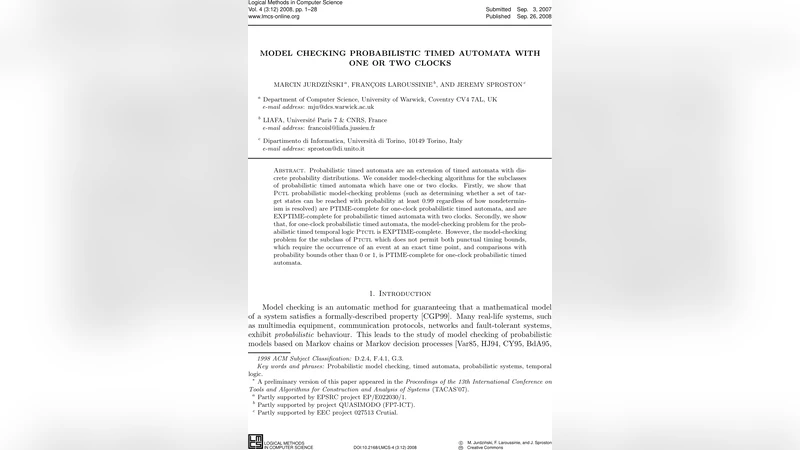
Probabilistic timed automata are an extension of timed automata with discrete probability distributions. We consider model-checking algorithms for the subclasses of probabilistic timed automata which have one or two clocks. Firstly, we show that PCTL probabilistic model-checking problems (such as determining whether a set of target states can be reached with probability at least 0.99 regardless of how nondeterminism is resolved) are PTIME-complete for one-clock probabilistic timed automata, and are EXPTIME-complete for probabilistic timed automata with two clocks. Secondly, we show that, for one-clock probabilistic timed automata, the model-checking problem for the probabilistic timed temporal logic PCTL is EXPTIME-complete. However, the model-checking problem for the subclass of PCTL which does not permit both punctual timing bounds, which require the occurrence of an event at an exact time point, and comparisons with probability bounds other than 0 or 1, is PTIME-complete for one-clock probabilistic timed automata.
💡 Research Summary
The paper investigates the computational complexity of model‑checking problems for Probabilistic Timed Automata (PTA) when the number of clocks is restricted to one or two. PTAs extend classical timed automata by allowing discrete probability distributions on transitions, and they are a natural formalism for systems that combine real‑time constraints with stochastic behavior, such as wireless protocols, real‑time scheduling, and safety‑critical control loops.
The authors first focus on the probabilistic computation tree logic (PCTL), a widely used temporal logic for specifying quantitative reachability and safety properties. They show that for PTAs equipped with a single clock (1‑clock PTA), the PCTL model‑checking problem is PTIME‑complete. The key technical contribution is a region‑based abstraction: the continuous time domain can be partitioned into a finite set of intervals (regions) that preserve the probabilistic behavior of the automaton. By collapsing each region into a single abstract state, the 1‑clock PTA is transformed into a finite Markov decision process (MDP). Since PCTL model checking on MDPs can be performed in polynomial time, the whole procedure remains within PTIME, and a matching PTIME‑hardness proof establishes completeness.
When a second clock is added, the situation changes dramatically. The two‑dimensional time space yields a grid of rectangular regions whose number grows exponentially with the size of the input. The authors construct a reduction from the EXPTIME‑complete tiling problem to the PCTL model‑checking problem for 2‑clock PTAs, thereby proving EXPTIME‑hardness. Together with an EXPTIME upper bound obtained by a straightforward region construction, they conclude that PCTL model checking for PTAs with two clocks is EXPTIME‑complete.
The paper then distinguishes between the full PCTL language and a restricted fragment. Full PCTL allows punctual timing bounds (e.g., “event occurs exactly at time 5”) and probability comparisons against arbitrary thresholds (e.g., “≥ 0.75”). The authors prove that even for 1‑clock PTAs, the presence of punctual bounds forces the region abstraction to become exponentially fine, raising the complexity to EXPTIME‑complete. Conversely, if one disallows punctual bounds and restricts probability comparisons to the trivial values 0 and 1, the resulting fragment—essentially a qualitative version of PCTL—remains PTIME‑complete for 1‑clock PTAs. This fragment captures many practical specifications such as “event eventually happens with probability 1” or “event never happens with probability 0,” without requiring exact timing.
From a practical standpoint, the results give system designers a clear guideline: if the specification can be expressed in the qualitative, non‑punctual fragment, verification of 1‑clock PTAs can be performed efficiently; otherwise, one should expect exponential‑time algorithms, especially when exact timing or intermediate probability thresholds are needed. The authors also discuss potential extensions, including the analysis of PTAs with more than two clocks, the study of other probabilistic timed logics such as CSL or PTCTL, and the development of tool support that automatically selects the appropriate abstraction based on the specification’s features.
In summary, the paper establishes a precise complexity landscape for probabilistic timed model checking: PTIME‑complete for 1‑clock PTAs under qualitative, non‑punctual PCTL, EXPTIME‑complete for 2‑clock PTAs, and EXPTIME‑complete for full PCTL even with a single clock. These findings deepen our theoretical understanding of the interplay between time, probability, and nondeterminism, and they provide actionable insights for the verification of real‑time stochastic systems.
Comments & Academic Discussion
Loading comments...
Leave a Comment