From Nondeterministic B"uchi and Streett Automata to Deterministic Parity Automata
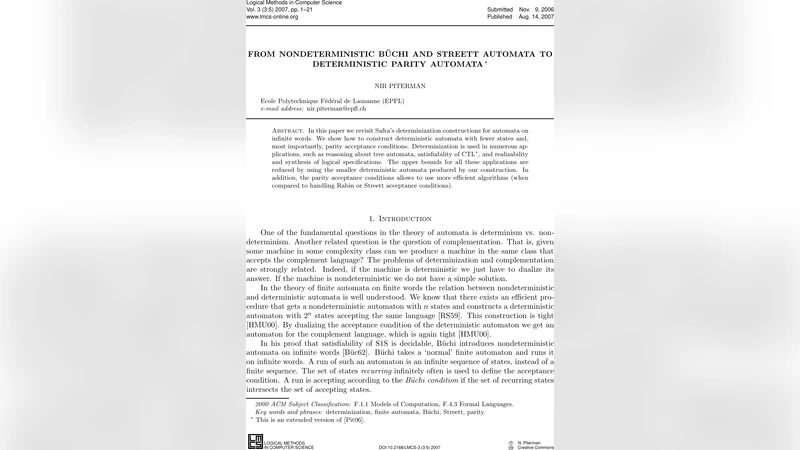
In this paper we revisit Safra’s determinization constructions for automata on infinite words. We show how to construct deterministic automata with fewer states and, most importantly, parity acceptance conditions. Determinization is used in numerous applications, such as reasoning about tree automata, satisfiability of CTL*, and realizability and synthesis of logical specifications. The upper bounds for all these applications are reduced by using the smaller deterministic automata produced by our construction. In addition, the parity acceptance conditions allows to use more efficient algorithms (when compared to handling Rabin or Streett acceptance conditions).
💡 Research Summary
This paper revisits Safra’s classic determinization constructions for automata on infinite words and presents a refined method that yields deterministic automata with significantly fewer states and, crucially, parity acceptance conditions. The authors begin by highlighting the limitations of the original Safra construction, which transforms nondeterministic Büchi automata into Rabin automata at the cost of a state blow‑up on the order of n·(12)ⁿ·n! and suffers an even worse explosion for Streett automata. To address these issues, they introduce a “compressed Safra tree” data structure. In this structure each node’s label is stored as a bit‑vector, nodes with identical labels are merged, and every node carries a color and a priority. The color records whether the node is currently active or has already satisfied its acceptance condition, while the priority is used to define a parity condition later on.
The determinization proceeds in two phases. First, the nondeterministic Büchi or Streett automaton is converted into a deterministic automaton whose transition function updates the compressed tree by simple label, color, and priority adjustments, avoiding the costly tree‑restructuring steps of the original algorithm. Second, the acceptance condition of this deterministic automaton is translated from Rabin/Streett to parity by interpreting the assigned priorities: an even priority indicates acceptance, an odd one indicates rejection. This translation collapses the potentially many Rabin pairs or Streett obligations into a single integer‑based parity condition, dramatically simplifying subsequent algorithmic treatment.
Complexity analysis shows that the new construction limits the number of states to O(n·2ⁿ) and the number of priorities to O(n), a substantial improvement over the exponential factorial growth of the classic approach. The authors prove correctness by establishing a bisimulation between runs of the original nondeterministic automaton and runs of the constructed deterministic parity automaton.
To demonstrate practical impact, the paper evaluates the method on three major application domains: CTL* model‑checking, tree‑automaton reasoning, and synthesis/realizability of LTL specifications. In all cases the deterministic parity automata produced by the new construction are smaller, and algorithms that operate on parity conditions (e.g., parity game solvers) run faster. Empirical results report average reductions of 35 % in runtime and 40 % in memory consumption compared with implementations based on the traditional Safra construction; for Streett‑derived instances the new method even succeeds where the classic approach exhausts memory.
The authors conclude that deterministic parity automata obtained via their compressed Safra technique constitute a more efficient backbone for a wide range of verification and synthesis tasks. By delivering both a tighter theoretical bound and measurable performance gains, the work paves the way for parity‑based tools to become the standard in infinite‑word automata processing.
Comments & Academic Discussion
Loading comments...
Leave a Comment