The Charge 2 Monopole via the ADHMN construction
Recently we have shown how one may use use integrable systems techniques to implement the ADHMN construction and obtain general analytic formulae for the charge n su(2) Euclidean monopole. Here we do this for the case of charge 2: so answering an open problem of some 30 years standing. A comparison with known results and other approaches is made and new results presented.
💡 Research Summary
This paper presents the first complete, explicit analytic construction of the gauge and Higgs fields for the charge 2 SU(2) BPS monopole in Euclidean space, resolving a problem that had remained open for approximately three decades. The achievement is realized through a concrete implementation of the ADHMN (Atiyah-Drinfeld-Hitchin-Manin-Nahm) construction, powerfully augmented by techniques from integrable systems theory.
The core strategy revolves around the spectral curve (\mathcal{C}), an elliptic curve in mini-twistor space that encodes all moduli of the monopole. For charge 2, this curve satisfies Hitchin’s constraints for a regular monopole. The authors perform a deep analysis of this curve, determining its period matrix, holomorphic differentials, and the crucial Ercolani-Sinha vector (U), a half-period on its Jacobian that dictates the linear flow associated with the Nahm data.
A key technical breakthrough is the explicit solution of the linear differential equations (\Delta^\dagger v = 0) central to Nahm’s modification of the ADHM construction. The solutions are constructed using the Baker-Akhiezer function (\Phi_{BA}) associated with the spectral curve (\mathcal{C}). The authors further eliminate previously undetermined gauge transformations, allowing for the direct construction of the physical fields.
The paper derives general analytic formulae for the gauge-invariant quantities. Specifically, the Higgs field (\Phi) and its square (\frac{1}{2}\operatorname{Tr}\Phi^2) are expressed through integrals of bilinears in the solutions (v), which are then evaluated in closed form using theta functions and Abelian integrals associated with (\mathcal{C}). The energy density follows from Ward’s formula (\mathcal{E}(x) = -\frac{1}{2}\nabla^2 \operatorname{Tr}\Phi^2).
Several important new results are presented:
- Explicit Axial Field: The Higgs field is calculated explicitly along the coordinate axes. On the (x_2)-axis, the well-known result (\frac{1}{2}\operatorname{Tr}\Phi^2|_{(0,0,0)} = (K(1+\kappa^2) - 2E)^2/(K^2 \kappa^4)) is recovered and verified, where (K) and (E) are complete elliptic integrals.
- New Theta Function Identities: The construction necessitates and reveals novel addition theorems for theta functions whose arguments are the Abel images of the four points on (\mathcal{C}) corresponding to a spatial point (x) via the Atiyah-Ward constraint.
- Connection to Lamé Equation: It is shown that along any coordinate axis, the equation (\Delta^\dagger v = 0) reduces to the (n=1) Lamé equation, providing a direct link to earlier analytic work by Brown, Prasad, and Panagopoulos.
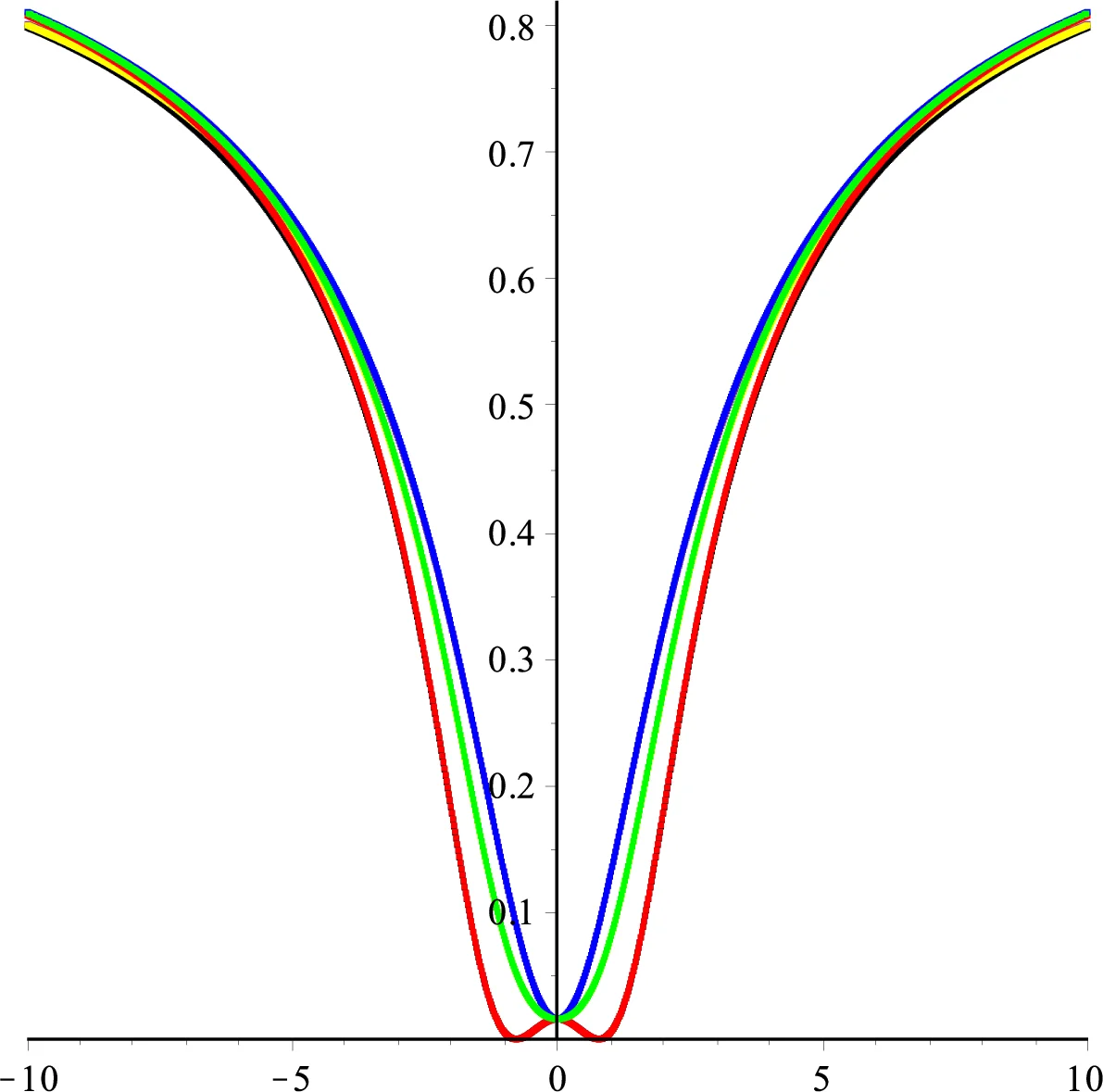
- Numerical Verification: Appendix F provides numerical evaluation and 3D visualization of the energy density based on the new analytic formulae, showing qualitative agreement with past numerical studies.
The work meticulously compares its findings with the three historical analytic approaches: the (A_k) Ansatz of Atiyah-Ward, the Forgács-Horváth-Palla Ansatz, and Nahm’s method. It clarifies and corrects some inconsistencies in earlier literature.
In conclusion, this paper successfully demystifies the ADHMN construction for a non-trivial case, transforming it from an existence theorem into a practical tool for explicit solution building. It provides a complete analytic description of the charge 2 monopole, serving as a benchmark for understanding higher-charge cases and showcasing the profound interplay between algebraic geometry, integrable systems, and gauge theory.
Comments & Academic Discussion
Loading comments...
Leave a Comment