Como Mensurar a Import^ancia, Influ^encia e a Relev^ancia de Usuarios do Twitter? Uma analise da interac{c}~ao dos candidatos `a presid^encia do Brasil nas eleic{c}~oes de 2018
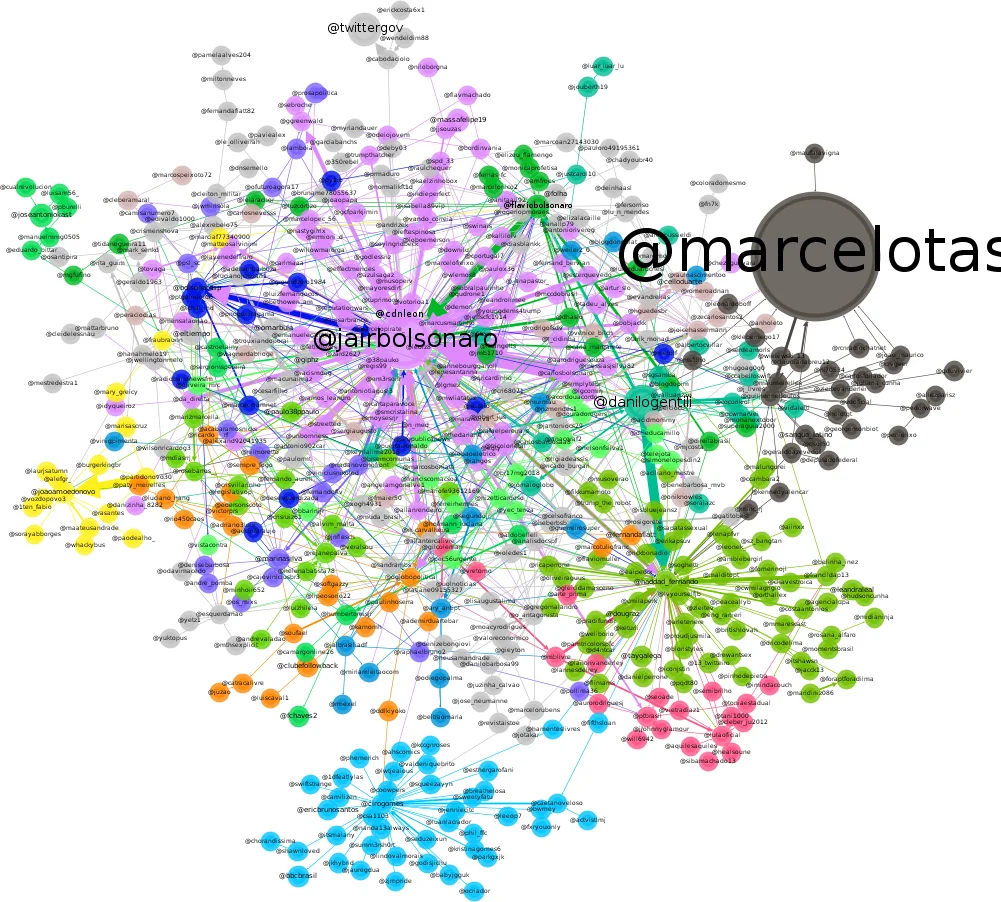
In the contemporary world, a significant number of people use social networking services for a variety of purposes, including, but not limited to, communicating, exchanging messages and searching for information. A popular social network in the political arena is Twitter, a microblogging service for posting messages of up to 280 characters, called “tweets,” where influential politicians from various countries often use this medium to spread ideas and make public statements. In this work, an analysis was made of the connections of candidates for the presidency of the Republic of Brazil in the year 2018. Using the analysis of complex networks to measure influence and relevance, a metric was established able to quantify the importance of users in the network. As part of the analysis, a Memory Algorithm was used to detect communities, groups of strongly connected vertices (tweets) evidencing groupings of users.
💡 Research Summary
This paper investigates how to quantitatively assess the importance, influence, and relevance of Twitter users in the context of the 2018 Brazilian presidential election. The authors collected a large-scale dataset using the Twitter API, retrieving 5,000 tweets per day over a 61‑day period (August 3 to October 29, 2018). The seed set consisted of the verified accounts of the twelve presidential candidates and related public figures. From the raw tweets, they extracted five types of nodes—hashtags, links, media, tweets, and users—and constructed a directed, weighted graph with 265,548 vertices and 3,889,649 edges representing mentions, retweets, and replies.
To rank vertices, the authors propose a composite importance metric that combines topological centrality (the degree k of a node) with a normalized social‑media strength I_norm derived from the number of followers and friends (followings). I_norm is calculated as the square‑average of the follower‑to‑max‑follower ratio and the friend‑to‑max‑friend ratio, yielding a value between 0 and 1. The final importance of a vertex v is I(v) = k(v) × I_norm(v). This formulation captures both how often a user participates in the network (degree) and how capable the user is of diffusing information (followers) or being receptive to information (friends).
Community detection is performed with the memetic algorithm MADOC (Memetic Algorithm for Detecting Overlapping Communities). MADOC blends a genetic algorithm’s global search with a local refinement phase, aiming to maximize modularity Q. The algorithm identified 30 non‑overlapping communities with Q = 0.492, indicating a reasonably strong modular structure. Visualizations show each community as a colored cluster; node size reflects importance, arrow direction indicates the flow of information, and edge thickness corresponds to interaction frequency.
The results reveal that the top‑20 vertices by degree are dominated by candidates and high‑profile media personalities. Jair Bolsonaro’s account has the highest degree (12,148) and the largest follower count (1,552,494). Marina Silva follows with the second‑largest follower base (1,889,764) but a lower degree, suggesting high reach but less direct interaction. Alvaro Dias exhibits an unusually high friend count (over one million), hinting at a follow‑/unfollow strategy to artificially inflate his network. The analysis also notes that external figures such as @realdonaldtrump have no direct edges within the candidate network yet appear through mentions, demonstrating indirect influence.
A deeper inspection of the network topology shows that interactions between candidates are relatively sparse compared to the dense connections between candidates and journalists, TV hosts, or other public figures. This suggests that traditional media act as intermediaries in shaping the political discourse on Twitter. The identified communities tend to cluster around individual candidates or influential media personalities, reflecting the formation of supporter sub‑networks.
In the discussion, the authors acknowledge limitations: the dataset is limited to interactions involving verified candidate accounts, omitting private or peripheral users; the importance metric relies solely on follower/friend counts, which may not fully capture engagement quality; and the analysis does not incorporate textual sentiment or temporal dynamics. They propose future work that integrates sentiment analysis, content similarity, and time‑evolving network models to build a more nuanced picture of political influence on social media.
Overall, the study demonstrates that a hybrid metric combining network degree with normalized follower/friend counts, together with a memetic community detection approach, can effectively highlight key actors and structural patterns in a politically charged Twitter ecosystem. This methodology can be adapted to other electoral contexts or social‑media‑driven public debates.
Comments & Academic Discussion
Loading comments...
Leave a Comment