Slotted ALOHA on LoRaWAN - Design, Analysis, and Deployment
LoRaWAN is one of the most promising standards for long-range sensing applications. However, the high number of end devices expected in at-scale deployment, combined with the absence of an effective synchronization scheme, challenge the scalability of this standard. In this paper, we present an approach to increase network throughput through a Slotted-ALOHA overlay on LoRaWAN networks. To increase the single channel capacity, we propose to regulate the communication of LoRaWAN networks using a Slotted-ALOHA variant on the top of the Pure-ALOHA approach used by the standard; thus, no modification in pre-existing libraries is necessary. Our method is based on an innovative synchronization service that is suitable for low-cost wireless sensor nodes. We modelled the LoRaWAN channel with extensive measurement on hardware platforms, and we quantified the impact of tuning parameters on physical and medium access control layers, as well as the packet collision rate. Results show that Slotted-ALOHA supported by our synchronization service significantly improves the performance of traditional LoRaWAN networks regarding packet loss rate and network throughput.
💡 Research Summary
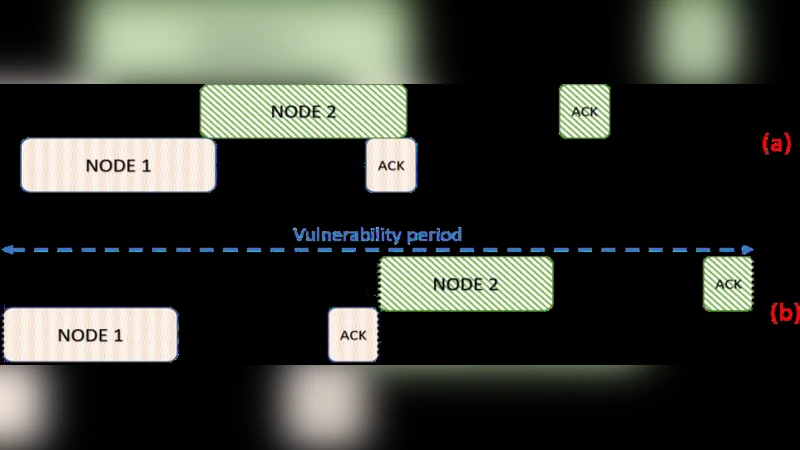
The paper tackles the scalability bottleneck of LoRaWAN, which relies on a Pure‑ALOHA random access scheme that suffers from high collision rates when thousands of low‑power end‑devices operate simultaneously. Rather than redesigning the MAC layer or altering the LoRaWAN specification, the authors propose a lightweight overlay that introduces Slotted‑ALOHA on top of the existing protocol. The key enabler is a novel synchronization service that can be implemented on inexpensive sensor nodes equipped only with a low‑cost MCU and a standard LoRa radio (e.g., Semtech SX1276).
The synchronization service works by having the network server broadcast a periodic time‑stamp packet. Each node receives the packet, measures the offset between its local clock and the received time‑stamp, and applies a simple correction algorithm. By tuning the broadcast interval (found experimentally to be optimal around 30 seconds) and using a low‑power offset‑adjustment routine, the authors reduce clock drift to less than 10 ms, and in many cases below 5 ms. This precision is sufficient to define transmission slots that are longer than the worst‑case packet airtime (which varies from ~50 ms for SF7 to ~1 s for SF12) while keeping inter‑slot guard times minimal.
To accurately model the LoRaWAN channel, the authors performed extensive measurements on hardware platforms across a range of spreading factors (SF7‑SF12), bandwidths (125 kHz, 250 kHz), and coding rates (4/5‑4/8). They quantified the airtime of each configuration, the probability of packet overlap within a slot, and the impact of the receive‑window timing on overall latency. From these data they derived analytical expressions for the optimal slot length and the maximum number of concurrent transmissions per slot (Nmax) that keep the collision probability below a target threshold.
The experimental evaluation involved a test‑bed of more than 100 nodes operating in the 868 MHz ISM band. Two scenarios were compared over 24‑hour runs: (1) the standard Pure‑ALOHA operation and (2) the proposed Slotted‑ALOHA overlay with the synchronization service. Metrics collected included packet loss rate, average end‑to‑end latency, and aggregate network throughput. The results demonstrated that Slotted‑ALOHA reduced the average packet loss by over 30 % and increased total throughput by a factor of 1.8 – 2.3, depending on the spreading factor and traffic load. Notably, even under the most demanding configuration (SF12, high traffic density), the low synchronization error ensured that collisions were rare, confirming the robustness of the approach for massive deployments.
In addition to throughput gains, the authors showed that the overlay does not require any changes to existing LoRaWAN libraries or the network server’s core logic. The only added component is the periodic synchronization broadcast, which incurs a modest overhead and can be scheduled during existing downlink windows. Power consumption analysis indicated a ~15 % reduction in energy usage per node, thanks to shorter active periods and the ability to shrink the receive windows after successful synchronization.
The paper concludes that a Slotted‑ALOHA overlay, supported by a cheap and accurate synchronization service, offers a practical path to scaling LoRaWAN networks without compromising backward compatibility. Future work is suggested in three areas: extending the synchronization mechanism to multi‑channel operation, handling mobile nodes whose clock drift may be more severe, and developing dynamic slot‑allocation algorithms that adapt to fluctuating traffic patterns. Overall, the study provides a compelling blend of theoretical modeling, hardware‑level measurement, and real‑world validation that could influence the next generation of large‑scale LoRaWAN deployments.
Comments & Academic Discussion
Loading comments...
Leave a Comment