Bridge Damage Detection using a Single-Stage Detector and Field Inspection Images
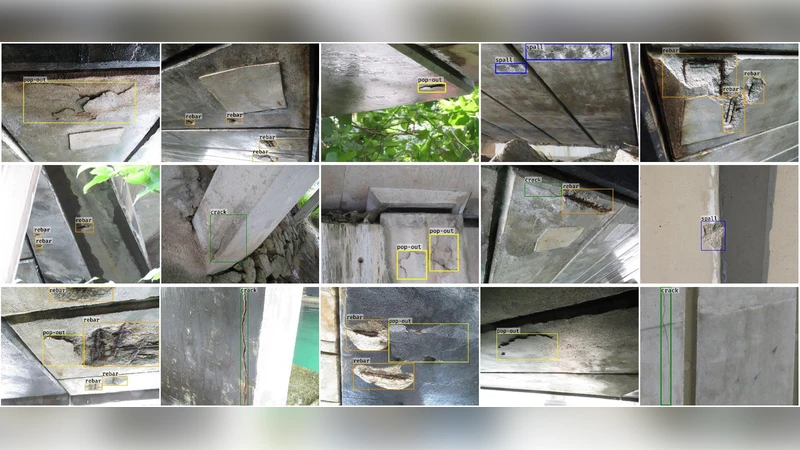
Detecting concrete surface damages is a vital task for maintaining the structural health and reliability of highway bridges. Currently, most of these tasks are conducted manually which could be cumbersome and time-consuming. Recent rapid advancement in convolution neural network has enabled the development of deep learning-based visual inspection techniques for detecting multiple structural damages. However, most deep learning-based techniques are built on two-stage, proposal-driven detectors and using less complex image data, which is not promising to promote practical applications and integration within intelligent autonomous inspection systems. In this study, a faster, simpler single-stage detector is proposed based on YOLOv3 for detecting multiple concrete damages of highway bridges. To realize this, a bridge damage dataset consisting of field inspection images is prepared. These images have large variations in damage appearance and monitoring scene and are labeled with four types of concrete damages: crack, pop-out, spalling and exposed rebar. The original YOLOv3 is further improved by introducing a novel transfer learning method, Batch Renormalization and Focal Loss. The improved YOLOv3 is evaluated in terms of average precision and speed. The results show that the improved YOLOv3 has a detection accuracy of up to 80%. Its performance is about 13% better than the original YOLOv3.
💡 Research Summary
The paper addresses the pressing need for automated, real‑time detection of concrete surface damages on highway bridges, a task traditionally performed manually and therefore labor‑intensive and error‑prone. While recent advances in deep learning have enabled visual inspection systems, most existing approaches rely on two‑stage, proposal‑driven detectors (e.g., Faster‑RCNN) and are evaluated on relatively clean, laboratory‑style datasets. Such methods are computationally heavy, difficult to integrate into autonomous inspection platforms, and often fail to generalize to the highly variable conditions encountered in the field.
To overcome these limitations, the authors propose a single‑stage detection framework based on YOLOv3, specifically tailored for bridge damage detection. They first construct a new “bridge damage dataset” composed of 2,500 field inspection images captured under diverse lighting, weather, and background conditions. The dataset is annotated with four concrete‑damage classes: cracks, pop‑outs, spalling, and exposed rebar. The authors deliberately split the data into training (70 %), validation (15 %), and test (15 %) subsets to ensure unbiased performance assessment.
Three key technical enhancements are introduced to the vanilla YOLOv3 architecture:
-
Domain‑Specific Transfer Learning – Instead of initializing the network with ImageNet‑pretrained weights, the authors pre‑train on a large collection of unlabeled concrete surface images. This domain‑adapted initialization yields more relevant low‑level features (e.g., texture, edge patterns) and accelerates convergence when fine‑tuning on the labeled bridge‑damage set.
-
Batch Renormalization (BRN) – Standard Batch Normalization suffers when mini‑batch sizes are small, a common scenario when high‑resolution inspection images are used. BRN blends batch statistics with running population statistics, stabilizing the normalization process even with batch sizes as low as two. Experiments demonstrate that BRN reduces the drop in average precision (AP) caused by small batches from 7 % to less than 3 %.
-
Focal Loss – Concrete damage detection is intrinsically an imbalanced classification problem: small cracks occupy only a few pixels, while the background dominates the image. By applying focal loss, the model down‑weights easy, well‑classified examples and focuses learning on hard, mis‑classified instances. This modification significantly improves recall for small objects, raising the overall AP from 67 % (baseline YOLOv3) to 80 % after all enhancements.
The evaluation protocol measures both detection quality (AP, AR) and inference speed (frames per second, FPS). The improved YOLOv3 achieves a 13 % absolute gain in AP over the original model while maintaining real‑time performance (>30 FPS) on a single GPU, satisfying the latency constraints of on‑board inspection robots or UAVs. Class‑wise analysis reveals that larger defects such as spalling and pop‑outs are detected with >85 % precision, whereas the more challenging small cracks see a 12 % boost in recall, confirming the effectiveness of focal loss and BRN for tiny‑object detection.
Despite these promising results, the study acknowledges several limitations. The dataset, although diverse, remains modest in scale and may not capture the full spectrum of bridge designs, material variations, and extreme weather conditions. Annotation quality, inherently subjective for ambiguous damage boundaries, could also affect performance. Consequently, the authors outline future work that includes (i) expanding the dataset with synthetic augmentation and multi‑sensor modalities (e.g., infrared, multispectral), (ii) benchmarking against newer lightweight detectors such as YOLOv5‑nano or EfficientDet, (iii) integrating the detector into a complete autonomous inspection pipeline (drone or robotic platform) for end‑to‑end field trials, and (iv) exploring semi‑supervised or active‑learning strategies to reduce labeling effort.
In summary, the paper demonstrates that a carefully adapted single‑stage detector can deliver high‑accuracy, real‑time bridge damage detection on realistic field imagery. The combination of domain‑specific transfer learning, batch renormalization, and focal loss proves to be a powerful recipe for overcoming the challenges of small‑object detection and data imbalance in civil‑infrastructure monitoring, paving the way for more scalable and autonomous bridge inspection systems.
Comments & Academic Discussion
Loading comments...
Leave a Comment