A Novel Universal Solar Energy Predictor
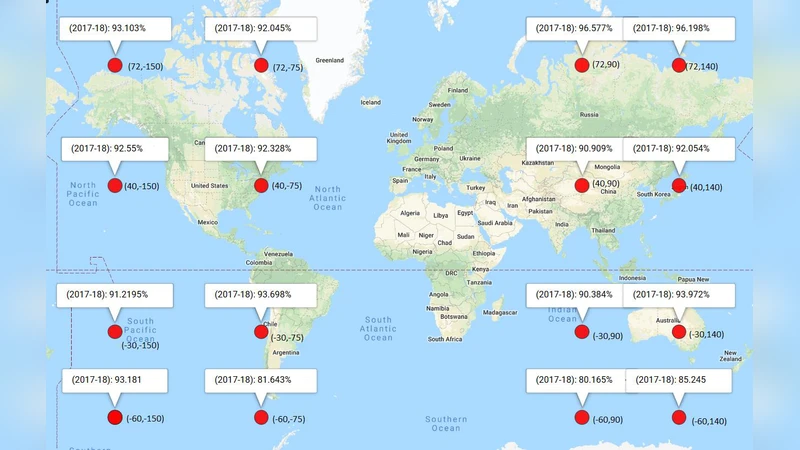
Solar energy is one of the most economical and clean sustainable energy sources on the planet. However, the solar energy throughput is highly unpredictable due to its dependency on a plethora of conditions including weather, seasons, and other ecological/environmental conditions. Thus, the solar energy prediction is an inevitable necessity to optimize solar energy and also to improve the efficiency of solar energy systems. Conventionally, the optimization of the solar energy is undertaken by subject matter experts using their domain knowledge; although it is impractical for even the experts to tune the solar systems on a continuous basis. We strongly believe that the power of machine learning can be harnessed to better optimize the solar energy production by learning the correlation between various conditions and solar energy production from historical data which is typically readily available. For this use, this paper predicts the daily total energy generation of an installed solar program using the Naive Bayes classifier. In the forecast procedure, one year historical dataset including daily moderate temperatures, daily total sunshine duration, daily total global solar radiation and daily total photovoltaic energy generation parameters are used as the categorical valued features. By way of this Naive Bayes program the sensitivity and the precision measures are improved for the photovoltaic energy prediction and also the consequences of other solar characteristics on the solar energy production have been assessed.
💡 Research Summary
The paper addresses the critical need for accurate solar energy forecasting, noting that traditional optimization relies heavily on expert intuition, which is impractical for continuous, site‑specific adjustments. To automate this process, the authors propose a machine‑learning approach based on the Naïve Bayes classifier, aiming to predict daily total photovoltaic (PV) energy generation from a set of environmental variables.
Data collection involved a one‑year historical record from a single solar installation, comprising daily average temperature, total sunshine duration, total global solar radiation, and the corresponding daily PV output. Although these variables are naturally continuous, the authors discretize each into categorical bins before feeding them into the classifier. The discretization scheme is not fully described, which raises concerns about reproducibility and potential information loss.
The Naïve Bayes model assumes conditional independence among features, an assumption that is clearly violated in meteorological data where temperature, sunshine, and radiation are strongly correlated. Despite this theoretical mismatch, the model is trained to compute posterior probabilities for predefined output classes (e.g., low, medium, high generation) and selects the class with the highest probability as the prediction.
Performance evaluation focuses on sensitivity (recall) and precision, reporting improvements over unspecified baseline methods. However, the study omits standard regression metrics such as Mean Absolute Error (MAE) or Root Mean Squared Error (RMSE), which are more appropriate for quantifying errors in continuous energy forecasts. Moreover, the paper does not benchmark the Naïve Bayes approach against more sophisticated alternatives like linear regression, random forests, gradient boosting, or recurrent neural networks, leaving the claim of “enhanced accuracy” insufficiently substantiated.
A notable contribution is the analysis of feature importance, indicating that sunshine duration and global solar radiation exert the strongest influence on PV output, while temperature plays a secondary role. This insight could guide operators in prioritizing sensor deployment and data collection. The authors also argue that the simplicity and low computational overhead of Naïve Bayes make it attractive for real‑time monitoring systems where rapid inference is essential.
Nevertheless, the study’s limitations are significant. The dataset’s narrow scope—single site, single year—precludes assessment of the model’s generalizability across different climates, panel technologies, or seasonal patterns. The categorical transformation discards granularity that could be leveraged by models capable of handling continuous inputs, such as Gaussian Naïve Bayes or regression‑based techniques. Additionally, the independence assumption may lead to biased probability estimates, especially under extreme weather conditions where variables co‑vary.
In the conclusion, the authors propose future work that includes expanding the dataset to multiple locations and years, exploring Bayesian network structures that relax independence constraints, and integrating time‑series models to capture temporal dynamics. They also suggest investigating hybrid approaches that combine the speed of Naïve Bayes with the predictive power of more complex algorithms.
Overall, the paper demonstrates a proof‑of‑concept that a lightweight probabilistic classifier can be deployed for solar energy prediction, offering quick, interpretable results. However, to be adopted in operational settings, the methodology must be validated on larger, more diverse datasets and compared rigorously against state‑of‑the‑art forecasting models.
Comments & Academic Discussion
Loading comments...
Leave a Comment