A Linear Category of Polynomial Diagrams
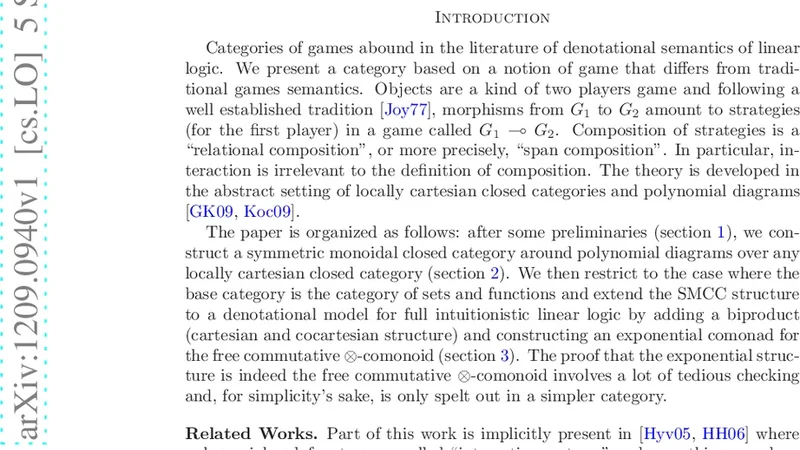
We present a categorical model for intuitionistic linear logic where objects are polynomial diagrams and morphisms are simulation diagrams. The multiplicative structure (tensor product and its adjoint) can be defined in any locally cartesian closed category, whereas the additive (product and coproduct) and exponential Tensor-comonoid comonad) structures require additional properties and are only developed in the category Set, where the objects and morphisms have natural interpretations in terms of games, simulation and strategies.
💡 Research Summary
The paper introduces a categorical model for intuitionistic linear logic (ILL) based on polynomial diagrams as objects and simulation diagrams as morphisms. The construction begins in an arbitrary locally cartesian closed category (LCCC), where a polynomial diagram is presented as a span (I \leftarrow E \rightarrow O) that captures a dependent type‑like relationship between an input set (I) and an output set (O). Morphisms are defined as simulation diagrams, i.e., spans between spans, which encode how one polynomial diagram can be simulated by another. This simulation perspective aligns naturally with game‑theoretic interpretations: objects become games, morphisms become strategies that simulate one game within another.
The multiplicative fragment of linear logic—tensor product (\otimes) and its right adjoint (linear implication) (\multimap)—is defined purely using the LCCC structure. For two polynomial diagrams (P) and (Q), the tensor (P\otimes Q) is obtained by taking the product of their input sets and the product of their output sets, yielding a new polynomial diagram that models the simultaneous play of two games. The linear implication (P\multimap Q) is constructed via the internal hom of the LCCC, representing a strategy that, given a move in (P), produces a move in (Q). The adjunction (\otimes \dashv \multimap) follows from the cartesian closedness of the slice categories, requiring no extra assumptions beyond the LCCC axioms.
Additive structure (product (&) and coproduct (\oplus)) and the exponential modality (!) cannot be defined in full generality on an arbitrary LCCC because they demand specific colimit and limit properties. The authors therefore specialise to the category of sets, (\mathbf{Set}), where these constructions become concrete. In (\mathbf{Set}), the product of polynomial diagrams is simply the cartesian product of their underlying sets, and the coproduct is the disjoint union. This yields a clear game‑theoretic reading: the additive product corresponds to a player having to make a move in both component games, while the coproduct corresponds to a choice between games.
The exponential modality is realised as a Tensor‑comonoid comonad on (\mathbf{Set}). The construction expands the input set of a polynomial diagram to its powerset, thereby allowing arbitrary duplication of resources, and equips the resulting object with comonoid structure (counit and comultiplication) that satisfies the usual comonad laws. This comonad provides the “!’’ of linear logic, enabling weakening and contraction at the categorical level. The authors verify that the comonad interacts appropriately with the tensor product, establishing the required coherence conditions for a linear exponential comonad.
A substantial portion of the paper is devoted to interpreting these categorical notions in terms of interactive games. An object (a polynomial diagram) is viewed as a game where the player chooses an input and the opponent responds with an output. A simulation diagram (a morphism) is a strategy that, given a move in the source game, produces a compatible move in the target game, preserving the structure of plays. The tensor product models parallel composition of games, the additive sum models a choice between games, and the exponential (!) models the ability to reuse a game arbitrarily many times. This interpretation bridges the abstract categorical framework with concrete computational intuitions, showing that the model captures both the resource sensitivity of linear logic and the interactive nature of computation.
Finally, the authors compare their model with existing linear‑logic categorical models such as *‑autonomous categories and coherence spaces. They argue that polynomial diagrams provide a more concrete, set‑based representation while still retaining the generality afforded by the LCCC foundation. By first developing the multiplicative fragment in any LCCC and then specialising the additive and exponential fragments to (\mathbf{Set}), the paper achieves a balance between abstract categorical elegance and concrete applicability to game semantics and resource‑aware programming languages. In summary, the work offers a novel, technically robust categorical semantics for ILL that unifies linear logic, dependent type theory, and game semantics through the lens of polynomial diagrams and simulations.
Comments & Academic Discussion
Loading comments...
Leave a Comment