New Bounds for Edge-Cover by Random Walk
We show that the expected time for a random walk on a (multi-)graph $G$ to traverse all $m$ edges of $G$, and return to its starting point, is at most $2m^2$; if each edge must be traversed in both directions, the bound is $3m^2$. Both bounds are tig…
Authors: Agelos Georgakopoulos, Peter Winkler
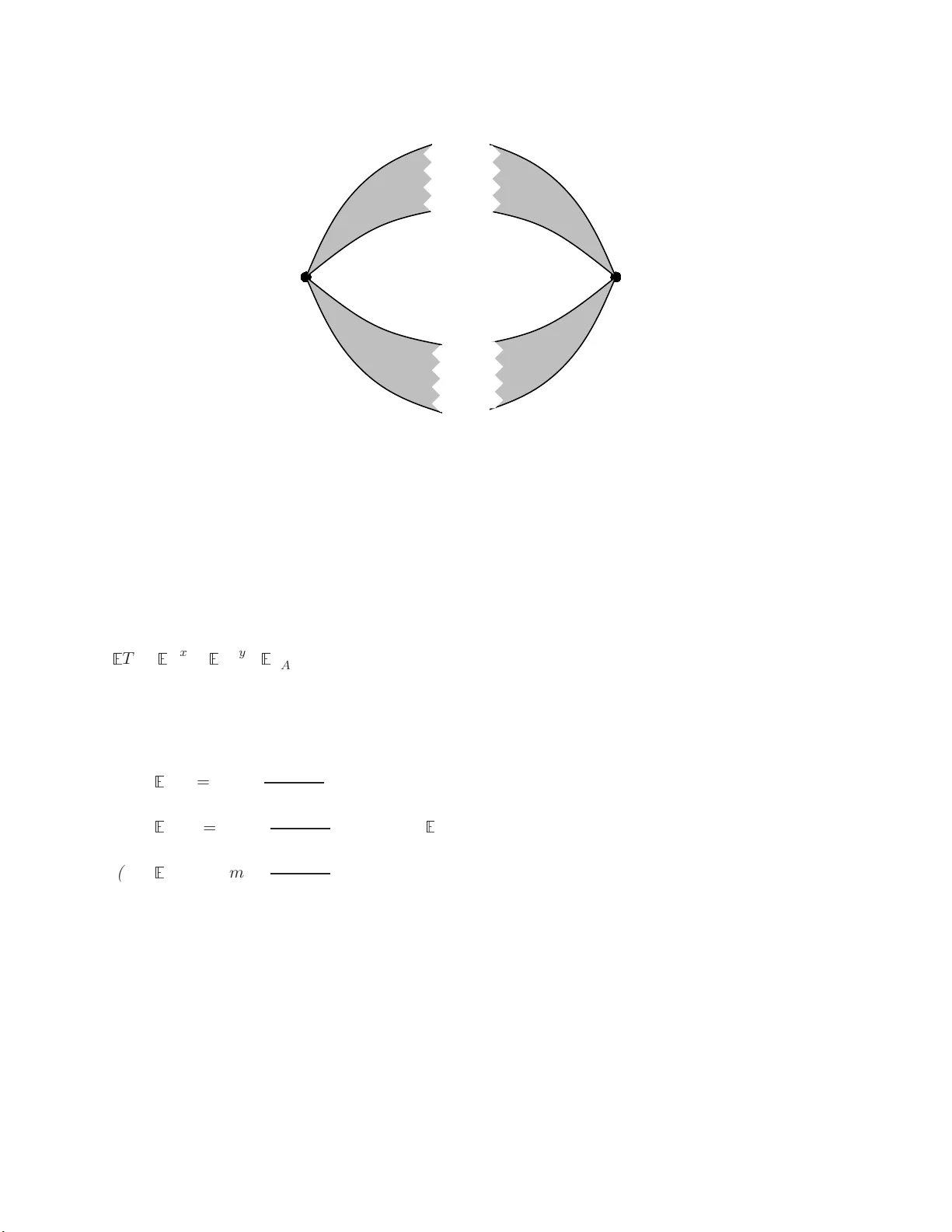
New Bounds for Edge-Co v er b y Random W alk Agelos Georgak op oulos ∗ and P eter Winkler † Octob er 13, 2018 Abstract W e show that the ex pec ted time for a ra ndom w alk on a (multi-)graph G to trav ers e all m edges o f G , and return to its s tarting p oint, is at mos t 2 m 2 ; if each edg e m ust b e trav ersed in b oth directions, the b ound is 3 m 2 . Both bo unds are tight and m ay be applied to graphs w ith ar bitr ary e dg e le ng ths, with implications for Brownian motio n o n a finite or infinite netw ork of total edge-length m . 1 In tro duction Ov erview The exp ected time for a rand om w alk on a graph G to hit all the ve rtices of G has b een extensiv ely studied by probabilists, com binatorialists and computer scien tists; applications include the construction of un iversal tra v ersal sequences [2, 7], testi ng graph conn ectivit y [2, 19], and p roto col testing [21]. It has also b een studied by physicists in terested in the fractal structure o f the unco v ered set of a finite grid ; see [11] for references and f or an interesting relation betw een the cov er t ime of a fi nite g rid and B rownian motion on R iemann ian manifolds. Here w e consider the time to co ve r all e dges of G , and moreo ver w e tak e as the f undamenta l parameter the n umb er m of edges of G , rather than the num b er of vertic es. Indeed, if the edges are tak en to b e of v arious lengths, then the num b er of vertic es is no longer of interest and the total edge -length (also denoted b y m ) b ecomes the n atur al p arameter b y means of whic h to b ound co ve r time. Earlier Results Let G = h V , E i b e a connected, u ndirected graph (p ossibly w ith lo ops and multiple edges), where | V | = n and | E | = m . Let r ∈ V b e a distingu ish ed “ro ot” v ertex. A (simple) r andom ∗ Department of Mathematics, T ec hn ische Univers it¨ at Graz, Austria; georgak op oulos@tugraz.at. The fi rst author ackno wledges the kind hospitality of the Dartmouth College and the second author. † Department of Mathematics, Dartmouth, Hanov er NH 03755-3551, U SA; p eter.winkler@dartmouth.edu. Researc h sup p orted by NSF grant DMS-0901475. 1 walk on G b eginning at r is a Mark o v c hain on V , defined as follo ws: if t he wa lk is cu rrent ly at v ertex x i t chooses an edge inciden t to x un iformly at random, t hen follo ws that edge to determine its next state. The exp ected v alue of the least time such that all vertice s in V hav e b een hit by the r andom w alk will b e denoted b y C V r ( G ) or simply C V r , and we call this n umb er the (exp ected) vertex c over time of G from r . The v ertex co v er time C V ( G ) of G is defined to b e the maxim um of C V r ( G ) o ve r all r ∈ V . Upp er b ound s on C V ( G ) ha ve b een widely sough t by the theoretical computer science comm unit y , and many results obtained. Th e co ver time of a simple graph (no lo op s or multi ple edges) wa s sho wn [2] to b e at most cubic in n ; more recentl y F eige [13] r efined the b ound to 4 27 n 3 plus lo w er-order terms, whic h is realized b y the same “lollip op” graph that maximizes exp ected hitting time [5]—namely , a clique on 2 3 n v ertices attac hed to one end of a path on the r emainin g v ertices. In fact [2] sho ws that C V ( G ) is O( mn ), thus trivially O( m 2 ), even if the walk is requ ir ed to retur n to the ro ot. The exp ected time to co ve r all v ertices and return to th e r o ot is called the (v ertex) c over and r eturn time , h ere denoted by CR V r ; it is often easier to w ork with than C V r . Among s im p le graphs (no lo ops or multiple edges) with m edges, the path P m +1 on m edges—starting in the m iddle—provides the greatest ve rtex co ve r time, namely m 2 + ⌊ m/ 2 ⌋⌈ m/ 2 ⌉ ∼ 5 4 m 2 [13]. The path started at one en d had earlier b een sho wn [6] to h a v e the strictly greatest v ertex co v er and return time among all trees with m edges. The exp ected time for a random wa lk b eginning at r to cov er all the e dges of G will b e denoted by C E r ( G ); if the w alk is required to co ve r all the ar cs , that is, to tr a v erse every edge of G in b oth directions, th e exp ected time is denoted by C A r ( G ). If the walk m ust return to r , w e use CR E r and CR A r as ab o v e. Edge-co v er is for some purp oses more natural than v ertex-co v er; for example, it mak es more sense on a graph with lo ops and multiple edges, where there is no b ound on an y kin d of cov er based only on the num b er n of vertic es, but th er e are natur al, tigh t b ounds (as we shall see) on CR E and CR A in terms of the num b er of edges. Bounds on exp ected edge-co v er times were obtained by Buss ian [8] and Zuck erman [28, 29]. Bussian noted that to co ve r the edges of a graph G , it suffices to hit eac h v ertex somewh at more often than its degree. Recen tly Ding, Lee and P eres [10] pr o v ed a conjecture of Winkler and Zuc ke rm an [27] saying roughly that the exp ected time to h it eve ry v ertex often is no more than a constan t times the vertex-co ver time, which for a regular graph is b oun ded b y 6 n 2 [18]; it 2 follo ws that the edge- (or arc-) co v er time for a regular graph is O( mn ), although th e constan t ma y b e a wful. F or general grap h s, Zu ck erman [29] succeeded in s ho wing CR A ( G ) ≤ 22 m 2 , using pr obabilistic metho ds. Our Results The main result of this pap er is that if G is a m ultigraph with m edges then the exp ected time it tak es for a simp le r andom w alk s tarted at any v ertex to tra verse all the ed ges of G (and return to its starting p oin t) is at most 2 m 2 ; in fact, w e can ev en fix an orien tation of eac h edge b eforehand, and 2 m 2 steps will b e enough on a v erage to trav erse eac h edge in its pre-sp ecified direction. If instead we insist that eac h edge b e tra v ersed b oth w a ys, then we ha v e to wait at most 3 m 2 steps on av erage . As an in termediate step in our pro of of the ab ov e b ound s w e obtain a refin emen t of a w ell-kno wn form ula of Chandra et. al. [9] concerning the commute time of random w alk. These results apply more generally if the edges of G are assigned p ositiv e r eal lengths and the transition probabilities of the random w alk, as well as th e time it takes to mak e a step, are appropriately adapted. In that case the ab o v e b oun ds apply when m is the sum of the lengths of the edges of G . W e call a graph with edge-lengths a network , and int erpr et it as an ele ctric al network by equating edge-length w ith resistance along an edge. The usual connections b et ween random w alk and elec trical net w orks (as in [12, 23] or see b elow) apply pro vided that in the definition of r andom w alk, the probability that an ed ge adj acen t to the cur ren t p osition is tra ve rsed is pr op ortional to its conductance—that is, inv ersely prop ortional to its resistance (length). Suc h random wal k h as th e same d istribution as th e sequence of ve rtices visited by stand ard Bro wnian motion. T o effect the correct scaling, an d to mak e our results work for standard Bro wn ian motion, w e sa y that tra ve rsin g an edge of length ℓ tak es time ℓ 2 . In fact the exp ected time for a standard Bro wnian particle to pro ceed fr om one v ertex to a neigh b oring v ertex is not generally the square of the length of the edge; that the “ ℓ 2 ” mo del for discrete r an d om w alk p ermits extending our r esults to Brownian motion is a consequen ce of an a v eraging argument to b e elucidated in Sectio n 5.1. F or example, the exp ected time f or a random w alk to pro ceed from one end to the other of a path P m +1 of length m (that is, a path consisting of m +1 vertice s and m unit-length edges) 3 is exactly m 2 ; this matc hes the time tak en by stand ard Bro wnian motio n to tra v el from 0 to m on th e non-negativ e X -axis, and the time for our generalized random walk to tra v el from on e end to the other of an y lin ear netw ork, regardless of the num b er and placemen t of v ertices on it. Thus it wo rks in all senses to sa y that the exp ected edge-co v er time C E a ( P m +1 ) of a path of length m from an endp oint a is m 2 . Our b ound s h a v e inte resting im p lications for Bro wnian motion on infinite net w orks. Moti- v at ed by earlier wo rk of the fir st author [15], Georgak opoulos and Kolesko [17] stud y Brownian motion on infin ite net w orks in whic h the total edge length m is fi n ite. Applied to this con text, our results imply th at Bro wnian motion w ill co v er all edges in exp ected time at most 2 m 2 , th us almost surely in finite time. See Section 5.2 for more details. 2 Definitions 2.1 Random W alk W e w ill d enote by N = h G, ℓ i a netw ork with under lyin g multig raph G and edge-lengths ℓ : E ( G ) → R + , also int erpr eted as resistances. An ar c of N is an oriente d edge; in our con text, a loop comprises t wo arcs. A r andom walk on N b egins at some vertex r and when at v ertex x , trav erses the arc ( x, y ) to y with p robabilit y 1 /ℓ ( x, y ) P z ∼ x 1 /ℓ ( x, z ) . (1) Our random w alks tak e p lace in con tinuous time. The time it tak es our random wa lke r to p erform a step, i.e. to m o v e fr om a v ertex x to one of its neigh b ors, dep ends on th e lengths of the edges inciden t with x . Th ere are v arious w a ys to define this dep endence. In this p ap er w e will consider t w o natural mod els for this d ep endence. Our main results will app ly to b oth mo dels with iden tical p r o ofs, except th at it tak es a differen t argum en t to pro ve (2) b elo w. The Bro wnian mo del Bro wnian motion on a line extends n aturally to Bro wnian motion on a net work (see, e.g., [3, 4, 14, 24]); when at a v ertex a Bro wnian p article mov es with equal lik eliho o d ont o any inciden t edge (with the un derstanding that an in ciden t lo op coun ts for this p urp ose as t w o inciden t edges). The edges in ciden t to a v ertex constitute a “W alsh spider” (see, e.g., [26, 4]) with equiprob ab le legs, and it is easily v erified that in such a setting the probabilit y of tr a v ersing 4 a particular inciden t edge (or orien ted lo op) first is prop ortional to the recipro cal of the length of that edge. In our mo del, we care only ab out wh ere the particle is after an edge-tra v ersal, and ho w long it to ok to get there. Th e latter should th us b e the time tak en b y a Bro wnian particle to tra v erse a giv en edge incident to its starting v ertex, giv en that it trav ersed that edge first; this time is a rand om v ariable whose distribu tion and exp ectation (the latt er to b e computed later) dep end not only on the length of the sp ecified edge, b ut on the lengths of the other incident edges as w ell. In the case of simple r an dom walk , i.e. when all edges ha v e length 1, the exp ected time for this rand om w alk to tak e a step is 1. The ℓ 2 mo del In this mo del, the time it tak es for the random wal k to tak e a step is less random: tra v ersing an edge of length ℓ alw a ys take s time ℓ 2 . Thus time is gov erned b y (1) alone. T he ℓ 2 mo del and the Bro wnian mod el differ only in timing; p r obabilities of w alks are iden tical, as in b oth cases the n ext edge to b e tra v ersed is chosen according to the distrib u tion in (1) for incident edges. If all edges of the net wo rk are of the same length, then in exp ectation, timing is iden tical as w ell. Readers in terested only in simple rand om w alk will lose nothin g by assuming thr oughout that all edges are of length 1. The exp ected time to co ve r all edges (resp ectiv ely , arcs) of N by a random w alk (in either mo del) will b e denoted by C E r ( N ) (resp., C A r ( N )); to co ve r all ed ges or arcs and retur n, by CR E r ( N ) or CR A r ( N ). Maximizing o v er r giv es C E ( N ), C A ( N ), CR E ( N ), and CR A ( N ). The effe ctive r esistanc e R xy b et wee n ve rtices x and y is d efi ned in electrical terms as the recipro cal of the amoun t of current that flo ws from x to y in N wh en a unit v olta ge difference is applied to them, assuming that eac h edge offers resistance equ al to its length. See [12] or [20] for the basic definitions conce rn ing ele ctrical n et w orks. Effectiv e resistances sum in series: if all paths from x to y go through z , then R xy = R xz + R z y . The r ecipro cals of effectiv e resistances, i.e., effectiv e cond u ctances, su m in parallel: if A and B are otherwise disjoint net w orks con taining x and y , then in the un ion of the t w o net w orks, 1 R xy = 1 R xy A + 1 R xy B . 5 3 Comm ute Times The c ommute time T x ↔ y from v ertex x to y in N is the (random) time it take s for a random w alk to tra vel from x to y and back to x . The exp ected commute time E T x ↔ y b et wee n t w o v ertices x, y of a net w ork has an eleg ant exp r ession p ro v ed in [9], and we ll kno wn for the case of u n it edge lengths: E T x ↔ y = 2 m R xy , (2) where m := P e ∈ E ( G ) ℓ ( e ) is the to tal length of the netw ork and R xy the effectiv e resistance as defined ab ov e. In fact a more general identit y is pro ve d in [9] (Theorem 2.2 there): s upp ose eac h trav ersal of an arc ~ e comes w ith a cost f ( ~ e ), where f is a p ossibly asymmetric cost f unction, and transition probabilities are still giv en by (1). Th en the exp ected cost of an x - y commute is F R xy , where F is the sum of f ( ~ e ) /ℓ ( e ) ov er all arcs ~ e . S ubstituting ℓ ( e ) 2 for f ( ~ e ) giv es the familiar 2 m R xy for comm ute time in the ℓ 2 mo del, with m no w understo o d as the total length of the net wo rk. That the same f orm ula applies to the Bro wnian mo del follo ws by appro ximating edge- lengths with rational n umbers , then sub dividin g so that ev ery edge has the s ame length; this has n o effect on comm ute time in the Brownian m o del b ut b rings tra v ersal times in line with the ℓ 2 mo del without c hanging th e form ula. In the rest of this section w e refin e (2) by different iating b et we en v arious comm ute tours according to their b eha vior w ith resp ect to su bnet works. W e will need th is refin emen t in order to prov e our m ain results in the next section. Supp ose that N is the union of t w o subnet w orks A, B suc h that A ∩ B = { x, y } (as in Fig. 1 b elo w). F or example, A could b e an x - y ed ge and B could b e the rest of N ; this is in fact the case that is needed later. W e define the follo w ing ev ent s for ran d om w alks on N starting at x : (i) An A -comm ute from x to y is a closed w alk starting at x and contai nin g either an x - y su b wal k via A or a y - x s u b walk via A ; (ii) An − → A -comm ute from x to y is a closed w alk starting at x and contai nin g an x - y sub wal k via A ; (iii) An ← − A -comm ute from x to y is a closed walk starting at x and cont aining a y - x sub wa lk via A ; 6 x A B y Figure 1: Net w orks A and B meeting only at vertice s x and y . (iv) An ← → A -comm ute from x to y is a closed walk starting at x and con taining b oth an x - y su b wal k via A and a y - x sub wal k via A . Define T xy A , T xy A → , T xy A ← , T xy A ↔ to b e the time for random wa lk on N starting at x to p erform an A -comm ute, a − → A -comm ute, a ← − A -comm ute, and a ← → A -comm ute fr om x to y , resp ectiv ely . Let E T xy A , E T xy A → , E T xy A ← , E T xy A ↔ denote the corr esp onding exp ected times. Theorem 3.1. F or ev ery networ k N = ( G, ℓ ) and any two subnetworks A, B having pr e ci se ly two vertic es x , y in c ommon, (i) E T xy A = 2 m R A R A + R B 2 R A + R B ; (ii) E T xy A → = 2 m R A 2 R A + R B 2 R A + R B = 2 m R A = E T xy A ← ; (iii) E T xy A ↔ = 2 m R A 3 R A + R B 2 R A + R B , wher e m := P e ∈ E ( G ) ℓ ( e ) is the total e dge-length, and R X is the eff e ctive r esistanc e b etwe en x and y in the network X . R e mark: Notice that th e three expressions differ only in the co efficient of R A in the nu- merator. Pr o of. In all cases, let the particle start at x and w alk on N ‘forev er’, and consider the times when the particle completes a commute from x to y . W e are in terested in the exp ectation of 7 the time T when the first A - comm ute, − → A -comm ute, or ← → A -comm ute is completed according whic h of the cases (i) - (iii) w e are considering. Note that any A -comm ute, − → A -c ommute, or ← → A -comm ute fr om x to y can b e decomp osed in to a sequence of d isjoin t comm utes. Th us we can define a rand om v ariable Y t o b e th e n umb er of x - y comm utes un til the fir st A -comm ute, − → A -c ommute, or ← → A -comm ute f rom x to y is completed, according to whic h of the cases (i) - (iii) w e are considering. Let X i , i = 1 , 2 , . . . b e the duration of th e i th x - y comm ute. Then our stopping time T satisfies T = X 1 ≤ i ≤ Y X i . Note that the exp ectation of eac h X i is E T x ↔ y = 2 m R xy b y (2). By W ald’s identit y [25] the exp ectation of T equals the exp ectation of Y times the exp ectation of X i , and so we ha v e E T = 2 m R xy E Y . (3) Th us it only remains to determine E Y in eac h of the cases (i) - (iii). In order to compu te E Y it is u seful to fi rst calculate th e p robabilit y p A that th e firs t visit to y of a random walk starting at x will b e via A . F or this it is conv enien t to use the electrica l net work tec hnique. Disconnect A and B at their common v ertex y to obtain a netw ork consisting of A, B connected ‘in ser ies’ at x . Denote by y A the verte x of A corresp on d ing to y , and b y C A = 1 / R A the effect ive conductance b et w een x and y in A ; similarly for B . F rom [12] w e ha ve the probabilit y that a random w alk started at x hits y A b efore y B is C A / C B , th us p A = C A C A + C B = R xy R A . By the same argumen t, a rand om walk from y to x will go via A with the same p robabilit y p A . W e can n ow determine E Y in eac h of the three cases. F or case (ii), note that a comm ute from x to y is a − → A -c ommute if th e f orward trip is via A , wh ic h o ccurs with probabilit y p A . Th us w e ha ve E Y =: E Y ii = 1 / p A = R A R xy , since the exp ected num b er of Bernoulli trials until the first su ccess is the r ecipro cal of the su ccess probabilit y of one trial. Plugging this into (3) yields E T = E T xy A → = 2 m R A as clai med. By similar argumen ts this expression also equ als E T xy A ← . F or case (i), note that a co mmute from x to y fails to b e an A -comm ute if and only if b oth trips fail to b e via A . Since the tw o trip s are in dep end ent, the probabilit y that a r an d om x - y comm ute is an A -comm ute is 1 − (1 − p A ) 2 = p A (2 − p A ). By a similar argument as ab o v e w e obtain E Y =: E Y i = 1 p A (2 − p A ) and so E T = : E T xy A = 2 m R xy R A R xy 1 2 − p A = 2 mR A 1 2 − p A = 2 mR A 1 2 − R B / ( R A + R B ) = 2 mR A R A + R B 2 R A + R B . 8 Finally , to determine E Y in case (iii) we argue as follo ws. T o b egin with, w e h av e to make an exp ected Y i tries unt il w e go via A in at least one of the trips of some x - y commute, i.e. unt il we ac hiev e our fi r st A -comm ute. Then, unless our first A -comm ute w as an ← → A -comm ute, w e w ill ha ve to make another Y ii tries in exp ectation to go via A in the other d irection. By elementa ry calculations, an A -comm ute fails to b e an ← → A -comm ute with probab ility q = 2(1 − p A ) (2 − p A ) = 2 R A 2 R A + R B . Su m ming up , w e h a v e E Y =: E Y iii = E Y i + q E Y ii . Using our earlier calculatio ns and (3) this yields E T =: E T xy A ↔ = 2 mR A R A + R B 2 R A + R B + 2 R A 2 R A + R B = 2 mR A 3 R A + R B 2 R A + R B . 4 Main Results F or a random walk on a net work N starting at a v ertex x , define the r andom v ariable CR E x , called the e dge c over-and-r eturn time , to b e the fir st time when eac h edge of N has b een tra v ersed and the particle is bac k at x . Similarly , if N is a digraph , w e d efine CR A x , called the ar c c over-and-r etu rn time , to b e the first time when eac h arc of N h as b een tra v ersed and the particle is bac k at x . Here, the dir ections of the edges do n ot affect the b eha vior of the random w alk; the particle is allo w ed to tra v erse arcs b ac kw ards and its transition probabilities are alwa ys give n b y (1). If N is un d irected w e in terpret it as a d igraph b y replacing eac h edge (lo ops included) by an arc in eac h direction; thus, in that case, CR A x is the first time w hen eac h edge of N h as b een trav ersed in b oth directions and the particle is bac k at x . Theorem 4.1. L et N = ( G, ℓ ) b e an undir e cte d network and let m := P e ∈ E ( G ) ℓ ( e ) . Then (i) E CR E ( N ) ≤ 2 m 2 and (ii) E CR A ( N ) ≤ 3 m 2 . Mor e over, i f − → N is the r esult of orienting the e dges of N in any way, then (iii) E CR A ( − → N ) ≤ 2 m 2 . Pr o of. Ou r pro of follo ws the lines of the ‘sp anning tree argument’ used in [1] f or the verte x co v er time, the main difference b eing that w e apply Lemma 3.1 instead of (2). Let σ b e a closed wa lk in G starting at an arb itrary fix ed ro ot r and trav ersing eac h ed ge of G pr ecisely once in eac h d irection. Suc h a w alk alw a ys exists: if G is a tree th en a depth-fi r st 9 searc h will d o, and if not then one can consider a spannin g tree T of G , construct such a w alk on T , and then extend it to capture th e c hords. W e are going to use σ in order to define ep o chs for the random wa lk in N starting at x , and then apply Th eorem 3.1 to b ound the time time sp ent b et ween p airs of su c h ep o chs. These ep o c hs will differ dep ending on wh ic h of the t w o cases we are considering. Cases (i) and (i i i): W e p ro v e the stronger result that E CR A r ( − → N ) ≤ 2 m 2 . le t e i , i = 1 , 2 , . . . , 2 | E ( G ) | , b e the i th edge trav ersed b y σ , with endvertic es x i , y i app earing in σ in th at order. F or i = 1 , 2 , . . . , 2 | E ( G ) | d efine the i th ep o ch τ i as follo ws. If e i is directed from x i to y i , then τ i is the first time after τ i − 1 when σ is at y i and h as gone there from x i using th e ed ge e i in that step, where w e set τ 0 = 0. If e i is d irected the other w a y , then w e just let τ i b e the first time after τ i − 1 when σ is at y i . Note that at time τ 2 | E ( G ) | our random w alk is bac k to r and has p erformed an arc cov er- and-return tour. Thus E CR E r ( − → N ) is at most the exp ectation of τ 2 | E ( G ) | . No w the latter can b e b ound ed u sing Theorem 3.1 (ii) as follo ws. F or ev ery edge e = xy of G , there are precisely tw o time in terv als b ound ed b y the ab ov e ep o c hs corresp onding to e : If j, k are the t w o indices f or whic h e j = e k = e , then these are the time int erv als I 1 e := [ τ j − 1 , τ j ] and I 2 e := [ τ k − 1 , τ k ]. Note that, b y the definition of τ i , the motion of the r andom w alk er in the union of these t wo in terv als is in f act an − → e -comm ute or an ← − e -commute (as defin ed in Section 3) from x to y , according to whether e is dir ected from x to y or the other w a y round . T hus, applying Theorem 3.1 (ii) with A = { x, y ; e } and B = G − { e } yields that the exp ected v alue E e of | I 1 e | + | I 2 e | is 2 mℓ ( e ). Since the time interv al [0 , τ 2 | E ( G ) | ] is th e union of all such pairs of in terv als, one pair for eac h e ∈ E ( G ), we ha v e E τ 2 | E ( G ) | = X e ∈ E ( G ) E e = X e ∈ E ( G ) 2 mℓ ( e ) = 2 m 2 . This yields E CR A r ( − → N ) ≤ 2 m 2 , th us also E CR E r ( N ) ≤ 2 m 2 , as claimed. Case (ii): T o b ound E CR A r ( N ), we follo w the same arguments as b efore, except that we define th e ep o c hs sligh tly differently: the edges of G are not d irected now, and we alw a ys let τ i b e the fir s t time after τ i − 1 when ou r random walk is at y i and has gone there from x i using the ed ge e i in that step. W e d efine the time interv als I 1 e and I 2 e as ab ov e, but this time we note th at the motion of the r andom wa lke r in the u nion of th ese tw o interv als is an ← → e -commute. Applying Theorem 3.1 (iii) with A = { x, y ; e } and B = G − { e } , we obtain E e ≤ 2 mℓ ( e ) 3 ℓ ( e )+ R B 2 ℓ ( e )+ R B . This expr ession attains its maxim um v alue when R B = 0, and so we 10 obtain E e ≤ 2 mℓ ( e ) 3 ℓ ( e ) 2 ℓ ( e ) = 3 mℓ ( e ). Adding u p all E e , e ∈ E ( G ) as ab ov e we conclude that E CR A r ( N ) ≤ 3 m 2 , as claimed. The b oun ds of Th eorem 4.1 are tigh t in th e f ollo wing situations. F or Case (i) and th us also (iii) , we h a v e already noted that a p ath of length m tak es time 2 m 2 to co v er all edges and r eturn. F or Case (ii) , a net w ork consisting of a single v ertex and a loop (of an y length m ) tak es one step to co v er that lo op in one direction, then on a v erage t w o more to catc h the other direction, so for this netw ork E CR A = 3 m 2 . 5 Application to Bro wnian Motion and Infinite Net w orks 5.1 Finite net works W e b egin this section by sho wing d irectly that (exp ected) ed ge-co v er-and-retur n time—and, indeed, any kind of return time—is the same in the Bro wnian mo del of r an d om w alk as it is in the ℓ 2 mo del as defined in Section 2. Fix a net wo rk N and sup p ose that vertex x of N h as inciden t edges e 1 , . . . , e k of lengths ℓ 1 , . . . , ℓ k resp ectiv ely . (As usual lo ops m ust b e r epresen ted t wice in this list, once in eac h d irection.) The mean time tak en by a wa lk in the ℓ 2 mo del to tra v erse one of these edges, starting from x , is easily calculated using (1): k X i =1 1 ℓ i 1 C x ℓ 2 i = 1 C x k X i =1 ℓ i where C x := P k j =1 (1 /ℓ j ). T h e same is true in the Brownian mo del, b ecause we ma y identify the endp oints of the edges, call ing the unified vertex y , and compute the co mmute time b etw een x and y using the f ormula f rom S ection 3, wh ich holds in b oth mo dels. By symmetry , the desired quan tit y is half the comm ute time. Since the exp ected time tak en by a co v er-and-retur n tour in either mo d el is the su m o v er the vertic es of N of th e exp ected time sp ent exiting those v ertices, th is quant it y is the same for b oth mo dels. Note, ho w ev er, that this do es not mean that the exp ected time take n in the Bro wnian mo del for a p articular co ve r-and -r eturn tour is th e su m of the squares of the lengths of its ed ges, and indeed that is not generally the case. T o compu te the latter w e need to kno w what the exp ected edge-tra ve rsal times are in the Bro wnian mo del. T his is not needed to apply our b ounds , but the computatio n is easy and as far as w e k n o w, has not ap p eared elsewhere. W e mak e use of a coup le of simple (and kno wn , but p r o v ed h ere as well) facts about Bro wnian m otion. 11 Lemma 5.1. Cons ider standar d Br ow nian motion on the p ositive r e al half axis, and let t b b e the time of the first visit to ℓ ∈ R + , and t a the time of the last v isit to 0 b efor e t b . Then the exp e cte d value T ℓ of t b − t a is ℓ 2 / 3 . Pr o of. F rom scaling prop erties of Bro wn ian motion (see, e.g., [22]) we kno w that T ℓ m ust b e a multiple of ℓ 2 , say αℓ 2 . Then T ℓ/ 2 is αℓ 2 / 4. Consider the first time t c that the particle reac hes the p oint ℓ 2 . F rom th ere, it tak es exp ected time ℓ 2 / 4 to reac h either 0 or ℓ for the first time again, reac hing eac h of them fi rst with equal probabilit y 1 / 2. No w conditioning on the eve nt that ℓ w as r eac hed b efore 0 after t c , w e exp ect t b − t a to b e T ℓ/ 2 + ℓ 2 / 4, while if 0 w as r eac hed first then the exp eriment is effectiv ely restarted, and we exp ect t b − t a to b e its o v erall expectation T ℓ . C om bining we get T ℓ = 1 / 2( T ℓ/ 2 + ℓ 2 / 4) + 1 / 2 T ℓ . P lugging in the ab o v e form ulas f or T ℓ and T ℓ/ 2 w e can no w solv e for α , and we get α = 1 / 3. Lemma 5.2. Supp ose a Br ow nian p article b e gins at vertex x in a network N and pr o c e e ds until it tr averses one of the incident e dges e 1 , . . . , e k , and let T b e the (r andom) time sp ent b efor e the p article dep arts x for the last time. Then T is indep endent of the index of the e dge tr averse d. Pr o of. Sin ce the past is irrelev an t to th e p article, there is a fi xed d istribution σ on { 1 , 2 , . . . , k } for w h ic h edge is tra ve rsed after the particle d eparts x f or the last time (namely , the distribu tion whose p robabilities are prop ortional to the recipro cals of the edge-lengths). Thus, the in dex of the trav ersed edge is indep end en t of T , and necessarily , vice-v ersa. W e are n o w ready to d er ive our formula. Lemma 5.2 implies that in particular E T is indep end en t of which edge is trav ersed. C om bining with Lemma 5.1, the exp ected time tak en b y the p article to tra v erse an edge from x , giv en that it tra v ersed edge e i first, is E T + ℓ 2 i / 3. It follo ws that the exp ected time to tra v erse some edge from x is k X i =1 E T + ℓ 2 i / 3 1 ℓ i C x whic h we k n o w must b e equal to 1 C x P k i =1 ℓ i . Solving giv es E T = 2 3 1 C x P k i =1 ℓ i , an d we hav e pro ve d: Theorem 5.3. Supp ose a standar d Br ownian p article on a ne twork N b e g i ns at vertex x with incident e dges e 1 , . . . , e k of lengths ℓ 1 , . . . , ℓ k r e sp e ctively. Then the exp e cte d time taken by the p article to tr averse e dges e i , given that it tr averse d e i first, is 1 3 ℓ 2 i + 2 3 P k j =1 ℓ j . 12 A simple example of an edge-co v er-and return tour with differen t exp ected times for the t w o mo dels tak es p lace on th e net w ork N consisting of t w o v ertices x and y , connected by an edge e of length 1 and an edge f of length 2. Then the co v er tour from x consisting of e then f has exp ected time 5 / 3 + 8 / 3 = 13 / 3 in the Bro wnian mo del, but constan t time 1 2 + 2 2 = 9 in the ℓ 2 mo del. The exp ected time for an edge-co v er-and-return tour on N is 7.7 in either mo del, although wh en conditioned on (sa y) ha ving started with edge e , the r esu lts are quite differen t. 5.2 Infinite netw orks of finite total length W e conclude w ith some implicati ons for Br ownian motion on infinite netw orks. As an illustrative example, consider the infi nite b inary tree T , w ith edge-lengths 4 − k at lev el k (the edges incident to the r o ot coun ting as lev el 1). T o this net w ork of total length 1 it is natural to app end a b oundary ∂ T : considered as a metric space, T h as a m etric completion | T | and ∂ T is the s et of completion p oin ts. An equiv alen t wa y to d efi ne ∂ T is as the set of infinite paths starting at th e ro ot of T , whic h admits a natural bijectio n to the set of infi nite binary sequ ences. Note that ∂ T is homeomorphic to the Cantor set. It is p ossible to pr o v e that starting at the ro ot of T , Bro wn ian motion or random w alk in the ℓ 2 mo del will almost surely reac h ‘in finit y’, i.e. ∂ T , after finite time. Georgak op oulos and Kolesk o [17] sho w that it is p ossib le to let the particle contin ue its random m otion afterw ards: they construct a random pro cess on | T | whose s amp le paths are con tin uous with r esp ect to th e top ology of | T | and b eha v e lik e standard Brownian motion in the neigh b orho o d of eac h v ertex of T . This construction wa s motiv at ed by the results of [15] and an attempt to extend the theory of [12], relating electrical net wo rks and rand om pro cesses, to the infinite case. Applied in this conte xt, our resu lts ha ve a somewhat su rprising implication: Bro wnian motion on | T | will co v er all edges of T —and all of the con tin uum-many b oun dary p oints ∂ T — in exp ected time at most 2, thus almost surely in finite time. (W e pr o v ed our results here for fi nite n et w orks only , and so they cannot b e dir ectly app lied to infin ite ones. Ho wev er, the Bro wnian motion of [17] is constructed as a limit of th e Brownian motions on an in creasing sequence of finite sub graphs of T , and as our results apply to eac h mem b er of this sequence, they can b e extended to the limit; see [17] for detail s.) In fact, th e Bro wnian motion of [17] is defined not only for trees, b ut also for arbitrary net w orks of finite total length. It was sho wn in [16 ] that every su ch net w ork admits a b oundary 13 as ab ov e. Moreo v er, th is b oundary , with its corresp onding top ology , is well kn o wn and has had many applications. T o these results w e h a v e h ere added a (tig ht) b oun d on exp ected co ve r time, p erhaps adding f urther imp etus to the study of n et w orks of fin ite total length. 6 Ac kno wledgmen ts The p ortions of this researc h concernin g Bro wnian motion b enefited greatly from comm unica- tions with Stev e Ev ans (U.C. Berk eley) and with Y u v al Peres and Da vid B. Wilson (Microsoft Researc h). References [1] D. Aldous and J. Fill, R eversible Markov Chains and R and om W alks on Gr aphs, b o ok in preparation, http://www.stat.berkeley .edu/ aldous/RGW /b o ok.h tml (as of 201 1). [2] R. Aleliunas, R. Karp, R. Lipton, L. Lo v´ asz and C. Rac k off, Random walks, universal tra v ersal sequences, and the complexit y of maze trav ersal, Pr o c . 20th IEEE Symp. F ound. Computer Scienc e (1979) , 218–233. [3] J. R. Baxter and R. V. Chacon, The equiv alence of diffusions on net works to Brownian motion, Contemp. Math. 26 (1984), 33–47. [4] M. T. Barlo w, J. W. Pitman and M. Y or, On W alsh’s Bro wnian motions, S´ emina ir e de Pr ob abilit´ es (Str asb our g) 23 (198 9), 275–293 . [5] G. R. Bright well and P . Winkler, Maxim um hitting time for rand om wa lks on graphs, J. R andom Structur es and Al gorithms 1 #3 (1990), 263 –276. [6] G. R. Brigh t we ll and P . Winkler, Extremal co v er time for rand om w alks on trees, J. Gr aph The ory 14 #5 (19 90), 547–55 4. [7] A. Brod er, Univ ersal sequences and graph co v er times; a sh ort surv ey , Se quenc es (Naples/P ositano, 1988 ) 109–12 2, S pringer, New Y ork, 1990. [8] E. R. Bussian, Bounding the Edge Cover Time of R andom W alks on Gr aphs, PhD Thesis, Dept. of Mathematics, Georgia Institute of T ec hn ology (1996 ), http://www.dtic.mil/cg i- bin/GetTRDo c?AD=AD A311 706&Lo cation=U2&do c=GetTRDo c.p df. 14 [9] A. K. C h andra, P . Ragha v an, W. L. Ruzzo, R. Smolensky and P . Tiwari, T he electrical resistance of a graph captures its commute and co v er times, Pr o c. 21st A CM Symp. The ory of Computing (1989), 57 4–586. [10] G. Ding, J. L ee and Y. P eres, Co v er times, blank et times, and ma jorizing measures, h ttp://arxiv.org/abs/10 04.4371. [11] A. Dembo, Y. P eres, J. Rosen and O . Z eitouni, Cov er times for Bro wnian motion and random wa lks in t wo dimensions, A cta. M ath. 186 #2 (20 01), 239–2 70. [12] P . Do yle and J. L. Sn ell, R andom Walks and Ele ctric al N etworks, Mathematica l Asso cia- tion of Amer ica, 1984. [13] U. F eige, A tight upp er b ou n d on the co ver time for random w alks on graphs, R ando m Structur e s & Algorithms 6 #1 (1995). [14] H. F. F rank and S. Dur ham, Random motion on b in ary trees, J. Appl. Pr ob. 21 (1984), 58–69 . [15] A. Georgak opoulos, Un iqueness of elect ical curr ents in a net work of finite total resistance, J. L ondon Math. So c. 82 #1 (201 0), 256–27 2. [16] A. Georgak op oulos, Graph top ologies indu ced b y edge lengths. In Infi nite Graphs: Int ro- ductions, Conn ections, Surve ys. S p ecial issu e of Discr ete Math 311 (201 1), 1523–1 542. [17] A. Georgak op oulos and K. Kolesk o, In p r eparation. [18] J . D. Kahn , N. Linial, N. Nisan and M. E. Saks, On the co ve r time of r andom w alks on graphs, J. The or etic al Pr ob ability 2 (19 89), 121–12 8. [19] A. Karlin and P . Ragha v an, Random w alks and u ndirected graph connectivit y; a surve y , Discr ete Pr ob ability and Algorith ms (Minneap olis 1993), 95–101 , IMA V ol. Math. Appl. 72 , Sp r inger, New Y ork 19 95. [20] R . Ly ons with Y. P eres, Pr ob ability on T r e es and Networks, Cam bridge Universit y Pr ess, to app ear; 2011 dr aft at htt p://mypag e.iu.edu /~rdlyons/prbtree/book.pdf . [21] M. Mihail and C. Papadimitriou, O n th e random w alk method for proto col testing, Com- puter Aide d V erific ation (S tanf ord , CA), 132–141, Lecture Notes on Comp . Sci. 818 , Springer, Berlin 1994 . 15 [22] P . M¨ o rters and Y. Peres, Br ownian M otion , C ambridge Univ ersit y Press, Cam br idge 2010. [23] P . T etali, Rand om w alks and the effectiv e resistance of netw orks, J. The or etic al Pr ob. 4 (1991 ) 101–109. [24] N. Th . V aropoulos, Long range estimations for Marko v chains, Bu l l. Sc i . Math. 109 (1985 ) 225–2 52. [25] A. W ald, On cum ulativ e sums of random v ariables, Ann. Math. Stat. 15 #3 (Sept. 194 4), 283–2 96, d oi:10.1214/ aoms/1177731235. JST OR 223 6250. MR10927. Z bl 0063.081 22. [26] J . W alsh, A d iffu sion with discontin uous lo cal time, in T emps L o c aux, Ast´ erisque 52-53 (1978 ), 37–45. [27] P . Winkler and D. Zu c k erman, Multiple co v er time, R ando m Structur es & Algorithms 9 (1996 ), 403–411. [28] D. Zu c k erman, Co ve ring times of ran d om walks on b ound ed -degree trees and other graph s, J. The or etic al Pr ob. 2 # 1 (1989) 147–157. [29] D. Zu c k erman, On the time to trav erse all edges of a graph , Information Pr o c essing L etters 38 (1991) 335 –337. 16
Original Paper
Loading high-quality paper...
Comments & Academic Discussion
Loading comments...
Leave a Comment