A Geometric Approach to Orlovs Theorem
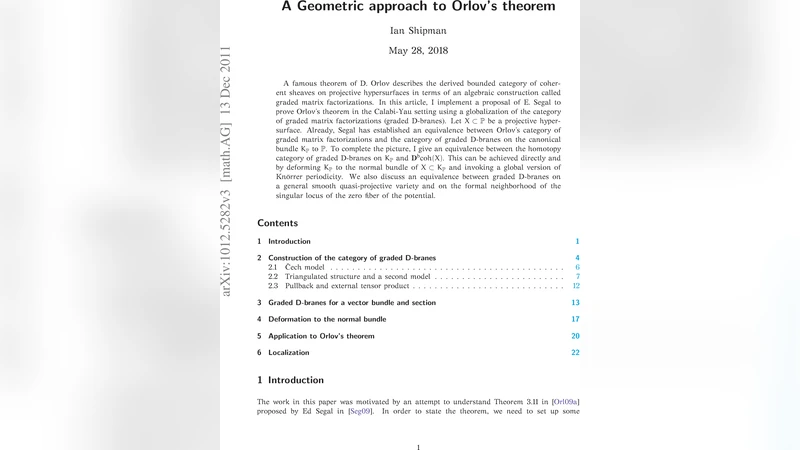
A famous theorem of D. Orlov describes the derived bounded category of coherent sheaves on projective hypersurfaces in terms of an algebraic construction called graded matrix factorizations. In this article, I implement a proposal of E. Segal to prove Orlov’s theorem in the Calabi-Yau setting using a globalization of the category of graded matrix factorizations (graded D-branes). Let X be a projective hypersurface. Already, Segal has established an equivalence between Orlov’s category of graded matrix factorizations and the category of graded D-branes on the canonical bundle K of the ambient projective space. To complete the picture, I give an equivalence between the homotopy category of graded D-branes on K and Dcoh(X). This can be achieved directly and by deforming K to the normal bundle of X, embedded in K and invoking a global version of Kn"{o}rrer periodicity. We also discuss an equivalence between graded D-branes on a general smooth quasi-projective variety and on the formal neighborhood of the singular locus of the zero fiber of the potential.
💡 Research Summary
The paper provides a complete proof of Orlov’s theorem in the Calabi‑Yau case by exploiting a geometric approach based on graded D‑branes. Orlov’s original result identifies the bounded derived category of coherent sheaves on a projective hypersurface X with the category of graded matrix factorizations (GMF) of the defining equation. While the theorem is well‑understood for Fano or general type hypersurfaces, the Calabi‑Yau situation (degree = dimension + 1) poses a difficulty because the associated Landau‑Ginzburg potential becomes homogeneous of degree zero, preventing the usual dimension‑reduction arguments.
The author builds on a proposal of E. Segal, who showed that for the total space K of the canonical bundle of the ambient projective space ℙⁿ, the category of graded matrix factorizations of the homogeneous potential W is equivalent to the category of graded D‑branes on (K,W). A graded D‑brane is a 2‑periodic complex (E,δ) on K satisfying δ² = W·id_E, equipped with the natural ℤ‑grading inherited from the line bundle. Segal’s construction preserves the grading and provides a bridge between the algebraic GMF world and the physical language of B‑branes in a Landau‑Ginzburg model.
The present work completes the picture by establishing an equivalence between the homotopy category of graded D‑branes on K and the derived category Dᶜᵒʰ(X). Two complementary methods are employed:
-
Direct construction – Using the global section y of the line bundle O_K(1) on K, the author writes the potential as W = y·f(x), where f is the defining polynomial of X. The graded D‑brane (E,δ) on K can then be pushed forward to a complex on X by restricting to the zero‑section y = 0 and applying a Koszul resolution. This yields a functor from D‑Branes(K,W) to Dᶜᵒʰ(X) which is shown to be fully faithful and essentially surjective on the level of homotopy categories.
-
Deformation to the normal bundle and global Knörrer periodicity – The total space K is deformed continuously to the normal bundle N_{X/ℙⁿ} of X inside ℙⁿ. During this deformation the potential varies as W_t = y·f_t(x), staying homogeneous of degree zero. Global Knörrer periodicity, a theorem stating that matrix factorization categories are invariant under adding a non‑degenerate quadratic term, is applied to identify the D‑brane categories on K and on N_{X/ℙⁿ}. Since on the normal bundle the potential reduces to the defining equation of X, the resulting D‑branes are precisely the objects of Dᶜᵒʰ(X). This yields a second, more geometric proof of the equivalence.
Beyond the hypersurface case, the author proves a general statement: for any smooth quasi‑projective variety Y equipped with a regular function W, the category of graded D‑branes on (Y,W) is equivalent to the category of graded D‑branes supported on the formal neighborhood of the singular locus of the zero fiber W⁻¹(0). The proof proceeds by localizing near each singular point, applying the local version of Knörrer periodicity, and then gluing the local equivalences via Čech complexes. This “local‑to‑global” principle shows that the derived category of singularities of the zero fiber can be recovered from the formal neighborhood, a result of independent interest for the study of singularity categories and for homological mirror symmetry.
The paper concludes with several directions for future research: extending the method to complete intersections, investigating the physical implications for B‑model string theory, and exploring connections with non‑commutative geometry via formal neighborhoods of singular loci. Overall, the work delivers a robust geometric proof of Orlov’s theorem in the Calabi‑Yau setting, highlights the power of global Knörrer periodicity, and deepens the relationship between graded matrix factorizations and graded D‑branes.
Comments & Academic Discussion
Loading comments...
Leave a Comment