Non connective K-theory via universal invariants
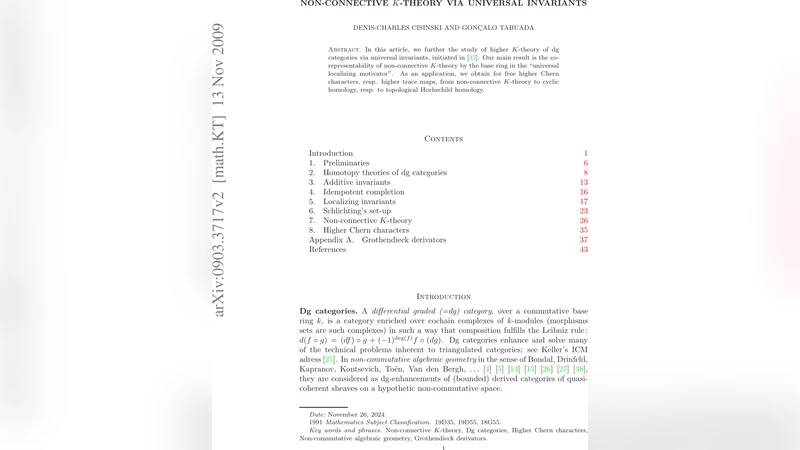
In this article, we further the study of higher K-theory of dg categories via universal invariants, initiated by the second named author. Our main result is the co-representability of non-connective K-theory by the base ring in the universal localizing motivator. As an application, we obtain for free higher Chern characters, resp. higher trace maps, e.g. from non-connective K-theory to cyclic homology, resp. to topological Hochschild homology.
💡 Research Summary
The paper advances the study of higher algebraic K‑theory for differential graded (dg) categories by placing it within the framework of universal invariants, a program initiated by the second author. The central achievement is the proof that non‑connective K‑theory is co‑representable by the base ring (or its associated spectrum) inside the universal localizing motivator, a stable ∞‑category that serves as the initial object for all localizing invariants of dg categories.
The authors begin by recalling the classical construction of K‑theory for dg categories, emphasizing the distinction between connective and non‑connective versions. They then introduce the notion of a universal invariant: a functor from the homotopy category of dg categories to a stable target that satisfies two key properties—localizing (it sends exact sequences of dg categories to fiber sequences) and Morita invariant (it identifies dg categories that are derived equivalent). By applying Bousfield localization to the category of dg motives, they construct the universal localizing motivator, denoted Mot_{loc}^{univ}. This motivator carries a canonical symmetric monoidal structure and admits a universal property: any other localizing invariant factors uniquely through it.
The main theorem states that the object representing the base ring R (or the sphere spectrum when working over ℤ) in Mot_{loc}^{univ} co‑represents non‑connective K‑theory. In concrete terms, for any dg category A there is a natural equivalence
K^{nc}(A) ≃ Hom_{Mot_{loc}^{univ}}(R, U_{loc}(A)),
where U_{loc} is the universal localizing functor. The proof proceeds by constructing a spectral functor K^{nc}: dgCat → Spectra, showing that it satisfies the universal property of a localizing invariant, and then verifying that the unit object R indeed yields the required co‑representability. Technical ingredients include the use of normalized suspension spectra to handle negative K‑groups, careful control of homotopy colimits, and the interplay between the model structures on dg categories and on spectra.
As immediate corollaries, the authors obtain canonical higher Chern character maps
ch: K^{nc}(A) → HC^{-}(A)
and higher trace maps
tr: K^{nc}(A) → THH(A),
where HC^{-} denotes negative cyclic homology and THH denotes topological Hochschild homology. These maps arise functorially from the universal property: any localizing invariant (such as HC^{-} or THH) corresponds to a morphism of motivators R → X, and composing with the co‑representability equivalence yields the desired natural transformation from K‑theory. The paper verifies that these constructions recover the classical Chern character and trace when restricted to connective K‑theory, while extending them to the full non‑connective setting.
The final sections illustrate the theory with examples. For smooth and proper dg algebras over a field, the co‑representability yields explicit calculations of K‑theory in terms of Hochschild homology and cyclic homology, confirming known results and providing new computational tools. The authors also discuss how the framework can be adapted to other invariants such as topological cyclic homology (TC) and periodic cyclic homology (HP), suggesting a broad unifying perspective for trace methods in non‑commutative geometry.
In summary, the paper establishes a powerful categorical backbone for non‑connective K‑theory: by identifying it as the universal co‑representable object in the localizing motivator, it not only clarifies the conceptual status of K‑theory among localizing invariants but also furnishes natural higher Chern characters and trace maps. This work opens the door to systematic comparisons between K‑theory and a wide array of homological invariants, and it sets the stage for future developments in the homotopy‑theoretic study of dg categories and non‑commutative motives.