When Celebrities Speak: A Nationwide Twitter Experiment Promoting Vaccination in Indonesia
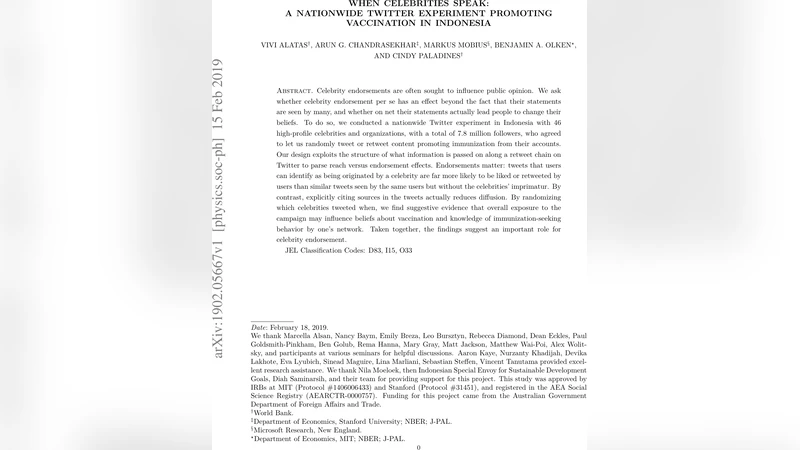
Celebrity endorsements are often sought to influence public opinion. We ask whether celebrity endorsement per se has an effect beyond the fact that their statements are seen by many, and whether on net their statements actually lead people to change their beliefs. To do so, we conducted a nationwide Twitter experiment in Indonesia with 46 high-profile celebrities and organizations, with a total of 7.8 million followers, who agreed to let us randomly tweet or retweet content promoting immunization from their accounts. Our design exploits the structure of what information is passed on along a retweet chain on Twitter to parse reach versus endorsement effects. Endorsements matter: tweets that users can identify as being originated by a celebrity are far more likely to be liked or retweeted by users than similar tweets seen by the same users but without the celebrities’ imprimatur. By contrast, explicitly citing sources in the tweets actually reduces diffusion. By randomizing which celebrities tweeted when, we find suggestive evidence that overall exposure to the campaign may influence beliefs about vaccination and knowledge of immunization-seeking behavior by one’s network. Taken together, the findings suggest an important role for celebrity endorsement.
💡 Research Summary
The paper presents a nation‑wide randomized field experiment on Twitter that evaluates the causal impact of celebrity endorsements on the diffusion of vaccination messages and on recipients’ beliefs in Indonesia. Forty‑six high‑profile celebrities and organizations (totaling 7.8 million followers) were recruited in partnership with the Indonesian government. Each influencer was given a library of pre‑approved immunization tweets containing the campaign hashtag #AyOImunisasi. The experiment randomized three dimensions: (1) whether the influencer posted the tweet themselves or retweeted an identical tweet originally authored by an ordinary user; (2) whether the tweet included an explicit, verifiable source citation; and (3) the timing of the tweet (Phase I in July–August 2015 versus Phase II in November 2015–February 2016).
The key methodological innovation exploits Twitter’s retweet architecture: when a follower (F2) sees a retweet, they can identify the original author and the immediate retweeter, but not intermediate steps. By comparing cases where the original author is a celebrity versus an ordinary “Joe/Jane,” the design isolates the pure endorsement effect while holding reach constant. Random assignment of source citations allows measurement of the credibility‑vs‑virality trade‑off.
Online engagement metrics show that endorsement matters dramatically: tweets known to be authored by a celebrity receive about 70 % more likes and retweets than identical content whose celebrity involvement is hidden. Conversely, attaching a source reduces subsequent retweet rates by roughly 50 %, suggesting that source information makes the message feel less novel or less share‑worthy. The diffusion pattern follows a “complex contagion” with diminishing returns: the first exposure raises retweet probability modestly, the second roughly doubles it, the third multiplies it by 2.5, and additional exposures add little further gain.
To assess offline effects, the authors leveraged the staggered timing of the two phases. Because followers of each influencer were known at baseline, the random phase assignment created exogenous variation in the number of campaign tweets each user was exposed to before a phone survey. Survey results indicate that a one‑standard‑deviation increase in exposure (≈15 campaign tweets/retweets in a month) raises awareness of the hashtag by 20 %, self‑reported exposure to immunization information on Twitter by 11 %, and the likelihood of correctly answering a factual question about domestically produced, halal‑certified vaccines by 12 %. Moreover, respondents reported higher awareness of vaccination behavior within their personal networks, implying that online exposure spurred offline discussion.
Statistical analysis employed logistic regressions with multi‑level controls for follower count, activity level, and regional demographics, and accounted for network structure by weighting observations according to the F1–F2 relationship. While the design mitigates endogeneity in celebrity participation (they could veto a tweet but never did), the possibility that F1’s decision to retweet is partially endogenous remains, though robustness checks on strictly chronological feed displays support the main findings.
The study yields three policy‑relevant insights: (1) celebrity endorsement provides a powerful amplification beyond raw audience size; (2) explicit source citations can hinder viral spread, so credibility may be better conveyed through separate channels; and (3) repeated exposure, rather than single high‑impact messages, is most effective for changing knowledge and attitudes. Consequently, public‑health campaigns should allocate resources to secure celebrity participation, design messages that capitalize on endorsement without over‑loading them with citations, and schedule multiple exposures across a broad set of influencers to maximize both online diffusion and offline belief change. Future work could track actual vaccination uptake and test whether similar dynamics hold on other platforms such as Instagram or TikTok.
Comments & Academic Discussion
Loading comments...
Leave a Comment