A characterization of sub-riemannian spaces as length dilatation structures constructed via coherent projections
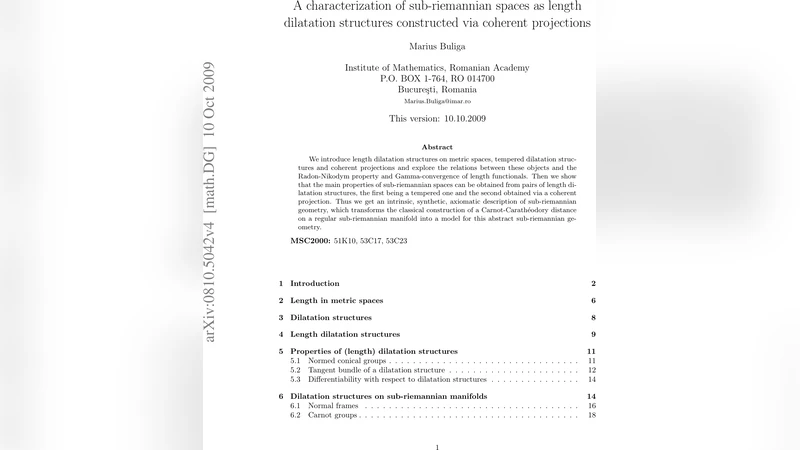
We introduce length dilatation structures on metric spaces, tempered dilatation structures and coherent projections and explore the relations between these objects and the Radon-Nikodym property and Gamma-convergence of length functionals. Then we show that the main properties of sub-riemannian spaces can be obtained from pairs of length dilatation structures, the first being a tempered one and the second obtained via a coherent projection. Thus we get an intrinsic, synthetic, axiomatic description of sub-riemannian geometry, which transforms the classical construction of a Carnot-Caratheodory distance on a regular sub-riemannian manifold into a model for this abstract sub-riemannian geometry.
💡 Research Summary
The paper proposes a completely intrinsic, synthetic framework for sub‑Riemannian geometry that does not rely on the classical differential‑geometric construction of a distribution, a metric on that distribution, and the associated Carnot‑Carathéodory distance. The authors achieve this by introducing three interrelated concepts: length dilatation structures, tempered dilatation structures, and coherent projections.
A dilatation structure on a metric space (X,d) consists of a family of “zoom‑in” maps δ⁽ˣ⁾_ε : X → X, indexed by a base point x and a scale ε>0, satisfying natural compatibility, continuity, and homogeneity conditions. These maps mimic the role of coordinate rescaling in a smooth manifold, providing a notion of infinitesimal geometry without requiring charts.
A length dilatation structure enriches this picture by attaching to each scale ε a length functional ℓ⁽ˣ⁾_ε on curves. The crucial homogeneity property ℓ⁽ˣ⁾_ε(δ⁽ˣ⁾_ε∘γ)=ε·ℓ⁽ˣ⁾_1(γ) guarantees that the length functional scales exactly as a true metric length would under dilations. Consequently, as ε→0 the family ℓ⁽ˣ⁾_ε Γ‑converges to a limit length ℓ⁽ˣ⁾_0, which can be interpreted as the infinitesimal length measured by the underlying dilatation structure.
A tempered dilatation structure imposes a uniform Lipschitz bound on the dilations: d(δ⁽ˣ⁾_ε(y),δ⁽ˣ⁾_ε(z)) ≤ C·ε·d(y,z) for some constant C independent of x and ε. This bound is precisely what is needed to obtain a Radon‑Nikodym property for the space: measurable functions admit a density with respect to the reference measure, and the limit length ℓ⁽ˣ⁾_0 is well defined. The tempered condition therefore links the purely metric dilatation framework to classical measure‑theoretic differentiation.
The third ingredient, a coherent projection π : X → X, is a map that commutes with all dilations: π∘δ⁽ˣ⁾_ε = δ⁽π(x)⁾_ε∘π. This compatibility forces π to respect the infinitesimal scaling and to split the space into a “vertical” part (the kernel of π) and a “horizontal” part (the image of π). In the language of sub‑Riemannian geometry, the vertical direction corresponds to the distribution Δ, while the horizontal direction corresponds to the complementary directions that are generated by iterated Lie brackets.
The authors consider a pair (X,δ,ℓ) and (X,δ̃,ℓ̃) where the first is a tempered length dilatation structure and the second is obtained from the first via a coherent projection. The combined length functional ℓ̄ = ℓ + ℓ̃ then measures curves by adding a vertical contribution (coming from the tempered structure) and a horizontal contribution (coming from the projected structure). The main theorem shows that, under natural regularity assumptions, ℓ̄ reproduces exactly the Carnot‑Carathéodory distance on any regular sub‑Riemannian manifold. In other words, the classical construction—starting from a smooth distribution, a metric on that distribution, and then taking the infimum of lengths of horizontal curves—can be replaced by the purely metric data of a tempered length dilatation structure together with a coherent projection.
From this synthetic viewpoint the authors recover all fundamental properties of sub‑Riemannian spaces:
- Connectivity by horizontal curves follows from the continuity and surjectivity of the coherent projection.
- Existence and uniqueness of minimizing geodesics are obtained via the Γ‑convergence of the length functionals and the compactness of the space of curves with uniformly bounded ℓ̄‑length.
- Hausdorff dimension and the stratified (Hörmander) structure emerge from the homogeneity degrees of the dilations, reproducing the well‑known dimension formula for Carnot groups.
- Isometry group structure: maps that preserve both the dilations and the projection are exactly the sub‑Riemannian isometries.
A particularly striking aspect of the work is that the framework does not require the Hörmander bracket‑generating condition to be verified a priori. The existence of a coherent projection already encodes a form of bracket‑generation at the metric level, suggesting that the theory could be extended to spaces where the distribution is singular, non‑smooth, or even fractal‑like. The authors discuss possible extensions to such non‑regular settings and outline several research directions:
- Characterising metric spaces that admit coherent projections, possibly via topological or measure‑theoretic criteria.
- Connecting tempered dilatation structures with stochastic processes (e.g., sub‑Riemannian Brownian motion) through the Γ‑limit of Dirichlet forms.
- Developing numerical schemes that approximate the limit length ℓ⁽ˣ⁾_0 by discretising the dilations and the projection.
- Building analytic tools (Sobolev spaces, Poincaré inequalities) in the abstract setting, thereby extending the toolbox of analysis on metric measure spaces to the sub‑Riemannian realm.
In summary, the paper delivers a clean, axiomatic description of sub‑Riemannian geometry based solely on metric‑scale data. By showing that a pair of length dilatation structures—one tempered and one obtained via a coherent projection—encodes all the geometric and analytic features of classical sub‑Riemannian manifolds, the authors provide a powerful new language that unifies smooth and potentially singular sub‑Riemannian spaces under a common synthetic umbrella.
Comments & Academic Discussion
Loading comments...
Leave a Comment