Discrimination in the Age of Algorithms
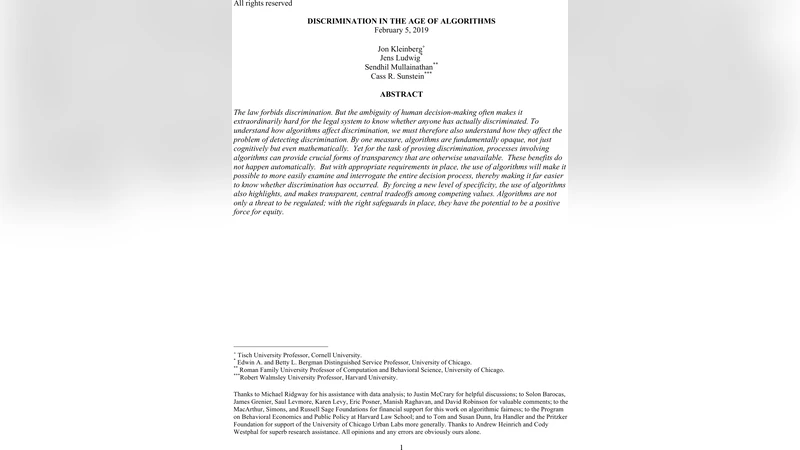
The law forbids discrimination. But the ambiguity of human decision-making often makes it extraordinarily hard for the legal system to know whether anyone has actually discriminated. To understand how algorithms affect discrimination, we must therefore also understand how they affect the problem of detecting discrimination. By one measure, algorithms are fundamentally opaque, not just cognitively but even mathematically. Yet for the task of proving discrimination, processes involving algorithms can provide crucial forms of transparency that are otherwise unavailable. These benefits do not happen automatically. But with appropriate requirements in place, the use of algorithms will make it possible to more easily examine and interrogate the entire decision process, thereby making it far easier to know whether discrimination has occurred. By forcing a new level of specificity, the use of algorithms also highlights, and makes transparent, central tradeoffs among competing values. Algorithms are not only a threat to be regulated; with the right safeguards in place, they have the potential to be a positive force for equity.
💡 Research Summary
The paper begins by observing a paradox at the heart of anti‑discrimination law: while statutes categorically forbid disparate treatment, the very nature of human decision‑making—laden with intuition, experience, and often unconscious bias—makes it extremely difficult for courts to determine whether discrimination actually occurred. Proving discrimination traditionally requires establishing both a discriminatory motive and a disparate impact, a burden that is hard to meet when the decision process is opaque, undocumented, and subject to conflicting testimonies.
Against this backdrop, the authors turn to algorithmic decision‑making. They first dissect “algorithmic opacity” into two dimensions. Cognitive opacity refers to the inability of users, regulators, or litigants to intuitively grasp how a model arrives at a particular output. Mathematical opacity denotes the technical difficulty of formally analyzing models that are highly complex, non‑linear, or involve millions of parameters—characteristics common to modern machine learning, especially deep learning. In such settings, the “why” behind a decision is hidden, which at first glance appears to exacerbate the evidentiary challenges faced by anti‑discrimination law.
However, the central thesis of the paper is that algorithms can also generate a new form of transparency that is uniquely valuable for discrimination detection, provided that specific safeguards are built into their design and deployment. The authors argue that an algorithmic system, unlike a human decision‑maker, can produce a complete, immutable audit trail: records of raw inputs, preprocessing steps, model parameters, scoring functions, and final decision rules. When these logs are required to be stored in standardized, machine‑readable formats, external auditors, regulators, or courts can reconstruct the causal chain linking protected attributes to outcomes. This “process documentation” transforms the evidentiary landscape from reliance on subjective testimony to reliance on objective, reproducible data.
To operationalize this potential, the paper outlines a set of technical and procedural requirements. First, data collection must be transparent about the inclusion of protected characteristics and must apply pre‑emptive fairness filters where appropriate. Second, model selection must be accompanied by explicit explainability and fairness metrics, and the trade‑off between predictive accuracy and equitable treatment must be quantified and disclosed. Third, after each decision, an automated “outcome log” must be generated, capturing the full decision pipeline for later review. Fourth, a legal regime of “algorithmic oversight” should be instituted, obligating organizations to meet these transparency standards and imposing sanctions for non‑compliance.
Beyond facilitating detection, the authors highlight that algorithms make value conflicts explicit. For instance, an automated hiring tool optimized for cost‑efficiency may inadvertently produce adverse impacts on a minority group. Because the algorithm’s objective function and constraints are mathematically encoded, policymakers can see precisely how much weight is being placed on efficiency versus equity, and can adjust the parameters or impose additional constraints to rebalance the system. In this way, algorithms become not merely a source of risk but a “value‑mediating instrument” that surfaces the trade‑offs that societies must negotiate.
The final section draws policy implications. By shifting the evidentiary burden from subjective human recollection to algorithmic logs and independent audits, courts gain a more reliable basis for adjudicating discrimination claims. This shift supports both preventive regulation—by requiring fairness‑aware design before deployment—and remedial action—by enabling precise post‑hoc analysis of discriminatory outcomes. The authors conclude that, while algorithms are not inherently benign, with appropriate regulatory scaffolding they can enhance equity, increase accountability, and ultimately serve as a positive force for social justice rather than a threat that must be merely curtailed.
Comments & Academic Discussion
Loading comments...
Leave a Comment