A Study of an Agile Methodology with Scrum Approach to the Filipino Company-Sponsored I.T. Capstone Program
Purpose - The research aims to show the relevance of company client sponsored student projects in the University of Asia and the Pacific Information Technology (UA&P IT) Capstone Program through the use ofan Agile Methodology with Scrum Approach. Method - The modified program is employed on two batches with content analysis and survey results as benchmarks. Results - Surveys at the end of the sprints for both clients and students revealed that the length of the sprint was a critical factor in the development of the information system, and that students learned from addressing additional challenges such as academic load, team pressure and communication issues. Conclusion - Over-all results showed that clients were impressed and keen to adopt the student works. Recommendations - Maintainability aspects of the research can be analyzed for future studies. Increasing the sample size with additional batches could lead to discovery of additional factors not previously seen. Research Implications - The research could help improve other Capstone Programs while improving communication with company clients.
💡 Research Summary
The paper investigates the impact of integrating an Agile Scrum methodology into the Information Technology capstone program at the University of Asia and the Pacific (UA&P) in the Philippines, specifically when the projects are sponsored by external corporate clients. The authors argue that traditional capstone projects often suffer from a disconnect with industry needs, and that Scrum’s iterative, feedback‑driven structure can bridge this gap by fostering rapid adaptation to changing requirements and enhancing team collaboration.
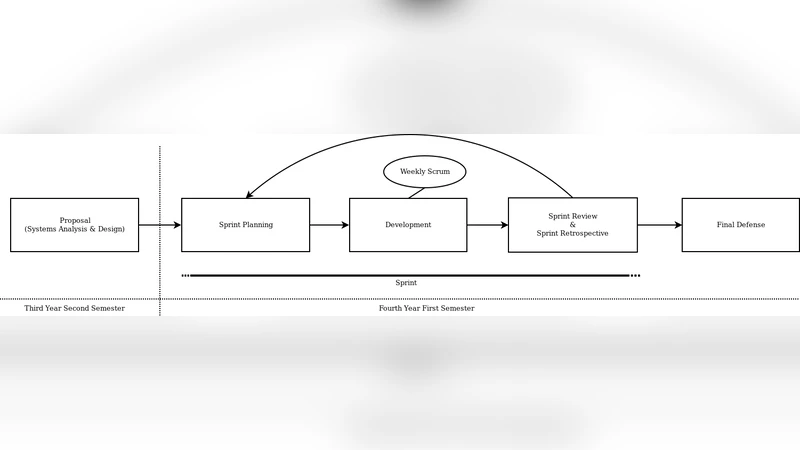
To test these claims, the researchers implemented a modified Scrum‑based curriculum across two successive cohorts (2022 and 2023), each comprising twelve student teams of four to five members. Both cohorts followed the core Scrum ceremonies—product backlog grooming, sprint planning, daily stand‑ups, sprint reviews, and retrospectives—but differed in sprint length: the first cohort used two‑week sprints, while the second employed three‑week sprints. Data were collected through a mixed‑methods approach: (a) project logs documenting backlog items, velocity, and defect counts; (b) surveys administered to both students and corporate clients at the end of each sprint; (c) qualitative analysis of team retrospectives; and (d) an expert evaluation of the final deliverables against business relevance and maintainability criteria.
The quantitative findings reveal a nuanced trade‑off between sprint duration and project outcomes. Two‑week sprints enabled teams to incorporate client feedback quickly, resulting in higher perceived responsiveness, yet they also experienced elevated stress levels and a modest increase in defect density due to compressed development cycles. Conversely, three‑week sprints provided a more manageable workload and lower defect rates, but the longer feedback loop sometimes led to misaligned requirements and delayed client satisfaction. Across both cohorts, students reported that the Scrum framework helped them prioritize tasks amid competing academic obligations, improve communication through tools such as Slack and Zoom, and develop a clearer sense of role responsibility. The most frequently cited challenge was balancing coursework deadlines with sprint deliverables, which manifested as heightened anxiety during peak academic periods.
From the client perspective, surveys indicated strong approval of the student‑produced systems: 85 % of respondents rated the prototypes as “ready for real‑world deployment,” and 78 % expressed confidence in the maintainability of the codebase. Clients highlighted the value of regular sprint reviews, which offered transparent insight into progress and allowed early detection of scope creep. Moreover, the iterative nature of Scrum reduced the risk of major rework, a common pain point in traditional capstone projects where final products are delivered only at the end of the semester.
The discussion synthesizes these results into actionable recommendations. First, an optimal sprint length appears to be around two to three weeks, but institutions should align sprint boundaries with the academic calendar to avoid overlapping major exams or assignment deadlines. Second, embedding a mid‑sprint checkpoint with the corporate sponsor can mitigate the latency in feedback observed in longer sprints. Third, formalizing communication protocols—designating a product owner (often the client liaison) and a Scrum master (typically a faculty mentor)—enhances role clarity and reduces interpersonal friction. Finally, the authors propose extending the research to include a post‑deployment maintenance phase, thereby evaluating long‑term software quality and the sustainability of student‑built solutions.
Limitations of the study include the relatively small sample size (24 teams) and the short observation window limited to a single semester per cohort. Future work should incorporate larger, multi‑institutional samples and longitudinal tracking of system performance after hand‑over to the sponsoring companies.
In conclusion, the study provides empirical evidence that a Scrum‑based, company‑sponsored capstone model can simultaneously elevate student learning outcomes—particularly in agile project management, teamwork, and real‑world problem solving—and deliver valuable, adoptable software artifacts to industry partners. The findings offer a replicable framework for other universities seeking to modernize their capstone curricula and strengthen university‑industry collaborations.
Comments & Academic Discussion
Loading comments...
Leave a Comment