Detecting Permanent and Intermittent Purchase Hotspots via Computational Stigmergy
The analysis of credit card transactions allows gaining new insights into the spending occurrences and mobility behavior of large numbers of individuals at an unprecedented scale. However, unfolding such spatiotemporal patterns at a community level implies a non-trivial system modeling and parametrization, as well as, a proper representation of the temporal dynamic. In this work we address both those issues by means of a novel computational technique, i.e. computational stigmergy. By using computational stigmergy each sample position is associated with a digital pheromone deposit, which aggregates with other deposits according to their spatiotemporal proximity. By processing transactions data with computational stigmergy, it is possible to identify high-density areas (hotspots) occurring in different time and days, as well as, analyze their consistency over time. Indeed, a hotspot can be permanent, i.e. present throughout the period of observation, or intermittent, i.e. present only in certain time and days due to community level occurrences (e.g. nightlife). Such difference is not only spatial (where the hotspot occurs) and temporal (when the hotspot occurs) but affects also which people visit the hotspot. The proposed approach is tested on a real-world dataset containing the credit card transaction of 60k users between 2014 and 2015.
💡 Research Summary
The paper presents a novel method for detecting spatial‑temporal “hotspots” in large‑scale credit‑card transaction data by leveraging Computational Stigmergy, a technique inspired by the pheromone‑based communication of ants. Each transaction is treated as a digital pheromone deposit at its geographic coordinates. Deposits decay over time and reinforce one another when they are close in both space and time, creating a continuously evolving pheromone field that highlights regions of high transaction density.
Key components of the algorithm include: (1) deposition of a pheromone amount proportional to transaction attributes (e.g., amount or frequency); (2) spatial aggregation within a configurable radius r; (3) exponential decay governed by a decay rate λ; (4) periodic thresholding of the pheromone concentration to generate binary hotspot maps; and (5) classification of hotspots into “permanent” (present throughout the observation window) or “intermittent” (appearing only during specific days or time slots). The method requires four main parameters—deposit magnitude, decay rate, spatial radius, and temporal window—which the authors tune empirically based on data characteristics such as overall transaction volume and urban density.
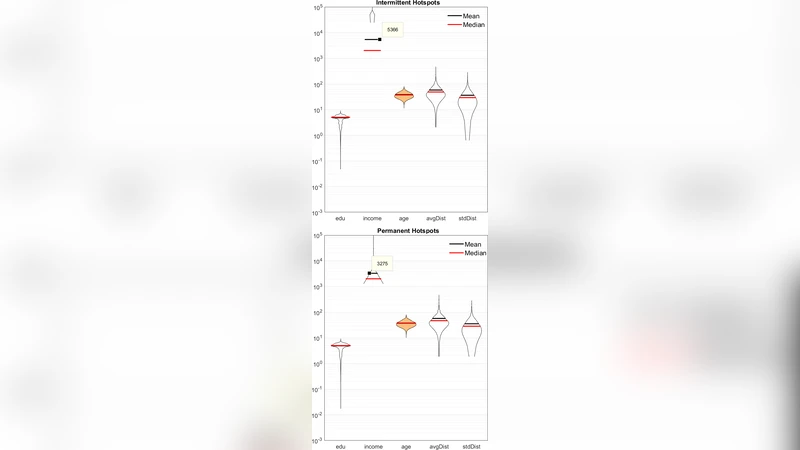
The authors evaluate the approach on a real‑world dataset comprising over one hundred million transactions from 60 000 users collected between 2014 and 2015. After preprocessing (geocoding, grid discretization, normalization), the stigmergy process is applied in a streaming fashion. Results show that permanent hotspots correspond to central business districts, major shopping centers, and transport hubs, where a diverse demographic consistently spends. In contrast, intermittent hotspots emerge during weekend evenings and align with nightlife districts, sports venues, and event locations. By cross‑referencing with external demographic and event calendars, the study demonstrates that intermittent hotspots have strong temporal correlation with concerts, festivals, and other community‑level activities, and that the user profiles visiting these hotspots differ markedly from those frequenting permanent hotspots (e.g., younger age groups, higher discretionary spending).
A comparative analysis against traditional kernel density estimation (KDE) and static heat‑map techniques highlights the advantages of stigmergy. KDE, which aggregates all data without temporal weighting, fails to preserve short‑lived spikes, causing intermittent patterns to be smoothed out. The stigmergy model, by design, integrates decay and spatial diffusion, preserving both persistent and fleeting activity clusters. Moreover, because the pheromone field is updated incrementally, the method scales to real‑time streams, enabling dynamic hotspot monitoring without recomputing the entire density map.
Limitations identified include sensitivity to parameter selection (especially decay rate) and the use of a simple exponential decay that may not capture more complex, non‑linear temporal dynamics. The authors propose future work on adaptive decay mechanisms, multi‑scale pheromone layers, and machine‑learning‑driven parameter optimization to address these issues.
In conclusion, Computational Stigmergy offers a powerful, flexible framework for uncovering both permanent and intermittent spending hotspots from massive transaction logs. Its ability to simultaneously model spatial proximity and temporal evolution provides richer insights into urban mobility and consumer behavior, with potential applications in city planning, targeted marketing, transportation management, and public safety.
Comments & Academic Discussion
Loading comments...
Leave a Comment