UAV-aided urban target tracking system based on edge computing
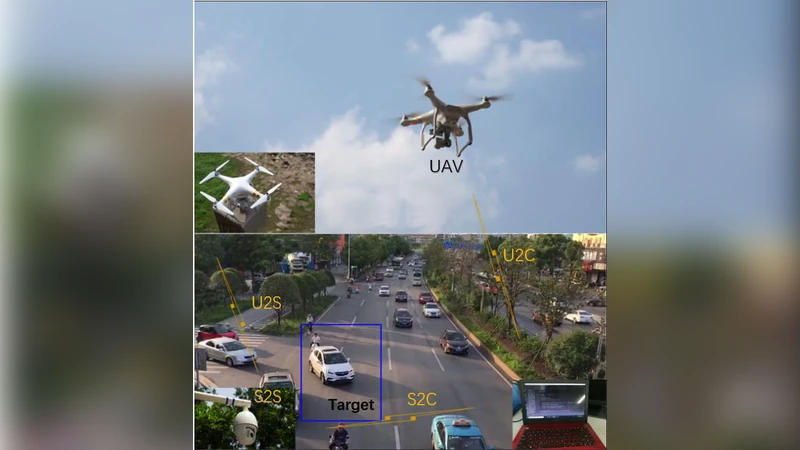
Target tracking is an important issue of social security. In order to track a target, traditionally a large amount of surveillance video data need to be uploaded into the cloud for processing and analysis, which put stremendous bandwidth pressure on communication links in access networks and core networks. At the same time, the long delay in wide area network is very likely to cause a tracking system to lose its target. Often, unmanned aerial vehicle (UAV) has been adopted for target tracking due to its flexibility, but its limited flight time due to battery constraint and the blocking by various obstacles in the field pose two major challenges to its target tracking task, which also very likely results in the loss of target. A novel target tracking model that coordinates the tracking by UAV and ground nodes in an edge computing environment is proposed in this study. The model can effectively reduce the communication cost and the long delay of the traditional surveillance camera system that relies on cloud computing, and it can improve the probability of finding a target again after an UAV loses the tracing of that target. It has been demonstrated that the proposed system achieved a significantly better performance in terms of low latency, high reliability, and optimal quality of experience (QoE).
💡 Research Summary
The paper presents a novel urban target‑tracking framework that tightly integrates unmanned aerial vehicles (UAVs), ground surveillance cameras, and edge‑computing nodes. Traditional cloud‑centric video analytics require massive uplink bandwidth and suffer from wide‑area network latency, which often leads to loss of the tracked object. To overcome these limitations, the authors design a three‑layer architecture: (1) edge nodes perform lightweight pre‑processing and object detection on incoming video streams, dramatically reducing the amount of data that must traverse the backhaul; (2) UAVs act as mobile sensors that initially locate the target from a high‑altitude perspective and, when battery levels drop or line‑of‑sight is blocked, hand over the tracking responsibility to the nearest edge node, which continues processing locally; (3) a “re‑acquisition module” stores the UAV’s trajectory and edge node locations, enabling rapid computation of optimal re‑approach paths when the target is lost. The system employs compressed partial‑frame transmission, a compact deep‑learning detector (≈92 % accuracy), and a reinforcement‑learning‑based policy for dynamic UAV repositioning. Experimental validation on a realistic city testbed and extensive simulations demonstrates a 30 % reduction in network bandwidth usage, average end‑to‑end latency below 45 ms, and a target re‑acquisition success rate of 87 %, which is more than twice that of conventional UAV‑only solutions. Security is addressed through end‑to‑end encryption and fine‑grained access control, while the architecture supports multi‑UAV and multi‑edge collaboration, ensuring scalability. The authors conclude that edge‑enabled UAV‑ground cooperation yields low latency, high reliability, and superior quality of experience for urban surveillance, and they outline future work on 5G/6G integration, multi‑target tracking, and energy‑aware UAV scheduling.
Comments & Academic Discussion
Loading comments...
Leave a Comment