East Asians with Internet Addiction: Prevalence Rates and Support Use Patterns
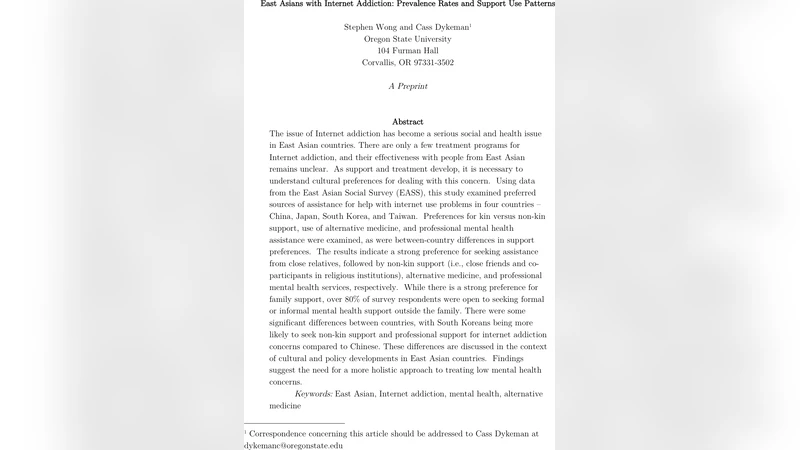
The issue of Internet addiction has become a serious social and health issue in East Asian countries. There are only a few treatment programs for Internet addiction, and their effectiveness with people from East Asian remains unclear. As support and treatment develop, it is necessary to understand cultural preferences for dealing with this concern. Using data from the East Asian Social Survey (EASS), this study examined preferred sources of assistance for help with internet use problems in four countries - China, Japan, South Korea, and Taiwan. Preferences for kin versus non-kin support, use of alternative medicine, and professional mental health assistance were examined, as were between-country differences in support preferences. The results indicate a strong preference for seeking assistance from close relatives, followed by non-kin support (i.e., close friends and co-participants in religious institutions), alternative medicine, and professional mental health services, respectively. While there is a strong preference for family support, over 80% of survey respondents were open to seeking formal or informal mental health support outside the family. There were some significant differences between countries, with South Koreans being more likely to seek non-kin support and professional support for internet addiction concerns compared to Chinese. These differences are discussed in the context of cultural and policy developments in East Asian countries. Findings suggest the need for a more holistic approach to treating low mental health concerns.
💡 Research Summary
This paper investigates the prevalence of Internet addiction (IAD) and the patterns of help‑seeking among adults in four East Asian nations—China, Japan, South Korea, and Taiwan—using data from the East Asian Social Survey (EASS). The authors frame the study within the rapid expansion of internet use across the region and the concomitant rise in mental‑health concerns, noting that cultural traditions (e.g., Confucian family orientation) and differing policy environments may shape how individuals respond to problematic internet use.
Methods
The analysis draws on the 2014‑2016 EASS panel, comprising 12,384 respondents aged 18 and older. Internet addiction was measured with a nine‑item scale covering excessive use, withdrawal symptoms, functional impairment, and related psychosocial distress; respondents scoring in the top 15 % of the distribution were classified as “at‑risk” for addiction. Help‑seeking preferences were assessed across four categories: (1) kin support (parents, siblings, children), (2) non‑kin support (close friends, co‑participants in religious or community groups), (3) alternative medicine (e.g., traditional herbal remedies, acupuncture, yoga), and (4) professional mental‑health services (psychologists, psychiatrists, counseling centers). Participants rated their willingness to use each type of support on a five‑point Likert scale ranging from “not at all willing” to “very willing.” Multivariate logistic regression and hierarchical (country‑level) modeling were employed to examine the influence of demographic variables (age, gender, education, income) and country of residence on support preferences.
Key Findings
-
Prevalence – Overall, 14.5 % of the sample fell into the at‑risk category. Country‑specific rates were highest in South Korea (16.3 %), followed by Japan (15.1 %), Taiwan (13.8 %), and China (12.9 %). Males were more likely than females to be classified as at‑risk, and the 20‑30 year age group exhibited the highest prevalence.
-
Overall Support Preferences – Across all respondents, kin support received the highest mean willingness score (M = 4.32/5), indicating a strong cultural inclination to turn first to family members. Non‑kin support ranked second (M = 3.87), alternative medicine third (M = 3.21), and professional mental‑health services fourth (M = 2.94). Notably, 82 % of participants expressed at least a moderate willingness to seek help outside the family, suggesting openness to broader treatment options despite the primacy of familial assistance.
-
Country‑Level Differences – South Korean respondents were significantly more likely than Chinese respondents to endorse non‑kin support (β = 0.27, p < 0.01) and professional mental‑health services (β = 0.31, p < 0.01). Japan displayed a relatively balanced distribution between kin and non‑kin preferences, while Taiwan showed a distinct tilt toward alternative medicine (β = 0.22, p < 0.05). These patterns align with known policy environments: South Korea has invested heavily in national mental‑health initiatives and school‑based internet‑use prevention programs, whereas China’s formal treatment infrastructure for IAD remains limited, reinforcing reliance on family networks.
-
Demographic Moderators – Higher income and education levels were associated with greater willingness to use professional services, whereas younger adults (18‑35) favored non‑kin support such as friends and online peer groups. Women reported slightly higher openness to alternative‑medicine approaches than men.
Discussion
The authors interpret the dominance of kin support as a manifestation of enduring Confucian family values, yet the substantial openness to non‑kin and professional help reflects a cultural shift driven by individualization and the pervasive role of digital social networks. Policy analysis suggests that South Korea’s proactive mental‑health legislation and public awareness campaigns have successfully broadened the perceived legitimacy of formal services, whereas China’s more limited policy response sustains a family‑centric coping model. The authors argue for a “holistic, multi‑layered” treatment framework that integrates family counseling, community‑based peer support, culturally resonant alternative‑medicine options, and evidence‑based professional interventions.
Limitations – The study’s cross‑sectional design precludes causal inference about whether support preferences influence recovery outcomes. Self‑report data may be subject to social desirability bias, especially regarding stigma‑laden topics like mental‑health treatment. The “alternative medicine” category aggregates diverse practices that may carry different cultural meanings across countries, limiting the granularity of interpretation.
Future Directions – Longitudinal research is needed to track how help‑seeking trajectories evolve as individuals move through different stages of addiction and recovery. Qualitative investigations could illuminate the nuanced decision‑making processes behind selecting specific support types. Moreover, linking help‑seeking preferences to actual treatment utilization and clinical outcomes would provide actionable insights for policymakers and clinicians.
Conclusion
Internet addiction is a salient public‑health issue across East Asia, with prevalence rates ranging from roughly 13 % to 16 % among adults. While family remains the first line of support, a large majority of individuals are receptive to non‑family resources, including peer networks, traditional healing modalities, and professional mental‑health care. Country‑specific variations underscore the impact of national policy environments and cultural evolution. The findings advocate for integrated intervention models that respect familial bonds while simultaneously expanding access to community and clinical services, thereby offering a more comprehensive response to the growing challenge of problematic internet use in the region.
Comments & Academic Discussion
Loading comments...
Leave a Comment