Open Problems for Painleve Equations
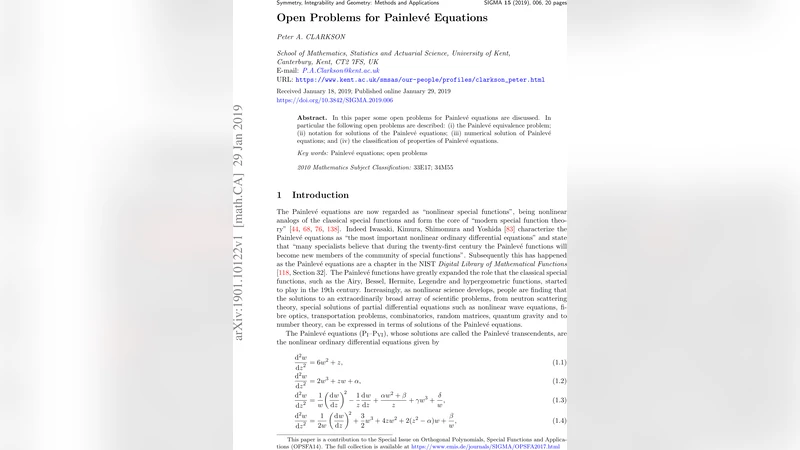
In this paper some open problems for Painlev'e equations are discussed. In particular the following open problems are described: (i) the Painlev'e equivalence problem; (ii) notation for solutions of the Painlev'e equations; (iii) numerical solution of Painlev'e equations; and (iv) the classification of properties of Painlev'e equations.
💡 Research Summary
The paper “Open Problems for Painlevé Equations” surveys the current state of research on the six classical Painlevé equations (P I–P VI) and identifies four broad, unresolved challenges that hinder their systematic use as nonlinear special functions.
First, the Painlevé equivalence problem asks: given a second‑order nonlinear ODE that possesses the Painlevé property (no movable branch points), how can one algorithmically decide whether it can be transformed into one of the six canonical Painlevé equations (or a σ‑equation) via a Möbius transformation of the dependent variable and a change of the independent variable? While the Painlevé test can confirm the property, there is no general procedure to construct the required rational functions (a(z),b(z),c(z),d(z)) and (\phi(z)). The author stresses the need for symbolic‑algorithmic tools that can search the space of admissible transformations and output the explicit mapping, thereby turning the “candidate” equations listed by Ince into recognized Painlevé forms.
Second, the notation problem concerns the lack of a unified symbolic language for the myriad solutions of Painlevé equations. Solutions differ by parameter sets ((\alpha,\beta,\gamma,\delta)), by initial conditions, and by special asymptotic or algebraic reductions (e.g., tronquée, rational, algebraic, or hierarchies of higher‑order analogues). Existing literature uses ad‑hoc notations such as (w(z;\alpha,\beta,\dots)) or labels like “(P_{II})‑type”, which become ambiguous when multiple reductions coexist. The paper proposes a systematic notation of the form (\mathcal{P}{\nu}^{\mathbf{a}}(z;\mathbf{c})), where (\nu) indexes the equation, (\mathbf{a}) encodes the parameter vector, and (\mathbf{c}) records the initial data; special solutions acquire additional subscripts (e.g., (\mathcal{P}{II}^{\mathrm{tr}}(z)) for the tritronquée). Such a convention would facilitate database construction, cross‑referencing, and automated manipulation in computer algebra systems.
Third, the numerical solution problem points out that standard ODE solvers (Runge‑Kutta, multistep methods) are ill‑suited for Painlevé equations because of rapid growth, pole‑like movable singularities, and the presence of conserved Hamiltonian structures. The author suggests two complementary strategies: (a) Hamiltonian‑preserving integrators that enforce the conserved quantity (H(z)) at each step, thereby improving stability; and (b) direct numerical solution of the associated Riemann–Hilbert problem using the Deift–Zhou nonlinear steepest descent method, which respects the isomonodromic nature of Painlevé equations. At present, no publicly available software implements these ideas; the paper calls for a dedicated library (e.g., “PainlevéSolver”) that integrates symbolic preprocessing, transformation detection, and robust numerical back‑ends.
Fourth, the classification of properties problem observes that Painlevé equations exhibit a rich web of symmetries, Bäcklund transformations, affine Weyl group actions, and connections to orthogonal polynomials, random matrix theory, and quantum field models. However, these attributes are scattered across many papers and lack a unified taxonomy. The author envisions constructing a “Painlevé property graph” where each node represents a specific Painlevé equation (including its parameter regime) and edges encode Bäcklund or symmetry transformations. Graph‑theoretic algorithms could then test for equivalence, identify missing links, and suggest new reductions. Such a framework would also aid in cataloguing degenerate cases, special function limits, and higher‑order analogues.
Throughout the manuscript, concrete examples illustrate the challenges: (i) reduction of the complex sine‑Gordon equation to Painlevé V via two distinct substitutions; (ii) transformation of a Tzitzéica‑type equation into the degenerate Painlevé III(7) form; (iii) conversion of third‑order nonlinear ODEs into Painlevé IV or Painlevé 34 through clever substitutions and scaling. These case studies demonstrate that, while the Painlevé property can be verified, finding the explicit equivalence mapping often requires deep insight and ad‑hoc calculations.
In conclusion, the paper proposes a research roadmap: develop automated equivalence detection algorithms, adopt a standardized notation for Painlevé transcendents, create robust numerical solvers that exploit integrable structures, and build a comprehensive classification graph of Painlevé properties. Achieving these goals would elevate Painlevé equations from isolated curiosities to a fully integrated component of modern applied mathematics, with reliable symbolic, numerical, and theoretical tools available to physicists, engineers, and mathematicians alike.
Comments & Academic Discussion
Loading comments...
Leave a Comment