Optimal Design of SWIPT-Aware Fog Computing Networks
This paper studies a simultaneous wireless information and power transfer (SWIPT)-aware fog computing network, where a multiple antenna fog function integrated hybrid access point (F-HAP) transfers information and energy to multiple heterogeneous single-antenna sensors and also helps some of them fulfill computing tasks. By jointly optimizing energy and information beamforming designs at the F-HAP, the bandwidth allocation and the computation offloading distribution, an optimization problem is formulated to minimize the required energy under communication and computation requirements, as well as energy harvesting constraints. Two optimal designs, i.e., fixed offloading time (FOT) and optimized offloading time (OOT) designs, are proposed. As both designs get involved in solving non-convex problems, there are no known solutions to them. Therefore, for the FOT design, the semidefinite relaxation (SDR) is adopted to solve it. It is theoretically proved that the rank-one constraints are always satisfied, so the global optimal solution is guaranteed. For the OOT design, since its non-convexity is hard to deal with, a penalty dual decomposition (PDD)-based algorithm is proposed, which is able to achieve a suboptimal solution. The computational complexity for two designs are analyzed. Numerical results show that the partial offloading mode is superior to binary benchmark modes. It is also shown that if the system is with strong enough computing capability, the OOT design is suggested to achieve lower required energy; Otherwise, the FOT design is preferred to achieve a relatively low computation complexity.
💡 Research Summary
This paper investigates a simultaneous wireless information and power transfer (SWIPT)‑aware fog computing network in which a multi‑antenna fog‑function integrated hybrid access point (F‑HAP) simultaneously delivers information and radio‑frequency (RF) energy to heterogeneous single‑antenna Internet‑of‑Things (IoT) devices. The network contains two types of devices: energy‑harvesting (EH) devices that collect RF power and information‑decoding (ID) devices that receive data. The F‑HAP employs separate beamforming vectors for energy and information, exploiting the distinct sensitivity requirements of EH and ID receivers.
In the downlink, the transmitted signal is a superposition of energy‑bearing symbols and information‑bearing symbols. EH devices harvest energy proportional to the received RF power, while ID devices must achieve a minimum data rate, which imposes a signal‑to‑interference‑plus‑noise ratio (SINR) constraint. In the uplink, each EH device partitions its computation task of size (D_i) into two parts: a portion (O_i) that is offloaded to the F‑HAP and the remainder ((D_i-O_i)) processed locally. Offloading uses frequency‑division multiple access (FDMA) with bandwidth allocation factors (\alpha_i) and transmit power (p_i). Local computation consumes energy according to a cubic CPU‑frequency model. The harvested energy must cover the sum of local computation energy, offloading transmission energy, and a fixed circuit consumption.
The objective is to minimize the total energy consumption at the F‑HAP, which includes the transmit power for both energy and information beams and the processing energy for the offloaded tasks. The decision variables are the information beamforming matrices (W_j), the energy covariance matrix (\Lambda), the bandwidth allocation vector (\alpha), the offloaded data vector (O), and the offloading time (t_u). Constraints enforce (i) the ID rate requirement, (ii) the EH energy balance, (iii) the local computation feasibility, (iv) the F‑HAP’s computational capacity, and (v) the total bandwidth and time budget.
Two design strategies are considered.
Fixed Offloading Time (FOT) Design – The offloading duration (t_u) is fixed. The original non‑convex problem is relaxed by introducing matrix variables (W_j = w_j w_j^H) and applying semidefinite relaxation (SDR). The rate constraints become linear matrix inequalities, and the energy balance constraints become convex after substituting the explicit expression for the required transmit power. The resulting problem (P1) is convex and can be solved by interior‑point methods. A key theoretical contribution is the proof that the optimal SDR solution always satisfies (\text{rank}(W_j)=1), guaranteeing that the relaxed solution is indeed globally optimal for the original problem. Moreover, by dual decomposition, semi‑closed‑form expressions for the optimal bandwidth allocation (\alpha_i) and offloading amount (O_i) are derived as functions of the dual variables (\mu_i) and (\nu). When (\mu_i=0) no offloading occurs; when (\mu_i>0) the optimal (O_i) and (\alpha_i) follow explicit formulas involving system parameters such as the energy conversion efficiency, channel gains, and CPU coefficients.
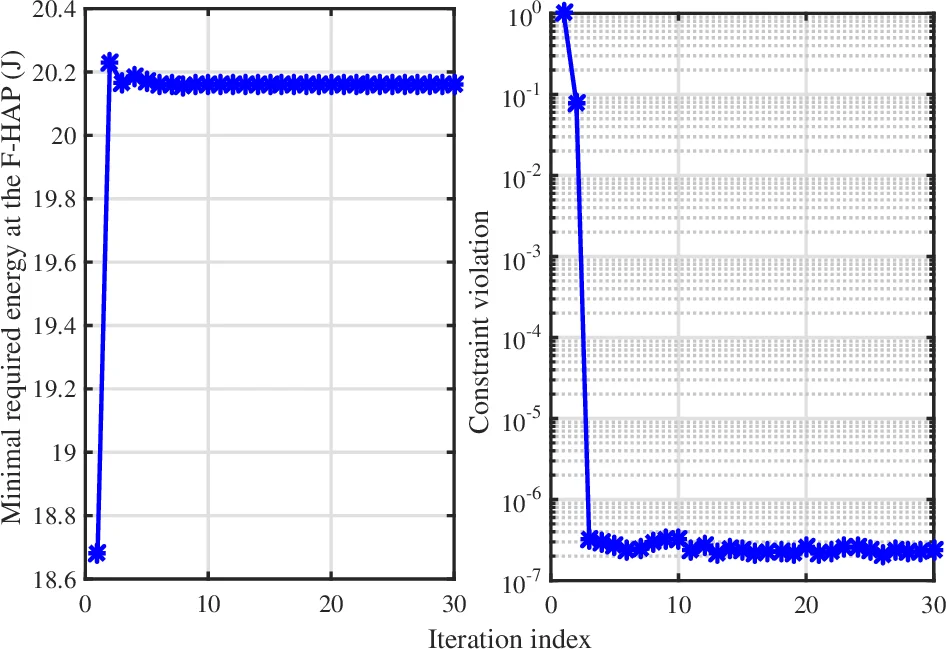
Optimized Offloading Time (OOT) Design – Here (t_u) is also a variable, which introduces a new non‑convex term coupling (t_u), (\alpha_i) and (O_i). To handle this, an auxiliary variable (\tilde a_i = t_u \alpha_i) is introduced, converting the problematic term into a function of (\tilde a_i) and (O_i) only. The problem is then reformulated as a penalized augmented Lagrangian (AL) problem. A Penalty Dual Decomposition (PDD) algorithm is proposed: the inner loop solves a convex sub‑problem for ((W,\Lambda,\alpha,O,\tilde a)) given the current penalty parameter (c) and dual variables (\tilde\lambda_i); the outer loop updates (c) and (\tilde\lambda_i) to enforce the equality constraints (\tilde a_i = t_u \alpha_i). This iterative scheme converges to a stationary point, providing a sub‑optimal solution for the OOT design.
Complexity analysis shows that the FOT design, solved via SDR, has polynomial‑time complexity dominated by the interior‑point solver, while the OOT design incurs additional overhead due to the outer PDD iterations.
Numerical simulations evaluate the two designs under varying numbers of antennas, users, energy conversion efficiencies, and F‑HAP computational capacities. Results demonstrate that (1) partial offloading (splitting tasks) consistently outperforms binary (all‑or‑nothing) offloading in terms of required energy; (2) when the F‑HAP possesses strong computational capability, the OOT design yields lower total energy by optimally adjusting the offloading time; (3) when computational resources are limited, the simpler FOT design is preferable because it achieves comparable energy savings with far lower algorithmic complexity.
In summary, the paper makes four major contributions: (i) a novel SWIPT‑aware fog computing system model that jointly handles heterogeneous EH and ID devices; (ii) a globally optimal SDR‑based solution for the fixed‑time case with a rigorous rank‑one proof; (iii) a PDD‑based algorithm for the more general time‑optimizing case; and (iv) a thorough trade‑off analysis between energy efficiency and computational complexity, providing practical design guidelines for future low‑power IoT and edge‑computing deployments. Future work may extend the framework to dynamic channels, multi‑cell cooperation, and real‑time scheduling.
Comments & Academic Discussion
Loading comments...
Leave a Comment