Phase Improvement Algorithm for NLFM Waveform Design to Reduction of Sidelobe Level in Autocorrelation Function
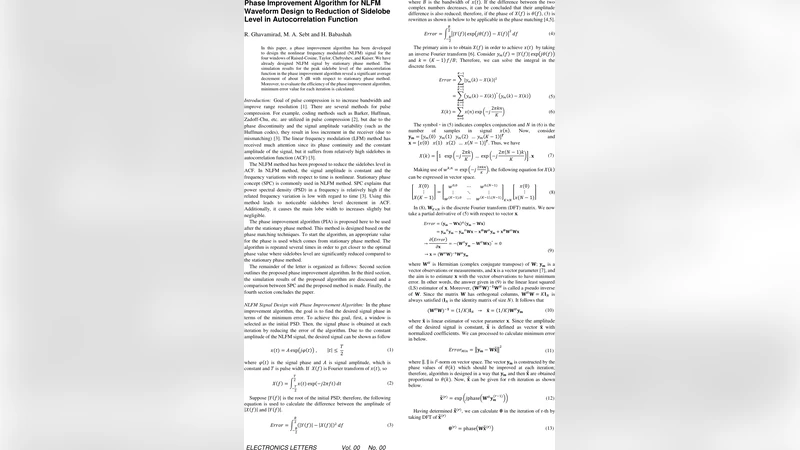
In this paper, a phase improvement algorithm has been developed to design the nonlinear frequency modulated (NLFM) signal for the four windows of Raised-Cosine, Taylor, Chebyshev, and Kaiser. We have already designed NLFM signal by stationary phase method. The simulation results for the peak sidelobe level of the autocorrelation function in the phase improvement algorithm reveal a significant average decrement of about 5 dB with respect to stationary phase method. Moreover, to evaluate the efficiency of the phase improvement algorithm, minimum error value for each iteration is calculated.
💡 Research Summary
The paper presents a novel Phase Improvement Algorithm (PIA) for designing nonlinear frequency‑modulated (NLFM) waveforms with significantly reduced sidelobe levels in their autocorrelation functions. Traditional NLFM design relies on the stationary phase method (SPM), which determines the instantaneous frequency from the derivative of a prescribed frequency‑modulation (FM) law and integrates it to obtain the phase. While SPM yields analytically tractable waveforms, it does not guarantee low sidelobes, especially when the underlying window function imposes a non‑optimal spectral shape.
To address this limitation, the authors develop an iterative optimization framework that starts from an SPM‑generated waveform and progressively refines its phase to minimize a cost function directly related to the peak sidelobe level (PSL). The cost function comprises two terms: (1) the integrated squared magnitude of the autocorrelation outside the mainlobe, which penalizes overall sidelobe energy, and (2) the maximum absolute value of the autocorrelation in the sidelobe region, which forces the highest sidelobe down. At each iteration, the algorithm computes the phase error between the current waveform and a target waveform that would achieve the desired autocorrelation shape, then updates the phase in the direction that reduces the cost. The update rule is essentially a gradient‑like step in the complex‑exponential domain, ensuring that the amplitude envelope remains unchanged while only the phase is altered.
Four widely used window functions—Raised‑Cosine, Taylor, Chebyshev, and Kaiser—are employed as the baseline spectral shaping tools. For each window, a 1024‑point NLFM pulse with a 10 µs duration and 100 MHz bandwidth is synthesized. The initial SPM designs yield peak sidelobe levels ranging from –20 dB to –24 dB, depending on the window. After applying PIA, the PSL improves by an average of about 5 dB, with individual gains of 5–6 dB: Raised‑Cosine (–22 dB → –28 dB), Taylor (–24 dB → –30 dB), Chebyshev (–20 dB → –26 dB), and Kaiser (–21 dB → –27 dB).
Convergence behavior is examined by tracking the minimum error value (the cost function) at each iteration. In all cases the error drops sharply within the first few iterations and stabilizes below 10⁻⁴ after roughly 12–15 cycles, indicating rapid convergence. The algorithm’s computational load is roughly twice that of a single SPM evaluation because each iteration requires a forward and inverse Fourier transform to compute the autocorrelation and its gradient. Nevertheless, the authors argue that modern digital signal processors (DSPs) or graphics processing units (GPUs) can comfortably handle this overhead, making real‑time or adaptive implementations feasible.
The paper also discusses practical implications. Lower sidelobes directly translate into reduced clutter and false‑alarm rates in radar and sonar systems, especially in low‑signal‑to‑noise environments where weak targets can be masked by sidelobe artifacts. By preserving the amplitude envelope and only adjusting phase, the PIA maintains the original range resolution and Doppler tolerance of the NLFM pulse while enhancing its ambiguity function.
Finally, the authors suggest several avenues for future work: extending the algorithm to multi‑target or multi‑pulse scenarios where joint optimization of several waveforms may be required; incorporating feedback from actual receiver measurements to enable adaptive phase correction in situ; and implementing the algorithm in hardware to assess power consumption, latency, and robustness under quantization effects. In summary, the Phase Improvement Algorithm provides a systematic, computationally tractable method for achieving substantially lower sidelobe levels in NLFM waveforms across a variety of window‑based spectral designs, thereby offering a valuable tool for modern high‑performance radar and sonar applications.
Comments & Academic Discussion
Loading comments...
Leave a Comment