Navigability evaluation of complex networks by greedy routing efficiency
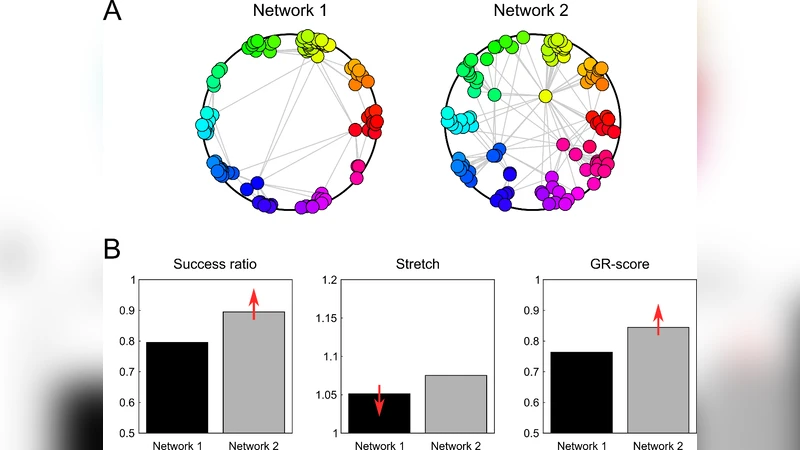
Network navigability is a key feature of complex networked systems. For a network embedded in a geometrical space, maximization of greedy routing (GR) measures based on the node geometrical coordinates can ensure efficient greedy navigability. In PNAS, Seguin et al. (PNAS 2018, vol. 115, no. 24) define a measure for quantifying the efficiency of brain network navigability in the Euclidean space, referred to as the efficiency ratio, whose formula exactly coincides with the GR-score (GR-efficiency) previously published by Muscoloni et al. (Nature Communications 2017, vol. 8, no. 1615). In this Letter, we point out potential flaws in the study of Seguin et al. regarding the discussion of the GR evaluation. In particular, we revise the concept of GR navigability, together with a careful discussion of the advantage offered by the new proposed GR-efficiency measure in comparison to the main measures previously adopted in literature. Finally, we clarify and standardize the GR-efficiency terminology in order to simplify and facilitate the discussion in future studies.
💡 Research Summary
The letter provides a critical re‑examination of the 2018 PNAS paper by Seguin et al., which introduced an “efficiency ratio” to quantify brain network navigability in Euclidean space using greedy routing (GR). The authors demonstrate that the formula presented by Seguin et al. is mathematically identical to the GR‑score (also called GR‑efficiency) originally defined by Muscoloni et al. in Nature Communications 2017. Specifically, both measures compute the average ratio of the GR‑induced path length to the true shortest‑path length across all unordered node pairs, assigning an infinite penalty to unsuccessful routes. This equivalence means that Seguin et al. inadvertently re‑named an already established metric without acknowledging prior work, creating unnecessary duplication in the literature.
The letter then dissects methodological and interpretational shortcomings in Seguin’s study. First, Seguin et al. treat success rate and path‑length efficiency as separate performance indicators and propose to combine them via simple averaging or weighting. In contrast, the GR‑score intrinsically integrates both aspects: successful routes contribute finite ratios, while failures contribute an infinite term, thereby automatically reflecting overall success probability and average stretch. By separating the two components, Seguin’s approach both obscures the unified nature of GR‑based evaluation and risks double‑counting information.
Second, the authors critique the reliance on a purely Euclidean embedding of the brain connectome. Physical distance alone does not fully capture the strength or likelihood of neural connections, which are also shaped by functional similarity, developmental constraints, and genetic factors. Consequently, a Euclidean GR may misrepresent true navigability. Muscoloni et al. previously showed that non‑Euclidean embeddings—particularly hyperbolic spaces—better preserve hierarchical and clustering properties of complex networks, leading to more accurate GR‑score assessments. The letter argues that Seguin’s omission of such alternatives limits the generality of their conclusions.
To address these issues, the letter proposes a set of standardization guidelines for future GR‑based navigability research: (1) adopt the established GR‑score definition and explicitly cite its origin; (2) avoid presenting success rate and stretch as independent metrics when the GR‑score already encapsulates both; (3) consider embedding strategies beyond Euclidean geometry, such as hyperbolic or other curvature‑adjusted spaces, to reflect the multifaceted nature of real‑world networks; and (4) maintain consistent terminology and notation to facilitate reproducibility and cross‑study comparisons.
In summary, the letter reaffirms that GR‑efficiency is a robust, unified measure of navigability applicable not only to brain networks but to a broad class of complex systems. By clarifying its equivalence to the previously published GR‑score and by recommending methodological best practices, the authors aim to streamline future investigations, improve the interpretability of results, and prevent redundant metric proliferation in the field of network science.
Comments & Academic Discussion
Loading comments...
Leave a Comment