Investigating Cooperativity of Overlapping Community Structures in Social Networks
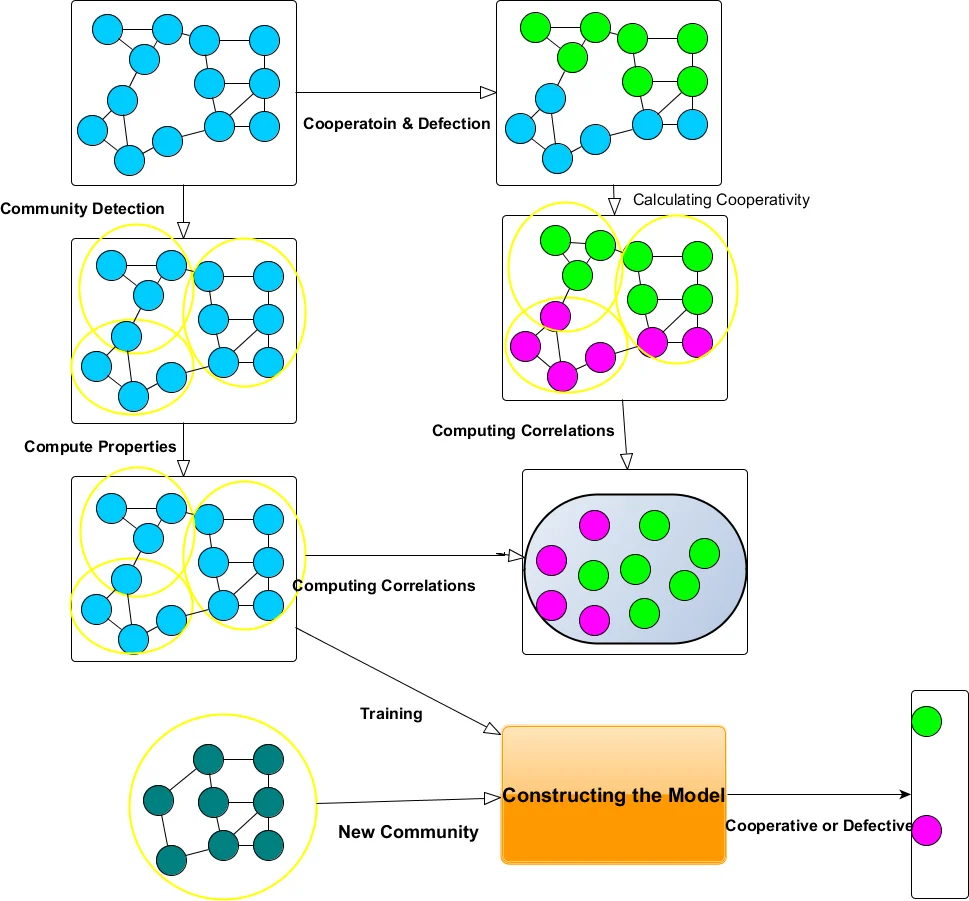
Many real-world networks can be modeled by networks of interacting agents. Analysis of these interactions can reveal fundamental properties from these networks. Estimating the amount of collaboration in a network corresponding to connections in a learning environment can reveal to what extent learners share their experience and knowledge with other learners. Alternatively, analyzing the network of interactions in an open source software project can manifest indicators showing the efficiency of collaborations. One central problem in such domains is the low cooperativity values of networks due to the low cooperativity values of their respective communities. So administrators should not only understand and predict the cooperativity of networks but also they need to evaluate their respective community structures. To approach this issue, in this paper, we address two domains of open source software projects and learning forums. As such, we calculate the amount of cooperativity in the corresponding networks and communities of these domains by applying several community detection algorithms. Moreover, we investigated the community properties and identified the significant properties for estimating the network and community cooperativity. Correspondingly, we identified to what extent various community detection algorithms affect the identification of significant properties and prediction of cooperativity. We also fabricated binary and regression prediction models using the community properties. Our results and constructed models can be used to infer cooperativity of community structures from their respective properties. When predicting high defective structures in networks, administrators can look for useful drives to increase the collaborations.
💡 Research Summary
This paper investigates the cooperativity of overlapping community structures in two real‑world domains: learning forums (LF) and open‑source software (OSS) projects. The authors first construct interaction networks where nodes represent learners or developers and edges capture communication or collaboration events. To quantify cooperativity, they employ an evolutionary Prisoner’s Dilemma (PD) game: each node repeatedly plays PD with its neighbors, updating its strategy according to payoff‑driven dynamics until a stable average cooperation level is reached. The resulting cooperativity scores are computed for the whole network and for each detected community.
Community detection is performed using seven overlapping‑community algorithms, including SSK, CliZZ, SLP‑A, Walktrap, and InfoMap. For every community the authors extract five structural attributes: size, internal density, average node degree, degree standard deviation, and a measure of internal connectivity. These attributes serve as explanatory variables in subsequent correlation and prediction analyses.
Statistical analysis reveals that most network‑level properties (e.g., clustering coefficient, average degree) are negatively correlated with cooperativity, confirming prior findings that dense, highly connected topologies can facilitate defection. At the community level, the sign and magnitude of correlations depend heavily on the detection algorithm. Small‑community algorithms (SSK, CliZZ) show that community size and density are the strongest predictors of cooperation, whereas large‑community algorithms (SLP‑A, Walktrap, InfoMap) highlight degree deviation and density as key factors. Notably, OSS networks exhibit higher overall cooperativity than LF networks, suggesting that the collaborative culture of OSS projects promotes more cooperative behavior.
To assess predictive power, the authors build both binary classifiers (high vs. low cooperativity) and regression models using machine‑learning techniques such as Random Forests, Support Vector Machines, and Logistic Regression. Cross‑validation results indicate accuracies around 78 % for classification and mean absolute errors near 0.12 for regression, demonstrating that structural features alone can reliably forecast cooperativity. Feature‑importance analysis confirms that clustering coefficient and average degree dominate at the network level, while community‑specific attributes (size, density, degree deviation) are decisive depending on the algorithm used.
The study contributes three main insights: (1) a clear quantitative difference in cooperativity between OSS and LF domains; (2) evidence that both global network metrics and local community metrics are linked to cooperative outcomes, with the direction of influence varying by community detection method; and (3) practical predictive models that administrators can employ to identify “defective” or low‑cooperation structures and intervene (e.g., by reshaping community size, adjusting density, or reducing degree heterogeneity). The authors suggest future work on dynamic networks, richer game‑theoretic models, and real‑time interventions to further enhance collaborative performance in online social systems.
Comments & Academic Discussion
Loading comments...
Leave a Comment