Trends in Demand, Growth, and Breadth in Scientific Computing Training Delivered by a High-Performance Computing Center
We analyze the changes in the training and educational efforts of the SciNet HPC Consortium, a Canadian academic High Performance Computing center, in the areas of Scientific Computing and High-Performance Computing, over the last six years. Initially, SciNet offered isolated training events on how to use HPC systems and write parallel code, but the training program now consists of a broad range of workshops and courses that users can take toward certificates in scientific computing, data science, or high-performance computing. Using data on enrollment, attendence, and certificate numbers from SciNet’s education website, used by almost 1800 users so far, we extract trends on the growth, demand, and breadth of SciNet’s training program. Among the results are a steady overall growth, a sharp and steady increase in the demand for data science training, and a wider participation of ’non-traditional’ computing disciplines, which has motivated an increasingly broad spectrum of training offerings. Of interest is also that many of the training initiatives have evolved into courses that can be taken as part of the graduate curriculum at the University of Toronto.
💡 Research Summary
This paper presents a data‑driven evaluation of the training activities offered by the SciNet High‑Performance Computing (HPC) Consortium at the University of Toronto over the past six to seven years. Initially, SciNet’s educational outreach consisted of isolated workshops on parallel programming and basic HPC system usage. Today, the program comprises a diversified portfolio that includes seminars, short‑duration workshops, graduate‑style courses, and an annual week‑long summer school, organized into three certification tracks: Scientific Computing, High‑Performance Computing, and Data Science.
The authors extracted anonymized enrollment, attendance, and certificate‑completion records from SciNet’s ATutor‑based learning management system, covering roughly 1,800 unique users. Each course was mapped to one of four categories (HPC, Scientific Computing, Data Science, Seminar) and enriched with demographic fields such as field of study and gender. Time‑series analyses of registration counts, course completions, and certificate awards reveal several key trends.
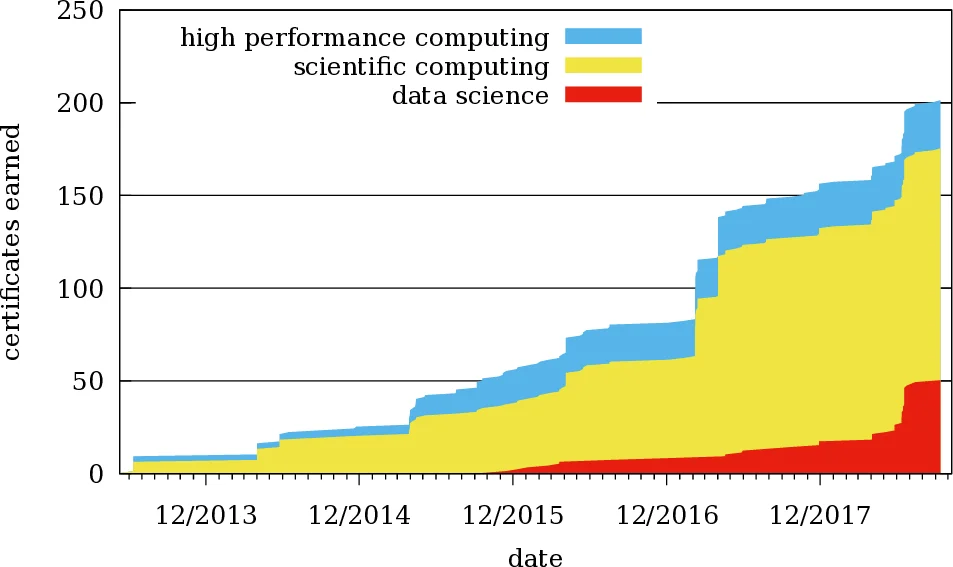
First, overall demand for SciNet training has risen steadily, with an average annual growth rate exceeding 20 %. The Data Science track shows the most rapid expansion, increasing by more than 30 % per year since its introduction in 2015. This surge mirrors the broader academic shift toward data‑intensive research across disciplines. Second, participation has broadened beyond traditional “HPC‑heavy” domains (physics, astronomy, chemistry) to include life sciences, medicine, social sciences, and digital humanities. By the most recent year, users from non‑traditional fields constitute over one‑third of all participants, up from less than 5 % at the program’s inception.
Third, the paper evaluates the pedagogical efficacy of the different formats. One‑hour seminars are effective for rapid dissemination of new tools or research highlights but lack depth for skill acquisition. Half‑day to full‑day workshops provide hands‑on experience with specific technologies (e.g., MPI, OpenMP, CUDA, R, Python) and are repeated several times per year. The graduate‑style courses, which combine twice‑weekly lectures with weekly programming assignments and online support (forums, office hours, recorded lectures), emerge as the most impactful format. They are assessed through assignment grades, contribute credit toward the 36‑hour threshold required for a SciNet certificate, and have been institutionalized as for‑credit university courses.
The certificate system, launched in December 2012, awards three distinct credentials once a learner accumulates at least 36 credit‑hours in the corresponding track. Short courses count one credit hour per lecture hour; longer courses with homework count 1.5 credit hours per lecture hour. The Data Science certificate, the newest of the three, has become the fastest‑growing credential, reflecting heightened interest in artificial intelligence, machine learning, and big‑data analytics. Certificates serve as formal proof of competency, enhancing CVs, grant applications, and employability.
A notable contribution of the work is the description of how several SciNet courses have been integrated into the University of Toronto’s graduate curriculum through partnerships with the Departments of Physics, Medical Sciences, and Physical & Environmental Sciences. The resulting for‑credit courses (PH Y1610, MSC1090, EES1137) retain the same instructional materials, assignments, and online infrastructure as the original SciNet offerings, while receiving academic credit and being taught by SciNet analysts appointed as sessional lecturers. This model distributes teaching load to partner departments (e.g., teaching assistants) and provides students with recognized academic credit, thereby creating a sustainable pathway for continued professional development.
The authors also discuss operational aspects of the learning platform, including LDAP integration for SciNet users, temporary accounts for external participants, and the categorization of events into “events” (lectures, labs, workshops) that determine course length. The paper highlights the importance of aligning training with institutional recognition mechanisms to motivate participation and ensure long‑term viability.
In conclusion, the study demonstrates that an academic HPC center can evolve from a pure computational resource provider into a comprehensive education hub that addresses the growing computational needs of a diverse research community. By systematically expanding training formats, instituting formal certification, and embedding courses within university degree programs, SciNet has successfully increased both the breadth and depth of scientific computing education. Future work suggested by the authors includes linking learning outcomes (e.g., assignment scores, project quality) with research productivity metrics (publications, software releases) to quantitatively assess the impact of such training initiatives on scientific output.
Comments & Academic Discussion
Loading comments...
Leave a Comment