Information Systems Development and Evolution: A replication study on work distribution in Norwegian Organizations
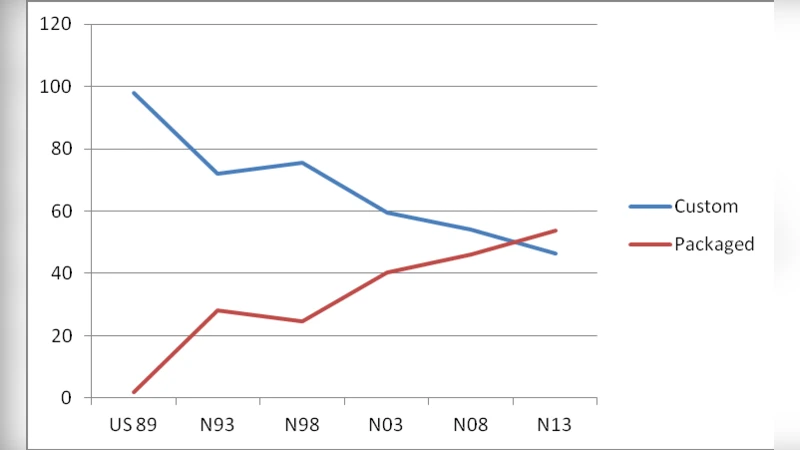
The information systems landscape is at first sight very different from how it was 20 years ago. On the other hand, it seems that we are still struggling with many of the same problems, including late or abandoned projects and unfilled customer demands. In this article we present selected data from survey investigations from 1993, 1998, 2003, 2008 and 2013 among Norwegian organizations on how they conduct information systems development and maintenance. In particular we compare data from 2008 and 2013 in more detail. A major finding is that whereas main work distribution numbers was very stable between 2003 and 2008, we see some changes as for time used on maintenance and development between 2008 and 2013. Even if we witness large changes in the underlying implementation technology and methods used, a number of aspects such as application portfolio upkeep (the amount of work for keeping the application portfolio operational) though are still on the same level as it has been the last 15 years. On the other hand, because of the more complex infrastructures supporting the application portfolio, and the increasing number of in particular external users, an increasing amount of resources is used for other tasks such as operations and user-support than in the first investigations, although also this appears to have stabilised between the last investigations.
💡 Research Summary
This paper presents a longitudinal replication study of information systems (IS) development and maintenance work distribution in Norwegian organizations, covering five survey waves conducted in 1993, 1998, 2003, 2008, and 2013. The authors selected a sample of 388 organizations from the membership lists of the Norwegian Computer Society (NCS) and the public‑sector IT forum OSDF, and distributed the questionnaire via SurveyMonkey. The main survey achieved 87 responses (22 % response rate), of which 68 were usable; a complementary “IT i praksis” survey added 208 usable responses, yielding an overall response rate of 39 %. Respondents were predominantly senior IT managers with an average of 21 years of experience, representing both private and public sectors and covering all three levels of IT support (strategic, operational, and frontline).
Conceptual framework
The study adopts the IEEE‑1999 taxonomy for maintenance—corrective, adaptive, and perfective—and further splits perfective into enhancive (functional) and non‑functional improvements. Building on earlier work, the authors introduce two higher‑level constructs: (1) Application Portfolio Upkeep, encompassing all activities required to keep the current functional coverage of the organization’s IS portfolio (corrective, adaptive, non‑functional perfective, and development of replacement systems); and (2) Application Portfolio Evolution, which captures work that expands functional coverage (enhancive maintenance and development of entirely new systems). This distinction allows the authors to differentiate between “keeping the lights on” and “growing the portfolio.”
Key findings on work distribution
Between 2003 and 2008 the split between development and maintenance was relatively stable: development accounted for roughly 55–60 % of total effort, while maintenance (including upkeep) made up about 40–45 %. In the most recent wave (2008‑2013) a modest shift is observed: maintenance share declines by about five percentage points, development share rises slightly, and the proportion of effort classified as “other work” (operations, user support, and similar activities) increases by more than ten percentage points. The authors attribute this to the growing complexity of underlying infrastructures (SOA, cloud, mobile) and the rise in external users, which push organizations to allocate more resources to operational support.
Portfolio upkeep vs. evolution
Application Portfolio Upkeep remains remarkably stable over the 20‑year span, consistently representing around 70 % of total IS work. This indicates that Norwegian organizations continue to devote the majority of their IS resources to sustaining existing systems rather than expanding functionality. In contrast, Portfolio Evolution accounts for less than 10 % of effort, suggesting limited investment in new functional capabilities or entirely new systems. These patterns echo earlier findings from Lientz & Swanson (1980) and subsequent Norwegian replications, reinforcing the view that “maintenance” dominates IS work.
Methodological considerations
The questionnaire comprised 41 items, mirroring those used in the earlier Norwegian surveys (1993‑2008) to ensure comparability. The authors discuss several validity threats: (a) sampling bias due to reliance on NCS and OSDF member lists; (b) relatively low response rates, especially for the main survey; (c) turnover in the actual organizations participating across waves, which precludes a true longitudinal panel but still permits a replication analysis. They acknowledge that the sample may over‑represent larger, more mature IT organizations.
Implications
For scholars, the study provides rare empirical evidence of how IS work allocation evolves over two decades, confirming that while technology and development methods (e.g., agile, cloud) have changed, the macro‑level balance between development and maintenance remains fairly constant, with a slight recent drift toward operational support. Practitioners can infer that sustaining existing applications continues to be the dominant cost driver, and that strategic initiatives to increase portfolio evolution will require deliberate reallocation of resources. The authors suggest future research should link work distribution to project outcomes, cost efficiency, and business value, possibly developing quantitative models that predict the impact of shifting effort from upkeep to evolution.
In conclusion, the replication study demonstrates that despite substantial technological change, Norwegian organizations have maintained a stable proportion of effort on portfolio upkeep, while the share of “other” operational tasks has grown in the latest period. This underscores the enduring challenge of balancing the need to keep legacy systems running with the desire to innovate, and highlights the value of long‑term, comparable survey data for tracking IS practice trends.
Comments & Academic Discussion
Loading comments...
Leave a Comment