Promoting effective application and management of ICT to enhance performance in secondary schools
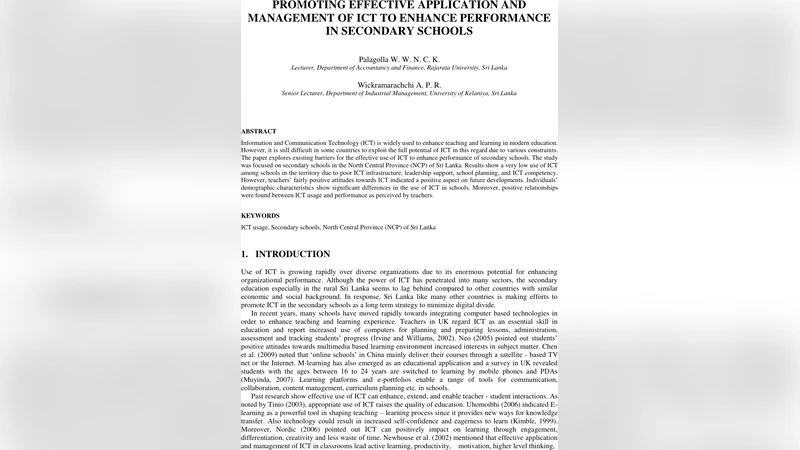
Information and Communication Technology (ICT) is widely used to enhance teaching and learning in modern education. However, it is still difficult in some countries to exploit the full potential of ICT in this regard due to various constraints. The paper explores existing barriers for the effective use of ICT to enhance the performance of secondary schools. The study was focused on secondary schools in the North Central Province (NCP) of Sri Lanka. Results show a very low use of ICT among schools in the territory due to poor ICT infrastructure, leadership support, school planning, and ICT competency. However, teachers fairly positive attitudes towards ICT indicated a positive aspect of future developments. Individuals demographic characteristics show significant differences in the use of ICT in schools. Moreover, positive relationships were found between ICT usage and performance as perceived by teachers.
💡 Research Summary
The study investigates why information and communication technology (ICT) is under‑utilised in secondary schools despite its recognised potential to improve teaching and learning. Focusing on the North Central Province (NCP) of Sri Lanka, the authors surveyed 250 teachers from roughly thirty secondary schools during the 2022 autumn term. The questionnaire covered five domains: (1) ICT infrastructure (hardware, software, network, electricity), (2) leadership support (principal and senior staff commitment to ICT), (3) school ICT planning (budget, strategic initiatives, professional development), (4) teacher ICT competency and attitudes, and (5) perceived school performance outcomes (student achievement, instructional innovation, administrative efficiency). All items used a five‑point Likert scale and demonstrated strong internal reliability (overall Cronbach’s α = 0.82; sub‑scales 0.74‑0.88).
Results reveal a stark deficiency in ICT infrastructure, with an average score of 2.1 out of 5. Many schools lack sufficient computers, printers, reliable internet, and stable electricity. Leadership support is similarly weak (mean = 2.4), indicating that principals and senior administrators allocate limited funds for ICT and provide minimal professional‑development opportunities. In contrast, teachers’ attitudes toward ICT are relatively positive (mean = 3.8), suggesting an awareness of ICT’s pedagogical value but also frustration with systemic constraints.
Demographic analysis shows significant differences in ICT use based on age, education, and experience. Younger teachers (≤30 years) and those who have completed recent ICT‑focused training report higher usage rates. Teachers with five years or less of service and those holding postgraduate qualifications also demonstrate greater engagement with technology. These findings underscore the importance of targeted training for older and more experienced staff.
Correlation analysis indicates a moderate, statistically significant positive relationship (r = 0.46, p < 0.01) between the extent of ICT use and teachers’ perceptions of school performance. Schools where ICT is more frequently employed are associated with higher reported student achievement, more varied instructional resources, and improved administrative efficiency. This supports the hypothesis that ICT can contribute meaningfully to educational outcomes when adequately supported.
Based on the evidence, the authors propose several policy recommendations: (1) increase governmental and provincial funding to upgrade ICT infrastructure and ensure reliable power supply; (2) formalise ICT strategic planning responsibilities for school leaders, including dedicated budget lines; (3) implement regular, differentiated ICT professional‑development programmes, especially for senior teachers; (4) embed ICT planning into school operational manuals to create sustainable management practices; and (5) develop quantitative ICT impact metrics to monitor and evaluate policy effectiveness over time.
The study acknowledges limitations: the sample is confined to NCP schools, limiting national generalisability, and reliance on self‑reported data may introduce response bias. Future research should incorporate longitudinal designs, qualitative interviews with teachers and administrators, and objective student achievement data to more precisely gauge ICT’s effect on learning outcomes. By addressing infrastructural, organisational, and capacity‑building barriers, the authors argue that Sri Lankan secondary schools can unlock ICT’s full potential and achieve measurable improvements in educational performance.
Comments & Academic Discussion
Loading comments...
Leave a Comment