Towards a Live Anonymous Question Queue To Address Student Apprehension
In today’s university climate many first and second year classes have over a hundred students. Large classrooms make some students apprehensive about asking questions. An anonymous method of submitting questions to an instructor would allow students to ask their questions without feeling apprehensive. In this paper we propose a Live Anonymous Question Queue (LAQQ), a system that facilitates anonymous question submissions in real time to mitigate student apprehension, increase student participation, and provide real-time feedback to the instructor. To study the necessary features of an LAQQ, we conducted a study of a system, namely Google Moderator, which best approached our concept of an LAQQ. We deployed Google moderator in large lectures and studied its support of a number of features that we envisioned for an LAQQ. Through our class observations, interviews with instructors, and surveys with the students, our results suggest that an LAQQ system must provide support for: notification of question submission to provide awareness for the instructor, and context for questions to allow an instructor to easily answer a question. Additionally our results suggest that an LAQQ system must be accessible and usable on multiple platforms. Finally our results suggest that in order to be successful in the classroom an LAQQ system must be fully adopted by the instructor and the classroom organizational structure must change to accommodate the use of the LAQQ.
💡 Research Summary
The paper addresses the well‑known problem of student apprehension in large university lectures, where many first‑ and second‑year classes contain over a hundred students. The authors propose a “Live Anonymous Question Queue” (LAQQ) as a technological intervention that enables students to submit questions anonymously in real time, thereby reducing fear of negative evaluation, increasing participation, and providing instructors with immediate feedback on student understanding.
To identify the essential features of an LAQQ, the researchers selected Google Moderator (GM) as a proxy system because it offers anonymous usernames, a public question queue, voting‑based ranking, and cross‑platform accessibility. The study involved three instructors teaching five sections (total enrollment 106–212 students per section) across different subjects and teaching styles (traditional lecture and flipped classroom). The methodology comprised five steps: pre‑study instructor interviews, classroom observations, a field experiment deploying GM for 1–2 weeks, a post‑experiment student survey, and post‑study instructor interviews.
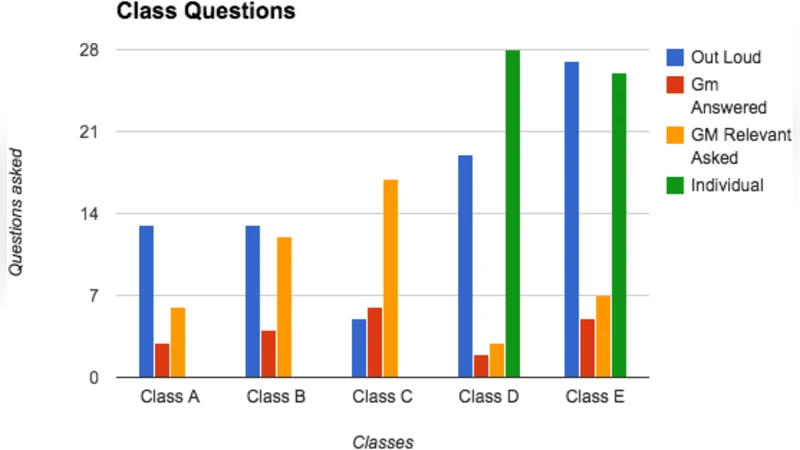
Survey data (N = 137) revealed that 41 % of students felt uncomfortable asking questions in class. The primary reasons were fear of asking a “dumb” question (26.5 %) and concern about peer or instructor judgment (≈22 %). Of those uncomfortable, 93 % indicated they would feel more at ease if anonymity were guaranteed. Despite this, only 57.2 % of respondents reported any interaction with GM, and merely 11 % actually posted a question. The most common reasons for not posting were lack of a question (57 %) and being preoccupied with the lecture (26 %). Non‑use of GM was attributed to lack of devices (18 % did not bring a laptop), unfamiliarity with the interface, and lack of a Google account.
Observational findings highlighted two critical functional gaps in GM. First, GM does not provide explicit, real‑time notifications to the instructor when a new question arrives; consequently, questions could linger at the top of the queue for up to twenty minutes, causing loss of contextual relevance. Second, the voting‑based ranking mechanism was underutilized, offering little impact on the order in which questions were addressed. The study also noted that instructor behavior strongly influenced usage: allocating dedicated class time for question submission dramatically increased the volume of questions, while the flipped‑class instructor abandoned the smartphone interface due to usability issues.
Based on these results, the authors expand the original six‑feature LAQQ model (live feedback, anonymity, question queue, ranking, notifications, accessibility) to include three additional requirements: shared memory (persistent storage of questions and answers), contextual information (linking questions to specific lecture moments), and alignment with class structure (formal integration of LAQQ activities into lesson plans). They argue that successful adoption hinges on full instructor buy‑in and structural changes to classroom practice, such as setting aside time for question submission and ensuring that the instructor monitors the queue continuously.
In conclusion, the paper demonstrates that while a tool like Google Moderator can approximate many desired LAQQ functionalities, practical deployment reveals shortcomings in notification, context preservation, and mobile usability. Future work should focus on designing a purpose‑built LAQQ platform with robust real‑time alerts, intuitive mobile UI, automated context tagging, and scalable ranking algorithms, as well as longitudinal studies measuring the impact on student learning outcomes and instructor teaching effectiveness.
Comments & Academic Discussion
Loading comments...
Leave a Comment