Visibility and Training in Open Source Software Adoption: A Case in Philippine Higher Education
Open Source Software (OSS) has been widely used in the educational environment largely due to its reduced cost of ownership. While OSS has evolved over the years, challenges exist in its implementation and wide adoption. Foremost among these detriments is the lack of available skills across industries. Since future users of this technology will settle in an organizational ecosystem where proprietary and OSS technologies coexist, it is vital to understand their learning environment where they initially acquire their technology skills. The University implements courses that champion the use of open source technologies within its curricula. However, other courses are also anchored on technologies that are proprietary. This study is based on the premise that training or the learning experience and visibility or the prevalence of OSS in the environment influences its adoption among students. Empirical evidences explore the relationship of visibility and training in the adoption of OSS from the perspectives of students in a Philippine university. A modified Technology Acceptance Model incorporating additional constructs is validated using Partial Least Squares Structural Equation Model. Results of the study confirms the applicability of TAM in this study, training has positive influence on both perceived ease of use and perceived usefulness and visibility has a positive influence on perceived ease of use towards initial acceptability of students of OSS. Educational implications of the study are discussed, limitations are acknowledged and research frontiers are recommended.
💡 Research Summary
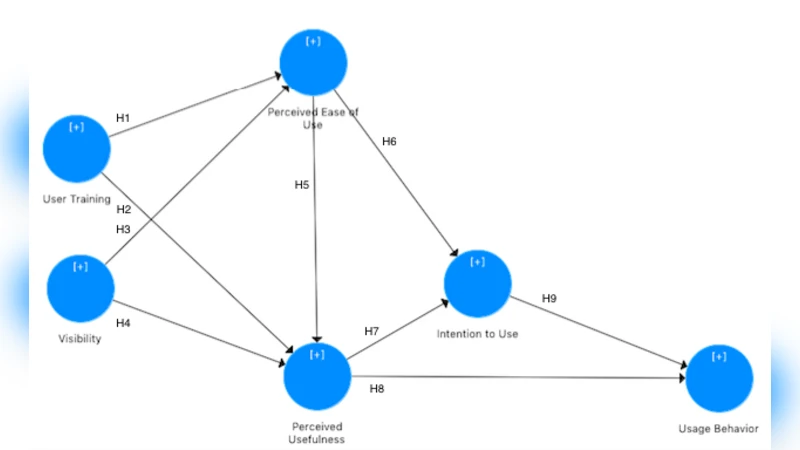
The paper investigates how two contextual factors—visibility (the extent to which students encounter open‑source software in their environment) and training (the formal instruction and hands‑on experience they receive)—affect the adoption of open‑source software (OSS) among university students in the Philippines. Building on Davis’s Technology Acceptance Model (TAM), the authors extend the model by adding the constructs of training and visibility, resulting in a nine‑hypothesis framework that links these new variables to the classic TAM determinants: perceived ease of use (PEOU), perceived usefulness (PU), intention to use (IU), and actual use behavior (UB).
Data were collected via an online questionnaire administered to 436 undergraduate students from diverse majors, years of study, and gender. Items measuring PEOU, PU, IU, and UB were adapted from prior TAM studies, while training items were drawn from Gallego et al. (2015) and visibility items from Chuah et al. (2016). All items used a five‑point Likert scale. The authors employed Partial Least Squares Structural Equation Modeling (PLS‑SEM) using SmartPLS, a technique well‑suited for predictive modeling with relatively small samples. Convergent validity (Cronbach’s α and Composite Reliability > 0.70) and discriminant validity (AVE > 0.50) were confirmed for all constructs, indicating reliable measurement.
The structural model yielded several key findings. First, training had a strong, positive effect on both PEOU (t = 11.336) and PU (t = 4.40), confirming that well‑designed instructional programs lower perceived barriers and increase the perceived value of OSS for learning tasks. Second, visibility positively influenced PEOU (t > 1.96) but did not affect PU (t = 0.015, not significant). This suggests that frequent exposure to OSS makes students feel the software is easier to use, yet exposure alone does not enhance their belief that OSS is useful—likely because usefulness is already shaped by formal training and curriculum integration.
All original TAM pathways were supported: PEOU positively predicted PU and IU; PU positively predicted IU and UB; and IU positively predicted UB. These results reaffirm the robustness of TAM in the OSS context and demonstrate that perceived ease of use and usefulness remain central drivers of adoption intentions and actual behavior.
The authors discuss the practical implications for higher‑education institutions. Since training emerged as the most potent lever, universities should invest in systematic OSS curricula, hands‑on labs, and certification schemes to build student competence. Visibility, while less influential on usefulness, can be leveraged by showcasing OSS projects, peer demonstrations, and campus‑wide deployments to reinforce ease‑of‑use perceptions.
Limitations are acknowledged: the study is confined to a single university, limiting external validity; the survey focused on the OSS tools currently used at the institution, which may not represent the broader OSS ecosystem; and the cross‑sectional design precludes strong causal inference. Future research directions include multi‑institutional or cross‑national samples, longitudinal designs to capture adoption trajectories over time, qualitative investigations to uncover deeper motivational factors, and the inclusion of additional OSS‑specific attributes such as security, customizability, and community support.
In conclusion, the study validates an extended TAM for OSS adoption among students, demonstrating that targeted training substantially enhances both perceived ease of use and usefulness, while visibility chiefly boosts ease‑of‑use perceptions. These insights provide a roadmap for educators and policymakers seeking to accelerate OSS uptake in developing‑country higher‑education settings.
Comments & Academic Discussion
Loading comments...
Leave a Comment