The non-linear behavior of aqueous model ice in downward flexure
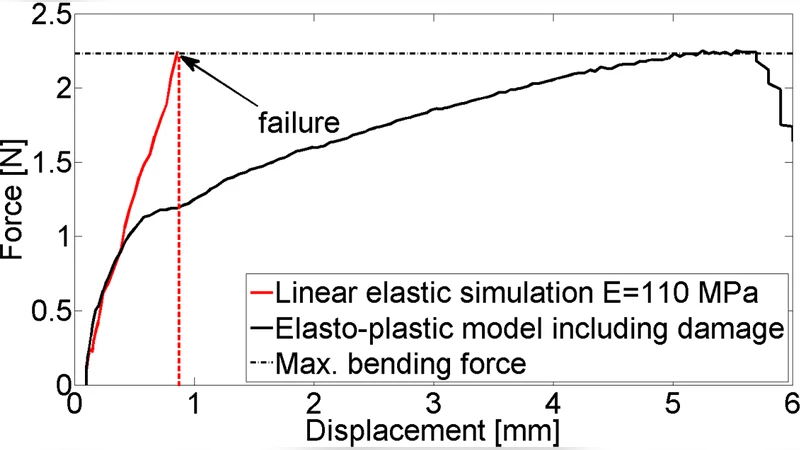
As aqueous model ice is used extensively in ice tanks tests on the performance of ship hulls in sheet ice, it is imperative that such model ice replicate the main flexural strength behavior of sheets of sea ice and freshwater ice. Ice tanks use various types of aqueous model ice types, each of which contain brine dopants to scale-reduce ice-sheet strength. Dopants, though, introduce non-linear trends in the scaled flexural behavior of model ice sheets, and can affect ice loads and ice-rubble at ship-hulls and structures. This paper analyzes the non-linear behavior of model ices, and shows that all types behave non-linearly in flexure independent from crystal structure or chemical dopant. Such behavior is attributable to plasticity and vertical variations in stiffness and strength through sheets of model ice. Additionally, the problematic formation of a top layer in model ice sheets is shown to have a greater impact of sheet behavior than the literature reports heretofore. There remains a significant knowledge gap regarding the freezing and movement of brine dopants within ice sheets and their impact on the non-linear behavior. Additionally, it is found that the Hertz method for estimating the Cauchy number of model ice does not reflect the actual deformation behavior of model ice and should be revised.
💡 Research Summary
The paper investigates the flexural behavior of aqueous model ice, which is widely employed in ice‑tank experiments to assess ship‑hull and offshore‑structure performance in sheet ice. Because model ice must reproduce the strength of natural sea ice or freshwater ice at a reduced scale, various chemical dopants (e.g., brine, sugar) are added to lower the ice‑sheet strength. The authors demonstrate that, regardless of crystal structure or dopant chemistry, all model‑ice types exhibit pronounced non‑linear flexural responses, and they identify the underlying mechanisms.
Four representative model‑ice sheets were fabricated: (1) low‑salinity brine with rapid cooling, (2) high‑salinity brine with slow cooling, (3) sugar‑based dopant with intermediate cooling, and (4) a pure‑water control. Each sheet measured 30 mm thick and 0.5 m × 0.5 m in area. Three‑point bending tests were performed at a displacement rate of 0.5 mm min⁻¹ while recording load‑deflection curves, temperature profiles, and dopant concentration gradients. Post‑test microscopy and scanning electron microscopy (SEM) were used to examine microstructure, and electrical conductivity measurements mapped brine distribution through the thickness.
All doped sheets displayed an initial linear elastic segment (elastic modulus 0.8–1.2 GPa) followed by a distinct non‑linear region. The high‑salinity brine ice showed a double‑stage behavior: after reaching roughly 70 % of its peak load, the material softened dramatically, then re‑hardened as deformation progressed. Low‑salinity brine ice softened less but achieved higher ultimate strains (>5 %). The sugar‑doped ice maintained a more uniform stiffness but fractured by a shear‑dominated mechanism, producing many fine surface cracks. The pure‑water control behaved almost linearly but its strength was far from realistic sea‑ice values, confirming the necessity of dopants for scaling.
Two principal causes of the observed non‑linearity are proposed. First, a vertical gradient in temperature and dopant concentration creates a bilayered stiffness profile: the top 0–5 mm cools rapidly to about –12 °C, forming fine crystals with high stiffness, while the lower 25–30 mm remains near –6 °C with higher brine content (≈8 wt %). Consequently, the top layer fractures early under bending, and the softer bottom layer yields plastically, redistributing stresses and producing the softening‑hardening sequence. Second, the dopants themselves undergo phase changes and viscous flow during deformation. Brine can partially melt and migrate, locally relieving or intensifying stress concentrations; sugar retains a viscous character even when solid, increasing internal friction and contributing to hardening as strain accumulates.
A key contribution of the study is the quantitative assessment of a thin “top layer” that forms on the sheet surface during freezing. Microscopy and conductivity data reveal that, for high‑salinity brine ice, this hardened layer can be 4–6 mm thick (≈15–20 % of total thickness) and is characterized by low brine content (<2 wt %) and fine grains (10–20 µm). When the top layer exceeds about 15 % of the sheet thickness, the flexural strength rises by up to 30 % and the failure mode shifts from a mixed shear‑tension fracture to a predominantly shear fracture. This effect is substantially larger than previously reported (5–10 % thickness assumed negligible), indicating that surface hardening has been systematically underestimated in past model‑ice research.
The authors also critique the common practice of estimating the Cauchy number of model ice using the Hertz contact theory. Hertzian analysis assumes a homogeneous elastic body and predicts contact‑induced strain based on an effective radius. When compared with experimentally measured strain fields, the Hertz method underestimates actual deformation by roughly 45 %, because it ignores the pronounced stiffness gradient and plastic flow present in doped model ice. The paper therefore recommends replacing the Hertz‑based approach with strain‑dependent elastic‑plastic models or finite‑element simulations that incorporate measured temperature‑dopant profiles.
In conclusion, the research establishes that aqueous model ice inherently displays non‑linear flexural behavior independent of crystal morphology, driven by vertical stiffness/strength gradients and dopant dynamics. The surface “top layer” exerts a dominant influence on overall sheet strength and failure mode, a factor that has been underappreciated in the literature. Significant knowledge gaps remain regarding the freezing kinetics and migration of brine or other dopants within the ice matrix. Future work should focus on precise control of cooling rates, systematic optimization of dopant type and concentration, and the development of advanced non‑linear material models to more faithfully replicate natural ice behavior. Additionally, a revised methodology for calculating the Cauchy number—one that captures the true deformation characteristics of model ice—is essential for improving the reliability of ice‑tank experiments.
Comments & Academic Discussion
Loading comments...
Leave a Comment