Gender bias in academic recruitment
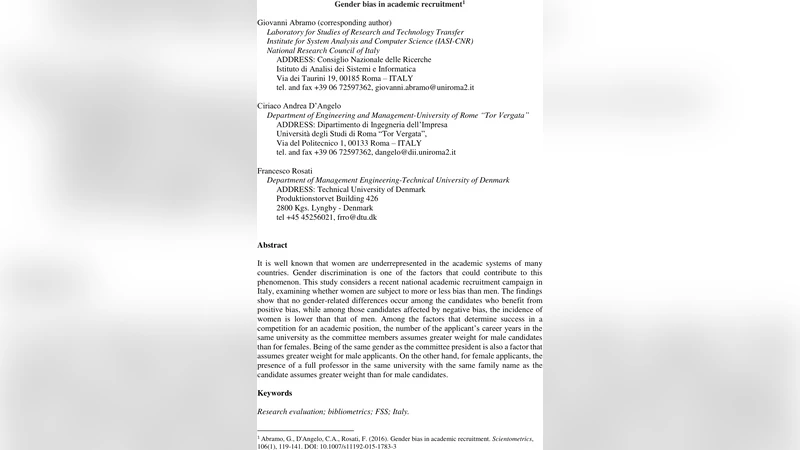
It is well known that women are underrepresented in the academic systems of many countries. Gender discrimination is one of the factors that could contribute to this phenomenon. This study considers a recent national academic recruitment campaign in Italy, examining whether women are subject to more or less bias than men. The findings show that no gender-related differences occur among the candidates who benefit from positive bias, while among those candidates affected by negative bias, the incidence of women is lower than that of men. Among the factors that determine success in a competition for an academic position, the number of the applicant’s career years in the same university as the committee members assumes greater weight for male candidates than for females. Being of the same gender as the committee president is also a factor that assumes greater weight for male applicants. On the other hand, for female applicants, the presence of a full professor in the same university with the same family name as the candidate assumes greater weight than for male candidates.
💡 Research Summary
The paper investigates gender bias in the Italian academic recruitment system by analysing a large‑scale dataset from the 2008 national competition for associate professor positions. From the 1,232 competitions announced that year, the authors focus on a subset of 287 “bibliometric” competitions (i.e., those in scientific disciplines where at least half of the professors have publications indexed in the Web of Science). This subset comprises 1,979 incumbent assistant professors (candidates) of whom 473 were selected as winners. The authors distinguish two types of bias: positive bias (candidates who win despite low scientific productivity) and negative bias (candidates who lose despite high productivity).
A cross‑tabulation of gender and bias type shows that positive bias occurs equally for men and women, whereas negative bias disproportionately affects men (62 % of negatively biased cases are male versus 38 % female). In other words, men are more likely to be penalised when scientific merit is high, suggesting that women are less exposed to this particular form of bias.
To understand the determinants of success, the authors estimate logistic regression models separately for male and female candidates. The explanatory variables include: (i) a bibliometric productivity indicator (FSS), (ii) the number of years the candidate has worked at the same university as the competition committee members (especially the president), (iii) whether the candidate shares the same gender as the committee president, (iv) the presence of a full professor in the same university who has the same family name (interpreted as a proxy for kinship or strong personal ties), and (v) control variables such as age and disciplinary area.
Key findings from the regressions are:
-
For male candidates, both “years in the same university as the committee president” (β ≈ 0.27, p < 0.01) and “gender match with the president” (β ≈ 0.19, p < 0.01) significantly increase the odds of winning. This indicates that men benefit strongly from institutional proximity and gender‑based affinity with the decision‑maker.
-
For female candidates, the variable “presence of a full professor with the same surname in the same university” is the only network‑related factor that is statistically significant (β ≈ 0.22, p < 0.05). The same‑university tenure and gender‑match effects that matter for men are not significant for women.
-
Scientific productivity (FSS) positively predicts success for both sexes, confirming that merit still matters, but its effect is modulated by the gender‑specific network variables.
The authors acknowledge several limitations. The “same surname” proxy does not guarantee a familial relationship; it may capture other forms of social proximity. The analysis excludes non‑bibliometric disciplines (humanities, many social sciences), limiting the generalisability of the results. Moreover, the data capture a single competition year, and longitudinal dynamics of career trajectories are not explored.
Overall, the study provides robust evidence that gender bias in Italian academic recruitment is not a simple “women are disadvantaged” story. Instead, the mechanisms differ by gender: men gain advantage from institutional familiarity and gender concordance with the committee president, while women’s advantage stems from kinship‑like ties (same surname) within the university. These findings suggest that policies aimed at reducing bias should focus on increasing transparency of evaluation criteria, diversifying committee composition, and limiting the influence of informal personal networks in hiring decisions.
Comments & Academic Discussion
Loading comments...
Leave a Comment