Towards Neural Co-Processors for the Brain: Combining Decoding and Encoding in Brain-Computer Interfaces
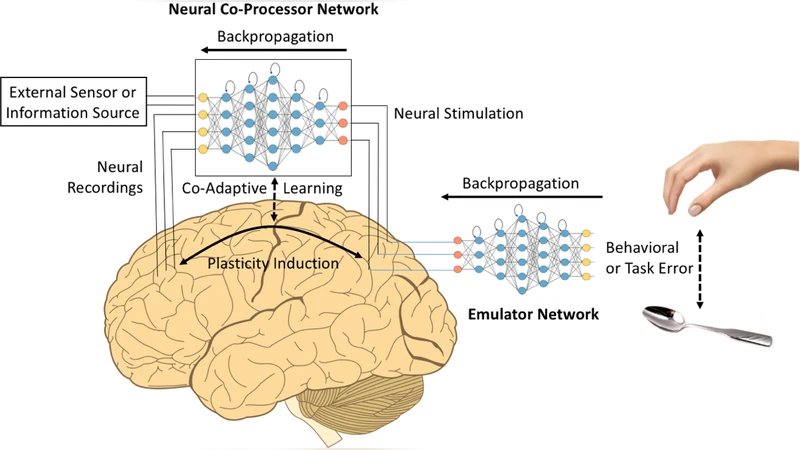
The field of brain-computer interfaces is poised to advance from the traditional goal of controlling prosthetic devices using brain signals to combining neural decoding and encoding within a single neuroprosthetic device. Such a device acts as a “co-processor” for the brain, with applications ranging from inducing Hebbian plasticity for rehabilitation after brain injury to reanimating paralyzed limbs and enhancing memory. We review recent progress in simultaneous decoding and encoding for closed-loop control and plasticity induction. To address the challenge of multi-channel decoding and encoding, we introduce a unifying framework for developing brain co-processors based on artificial neural networks and deep learning. These “neural co-processors” can be used to jointly optimize cost functions with the nervous system to achieve desired behaviors ranging from targeted neuro-rehabilitation to augmentation of brain function.
💡 Research Summary
The paper presents a forward‑looking vision for brain‑computer interfaces (BCIs) that moves beyond the classic one‑way paradigm of decoding neural activity to control an external device. Instead, it proposes a unified “neural co‑processor” that simultaneously decodes brain signals and encodes artificial stimulation, forming a closed‑loop system that can be jointly optimized with the nervous system. The authors argue that such a co‑processor can serve both therapeutic goals—such as inducing Hebbian plasticity for neuro‑rehabilitation after injury—and augmentative goals, including reanimation of paralyzed limbs and enhancement of memory.
Motivation and Background
Traditional BCI research has largely split into two camps. Decoding studies focus on extracting intentions (e.g., motor commands) from neural recordings to drive prosthetic limbs, cursors, or communication devices. Encoding studies, by contrast, deliver patterned electrical, magnetic, or optogenetic stimulation to evoke sensations, suppress pathological activity, or modulate cognition. The separation limits the ability to create a dynamic, bidirectional partnership between brain and machine, especially when long‑term plastic changes are required.
Concept of a Neural Co‑Processor
A neural co‑processor is defined as a single neuroprosthetic device that performs real‑time, multi‑channel decoding and encoding in a tightly coupled feedback loop. The hardware platform combines high‑density electrode arrays (or optogenetic probes) capable of recording from hundreds of sites with stimulation circuitry that can deliver precisely timed pulses to selected channels. The system operates with sub‑10 ms latency, ensuring that decoded intentions and stimulation commands can be aligned within the temporal window needed for spike‑timing‑dependent plasticity.
Deep Learning Framework
Central to the proposal is an artificial neural network (ANN) that maps recorded neural activity to a latent “common representation” and then branches into two output streams: (1) a decoder that predicts the user’s intended behavior and (2) an encoder that generates stimulation parameters. The total loss function is a weighted sum:
\
Comments & Academic Discussion
Loading comments...
Leave a Comment