Data Sharing, Distribution and Updating Using Social Coding Community Github and LaTaX Packages in Graduate Research
Current paper reports the advantages of the application of GitHub and LaTeX for the MSc thesis writing. The existing code-based program implemented in GitHub portal provides a great tool for scientists and students for data sharing and notification of the co-workers, tutors and supervisors involved in research about actual updates. It enables to connect collaborators to share around current results, release datasets and updates and more. Using standard command-line interface GitHub allows registered users to push repositories on the website. The availability of both public and private repositories enables to share current data updates with target audience: e.g. unpublished research work only for co-authors or supervisors, or vice versa. Therefore, there is a need in academic centres and universities to strongly popularize and increase the use of GitHub for student works. The case study is given on the graduate study: an MSc work written and maintained using open source GitHub service at the University of Twente, Faculty of Geo-Information Science and Earth Observation (Netherlands). It reports my successful experience of writing MSc thesis based on the effective combination of LaTeX and GitHub.
💡 Research Summary
The paper presents a practical case study demonstrating how the combined use of GitHub and LaTeX can transform the workflow of a master’s thesis from a traditional, error‑prone MS Word process into a transparent, collaborative, and reproducible research pipeline. After outlining the limitations of word processors—manual renumbering of sections, fragile cross‑references, and cumbersome bibliography handling—the author introduces GitHub’s core capabilities: distributed version control, commit history, diff visualisation, issue tracking, and fine‑grained access control through public and private repositories. These features enable supervisors and co‑authors to monitor progress in near‑real time, comment on specific changes, and retrieve any previous version of the manuscript with a single click.
The LaTeX component is described as a complementary technology that automatically manages hierarchical numbering, cross‑references, and bibliography generation via BibTeX. Because LaTeX compiles the document from source code, any insertion or deletion of figures, tables, or sections triggers an automatic update of all dependent numbers and citations, eliminating the repetitive manual adjustments required in MS Word.
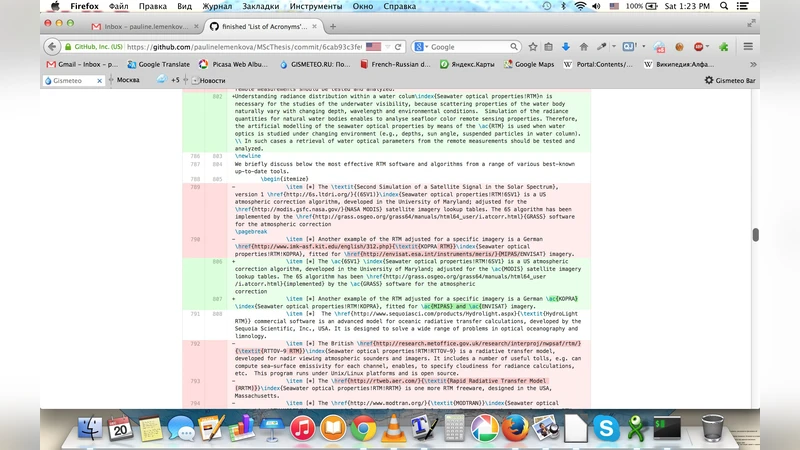
The central case study is the author’s MSc project “Seagrass monitoring and mapping along the coasts of Greece, Crete,” conducted at the University of Twente, Faculty of Geo‑Information Science and Earth Observation. The student created a GitHub repository at the start of the project, committed changes on a weekly basis, and used Pull Requests and Issues to receive feedback from two supervisors. The “git diff” output highlighted added (green) and removed (red) lines, allowing supervisors to quickly assess what had been written or revised since the previous review. GitHub Actions were employed to automatically compile the LaTeX source into a PDF after each push, ensuring that the latest version was always available online.
A comparative analysis shows that the GitHub‑LaTeX workflow reduces the risk of data loss, provides a complete audit trail, and supports both private development (pre‑defense drafts) and public dissemination (post‑defense open access). The paper also discusses the cultural and educational barriers that limit adoption in academia: lack of awareness, perceived steep learning curves, and entrenched reliance on word processors. To address these issues, the author recommends institutional measures such as introductory workshops, step‑by‑step tutorials, and active involvement of faculty in repository management.
In conclusion, the study argues that despite an upfront investment of time to learn Git and LaTeX, the long‑term benefits—enhanced collaboration, reproducibility, automated document management, and cost‑effective open‑source tooling—outweigh the initial hurdles. The author calls for broader integration of these tools into graduate curricula, suggesting that systematic support from universities could make version‑controlled, LaTeX‑based thesis writing the new standard for scientific communication.
Comments & Academic Discussion
Loading comments...
Leave a Comment