Extraire et r{e}utiliser des patrons de conception {`a} partir de Learning Games existants
Learning Games (LGs) are promising pedagogical tools but their design still remains experimental. Inspired by design-pattern based methods, recommended in educational domains, we propose a methodology and a model to analyze the scenario of LGs, which have proven to be effective, in order to extract design patterns. The proposed methodology and model allowed us to extract nine design patterns from the analysis of two LGs, which have been actively used in schools for nearly ten years. These design patterns proved to be very useful because half of them where adopted by teams of designers, in the process of creating LGs, for similar contexts to the ones of the existing LGs.
💡 Research Summary
The paper addresses the persistent challenge of designing Learning Games (LGs), which are inherently multidisciplinary and often rely on ad‑hoc, experimental methods. Inspired by design‑pattern approaches that have proven valuable in software and educational design, the authors propose a systematic methodology and a scenario model—LEGADEE (LEarning GAme DEsign Environment)—to extract reusable design patterns from proven LGs.
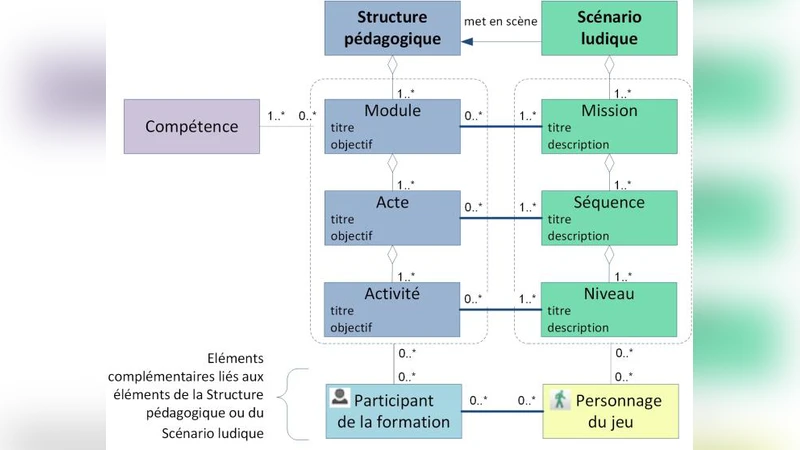
LEGADEE separates pedagogical elements (Modules, Acts, Activities) from ludic elements (Missions, Sequences, Levels) and explicitly models the “staging associations” that link educational objectives, competencies, and participants to concrete game actions. This dual‑layered representation makes it possible to reverse‑engineer existing games, identify recurring mechanisms, and re‑express them as patterns.
The authors applied the model to two long‑standing Jeux Épistémiques Numériques (JENs): Land Science (LS) and Puissance7 (PU). Both have been used for over a decade in secondary and higher‑education contexts. By mapping each game’s full scenario into LEGADEE—annotating titles, descriptions, linked competencies, participants, and teacher roles—the researchers could manually compare the two cases. The analysis revealed seven common mechanisms, to which two additional, game‑specific mechanisms were added, yielding nine design patterns:
- Game Teaser – an introductory hook that raises motivation.
- Multidisciplinary Problems – authentic, complex problems requiring cross‑subject knowledge.
- Personify Experts – avatars that embody professional expertise, allowing learners to adopt expert perspectives.
- Explore Different Solutions – provision of multiple strategies or tools to solve the same problem.
- Teacher as Support – a clearly defined supportive role for the instructor during gameplay.
- Briefing – pre‑game clarification of goals, rules, and context.
- Debriefing – post‑game reflection on actions, outcomes, and learning points.
- Teamwork from Multiple Viewpoints – collaborative tasks that leverage diverse participant perspectives (found in LS).
- Post‑Game Analysis Report – structured documentation of results for further discussion (found in PU).
These patterns were then introduced to design teams working on new LGs with similar educational contexts. The teams reported reduced design time, clearer alignment between learning objectives and game mechanics, and smoother communication between educators and game designers. The authors argue that the pattern‑based approach aligns with User‑Centered Design and Design‑Based Research principles, supporting iterative prototyping and field testing.
The paper also discusses limitations. LEGADEE currently captures static structural information; dynamic aspects such as timing, intensity of competition versus collaboration, and real‑time interaction data are recorded only as free‑text notes. Consequently, automated extraction of patterns from raw game logs remains an open challenge. Moreover, the study’s empirical base is limited to two JENs, raising questions about the generalizability of the nine patterns across other genres, age groups, or subject domains.
Future work is outlined: extending the model to incorporate dynamic interaction attributes, applying the methodology to a broader set of LGs, and developing tooling (e.g., scenario editors, pattern recommendation engines) that can automatically suggest pattern instantiations during the design phase.
In sum, the paper demonstrates that a rigorously defined scenario model combined with a reverse‑engineering methodology can successfully surface reusable design patterns from successful Learning Games. These patterns not only facilitate interdisciplinary collaboration but also improve design efficiency and pedagogical effectiveness, offering a promising pathway toward more systematic, evidence‑based LG development.
Comments & Academic Discussion
Loading comments...
Leave a Comment