Towards an Understanding of Scaling Frameworks and Business Agility: A Summary of the 6th International Workshop at XP2018
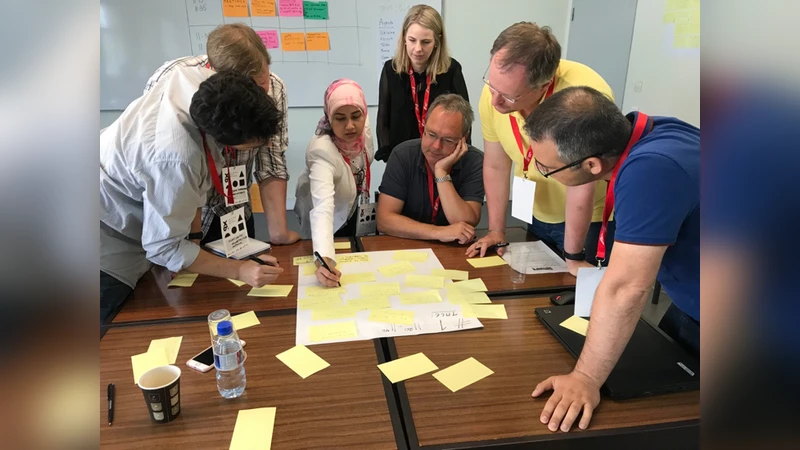
Large development projects and programs are conducted using agile development methods, with an increasing body of advice from practitioners and from research. This sixth workshop showed in increasing interest in scaling frameworks and in topics related to achieving business agility. This article summarizes four contributed papers, discussions in “open space” format and also presents a revised research agenda for large-scale agile development.
💡 Research Summary
The paper provides a comprehensive overview of the 6th International Workshop on Large‑Scale Agile Development held as a half‑day event at XP2018 in Porto. Six submissions were received, and four were selected for presentation. The authors summarize each contribution, the open‑space discussions, and a revised research agenda that reflects the current priorities of both researchers and practitioners.
The first presented paper (Diebold, Schmitt, Theobald) addresses the problem that many scaling frameworks exist but only a few are widely adopted, and there is little guidance on how to choose the most appropriate one. By conducting a literature review and practitioner workshops, the authors identified 25 criteria grouped into four high‑level categories: program structure, flexibility, technical practices, and certification/coaching. They applied these criteria to compare twelve agile scaling frameworks and propose a two‑step selection process: first, use the high‑level categories to narrow down the set of candidates, then conduct a detailed comparison based on the more granular criteria.
The second paper (Stray) investigates coordination in large‑scale agile projects through the lens of “feedback‑based coordination.” A survey of 65 participants from Poland, Norway, and China revealed that agile teams spend on average 1.1 hours per day in scheduled meetings, 1.6 hours in unscheduled meetings, and a total of 13.5 hours per week in coordination activities. Distributed teams tend to be larger than co‑located ones. The author proposes a theory linking scheduled and unscheduled meetings to the value they provide and calls for further empirical validation.
The third contribution (Horlach, Schirmer, Böhmann, Drews) focuses on agile portfolio management. Using a design‑science approach, the authors develop a set of patterns that define processes, methods, roles, and artifacts for managing IT portfolios in organizations composed of highly autonomous agile teams. These patterns aim to enable self‑organizing teams while still meeting regulatory and strategic constraints.
The fourth paper (Santos et al.) tackles the lack of requirements and architectural modeling support in many agile practices. The authors present a systematic transformation method that converts UML use‑case and component diagrams into agile backlog items (themes, epics, user stories). The approach is intended for platform development contexts and supports distributed Scrum teams by modularizing the architecture, refining it, and feeding it into the backlog structure.
The open‑space session generated lively discussions on four topics: (1) Design thinking in large‑scale agile – how to involve designers, architects, and development teams without creating hand‑over problems or overloading developers; (2) Meetings in large‑scale agile – the tension between necessary coordination and meeting overload, criteria for “good” meetings, and the role of technology in supporting them; (3) Enterprise architecture – balancing upfront architecture versus emergent design, the involvement of enterprise architects, and decision‑making authority; (4) Implementing SAFe – perceived complexity, top‑down coordination, cultural resistance, and the conditions under which SAFe adds value versus when lighter practices are preferable.
To close the workshop, participants revisited the 2017 research agenda and, after brainstorming new topics, voted on the three most important research directions. The top‑priority items are: (i) Agile in public/IT government, (ii) Agile transformation, (iii) Business agility, and (iv) Scaling agile. The second tier includes integrating non‑software and software parts (enterprise agile), knowledge sharing and networks, pattern‑based solutions for large‑scale agile problems, and the role of architects. The third tier highlights the impact of DevOps on agile and inter‑team coordination.
In conclusion, the workshop confirms the sustained interest in scaling frameworks while highlighting a shift toward broader business‑agility concerns such as transformation and enterprise‑wide agility. The identified research agenda underscores the need for deeper empirical studies on coordination mechanisms, architectural governance, portfolio management patterns, and the contextual suitability of frameworks like SAFe. The authors acknowledge the support of the Agile 2.0 project, the Research Council of Norway, and several industry partners.
Comments & Academic Discussion
Loading comments...
Leave a Comment