The iEnvironment Platform: Developing an Open Science Software Platform for Integrated Environmental Monitoring and Modeling of Surface Water
This paper describes the development of iEnvironment, an open science software platform that supports monitoring and modeling of aspects of surface water. The platform supports science and engineering research, especially in the context of the creation, sharing, analysis and maintenance of big and open data. In this era of big data, iEnvironment facilitates access to open data resources and research collaboration among science and research disciplines supported by computer scientists and software developers.
💡 Research Summary
The paper presents iEnvironment, an open‑science software platform designed to support integrated monitoring and modeling of surface‑water systems. Recognizing that surface‑water data (quality, quantity, and dynamics) are scattered across governmental agencies, NGOs, and research institutions, the authors argue for a unified infrastructure that enables data discovery, sharing, analysis, and reproducibility. iEnvironment addresses these challenges by providing a web‑based, three‑layer architecture—User Interface, Application, and Data layers—that abstracts the complexities of heterogeneous data sources and high‑performance computing resources.
The background section outlines how the platform leverages national digital infrastructure, particularly Compute Canada’s storage, compute, and cloud services, as well as commercial cloud (AWS). Diverse datasets—including historical climate records, water‑quality measurements, land‑use maps, LiDAR‑derived elevation models, and field observations—are ingested, catalogued with rich metadata, and made accessible through a programmable API that hides the underlying storage and job‑submission mechanisms. This design enables researchers to focus on scientific questions rather than infrastructure management.
The authors describe a suite of research applications that can be built on top of iEnvironment. These range from water‑quality and availability assessments, river‑network information systems, and cumulative‑effects analyses to modules for channel morphology, hydraulic simulations, biodiversity monitoring, and real‑time flood forecasting. Specific case studies include the Community Aquatic Monitoring Program (CAMP), fluvial‑geomorphology investigations using field measurements and numerical simulations, and conservation‑ecology projects examining species populations across wetlands, forests, and riverine habitats.
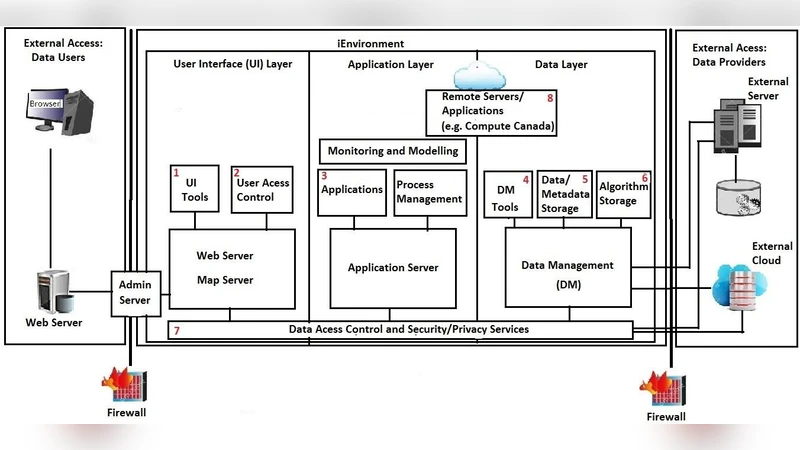
The system architecture is detailed with a high‑level diagram. The User Interface layer comprises web and mapping servers, user‑friendly tools, and an access‑control service that enforces authentication and authorization. The Application layer hosts an application server, monitoring and modeling components (notably the Flow ing Waters Information System, FWIS, and the fifth version of the CANadian W atersh ed Evaluation Tool, CANWET™ 5), and a process‑management module that records provenance information for reproducibility. The Data layer provides data‑management tools, metadata repositories, and connections to external storage services, enabling secure, privacy‑aware data exchange.
iEnvironment is built on the open‑source WIDE (Web Informatics Development Environment) toolkit, ensuring that the codebase is freely available for community contributions. Over fifty partners—including universities, conservation authorities, municipal water‑management agencies, and industry stakeholders—collaborate on the platform, contributing domain‑specific datasets and extending functionality through plug‑ins. Mobile support allows field personnel to enter and view data directly from handheld devices, further promoting real‑time collaboration.
In conclusion, iEnvironment offers a sustainable, extensible environment that lowers barriers for interdisciplinary surface‑water research. By integrating data, models, analysis tools, and provenance tracking within a single framework, it accelerates scientific discovery, supports evidence‑based decision‑making, and facilitates the sharing of best‑practice monitoring and modeling tools. The authors identify future work such as handling real‑time streaming data, automating data‑quality validation, establishing long‑term preservation policies, and aligning with international data standards to broaden the platform’s impact.
Comments & Academic Discussion
Loading comments...
Leave a Comment