3-Colorable Delaunay Triangulations
We propose an algorithm to create a 3-colorable Delaunay Triangulation. The input of the problem we are trying to solve is a set X of n twodimensional points. The output is a 3-colorable two-dimensional Delaunay triangulation T for X U Y , where Y is a set of m new points. We want to m be as few as possible.
💡 Research Summary
The paper addresses the problem of constructing a 3‑colorable Delaunay triangulation for a given set X of n planar points. A triangulation is 3‑colorable exactly when every interior vertex has even degree; such a triangulation is called an Even Delaunay Triangulation (EDT). The authors therefore aim to transform a standard Delaunay triangulation into an EDT while adding as few auxiliary points as possible.
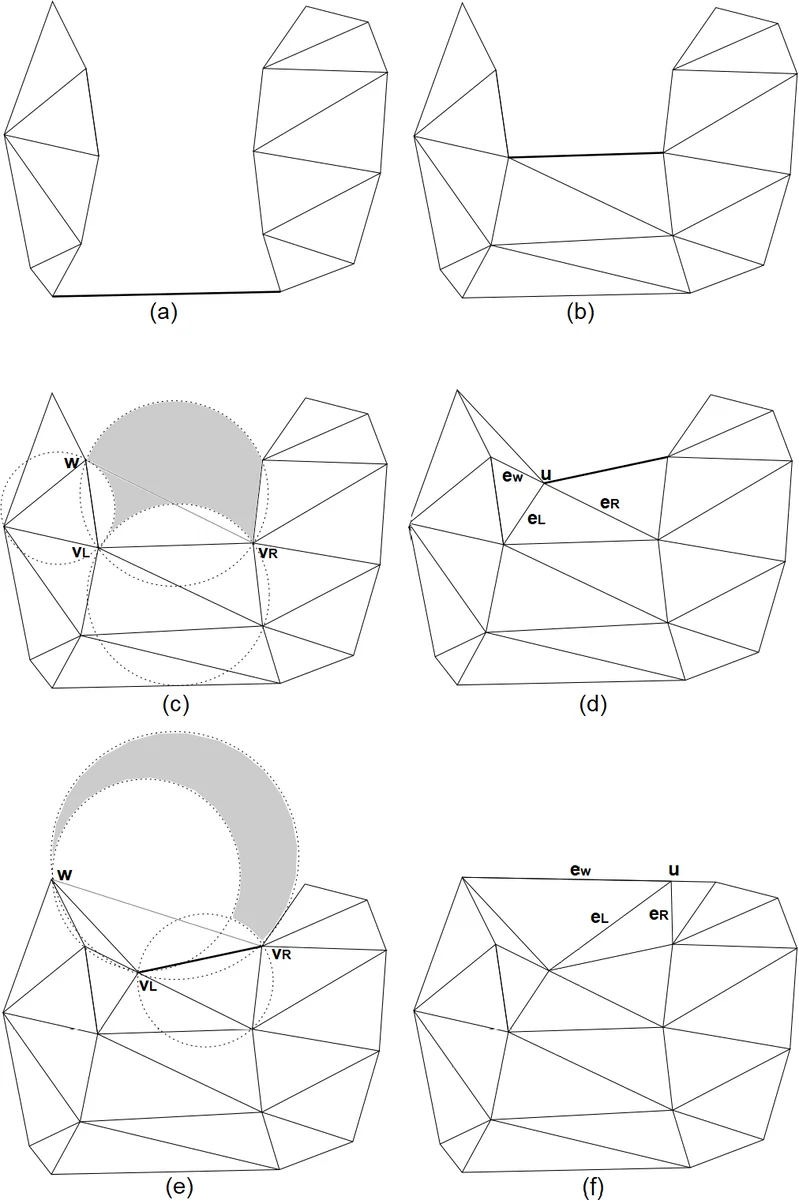
The starting point is the classic divide‑and‑conquer Delaunay algorithm (DQA) by Guibas and Stolfi, which runs in O(n log n). DQA sorts the points by x‑coordinate, groups them into triples (creating trivial triangles or edges), and then recursively merges the sub‑triangulations. The merge procedure builds a lower hull edge eLR between the leftmost vertices of the two sub‑triangulations and repeatedly finds the “next” vertex w that forms a locally Delaunay triangle with the current endpoints. This process yields a Delaunay triangulation of the whole point set.
To enforce even degree, the authors modify the merge step. Whenever the vertex w that would be added lies in the left sub‑triangulation (T_L) and the current left endpoint v_L has odd degree (or symmetrically for the right side), they insert a new auxiliary vertex u together with three edges: e_w (connecting u to w), e_L (connecting u to v_L), and e_R (connecting u to v_R). The new vertex u is placed in a region that guarantees the resulting structure remains an IDT (locally Delaunay). After insertion, the algorithm recursively merges u into the appropriate side (left or right) using a specialized routine Merge_u, which updates the endpoint (v_L or v_R) to u and continues the standard merge loop.
The paper proves two key properties. Lemma 1 shows that a suitable location for u always exists: u can be chosen on the arc of the triangle formed by v_L, v_R, and the current edge eLR, avoiding the interior of the circumcircles that would violate the locally Delaunay condition. Consequently, each insertion preserves the IDT invariant. The authors also argue that the only step that can turn a boundary vertex into an interior vertex is the insertion step, and that this step never creates an odd‑degree interior vertex; thus all interior vertices remain even throughout the algorithm.
However, the authors cannot fully prove that the insertion process terminates after a finite number of steps. They formulate Conjecture 1, stating that the number of times Step 5a’1 (the insertion of u) is executed is bounded for any input. Empirical testing has not produced a counter‑example, but a formal upper bound is missing. If the conjecture holds, DQA’ always produces an EDT; otherwise the algorithm works for all instances examined so far.
The paper concludes with several avenues for future work. Proving Conjecture 1 (or finding a counter‑example) would settle the algorithm’s correctness. If the number of auxiliary points can be bounded by a polynomial in n, the method would be practical for large data sets. Otherwise, the authors suggest a hybrid approach: limit the number of insertions to O(|X|) and then apply the Bueno‑Stolfi 3‑color subdivision algorithm to the remaining odd‑degree vertices, at the cost of slightly degrading the smallest angle guarantee. Such a hybrid would still produce a Delaunay‑compatible triangulation suitable for the GEM data structure, which stores each triangle’s three neighbor pointers indexed by vertex color, eliminating the need for explicit edge orientation.
Overall, the contribution is a novel modification of a classic Delaunay construction that enforces even degree (hence 3‑colorability) by inserting a small number of auxiliary points. While the termination proof remains open, the method offers a promising route to generate 3‑colorable Delaunay triangulations useful in graphics, GIS, and scientific computing where color‑based adjacency queries are advantageous.
Comments & Academic Discussion
Loading comments...
Leave a Comment