Sub-exponential complexity of regular linear CNF formulas
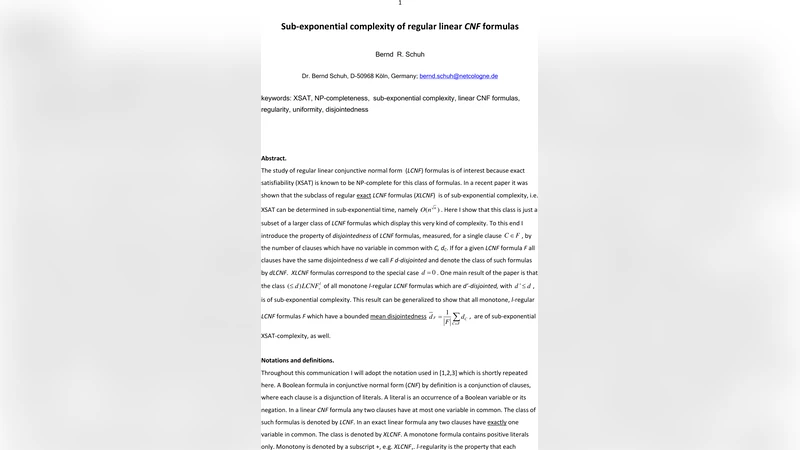
The study of regular linear conjunctive normal form (LCNF) formulas is of interest because exact satisfiability (XSAT) is known to be NP-complete for this class of formulas. In a recent paper it was shown that the subclass of regular exact LCNF formulas (XLCNF) is of sub-exponential complexity, i.e. XSAT can be determined in sub-exponential time. Here I show that this class is just a subset of a larger class of LCNF formulas which display this very kind of complexity. To this end I introduce the property of disjointedness of LCNF formulas, measured, for a single clause C, by the number of clauses which have no variable in common with C. If for a given LCNF formula F all clauses have the same disjointedness d we call F d-disjointed and denote the class of such formulas by dLCNF. XLCNF formulas correspond to the special cased=0. One main result of the paper is that the class of all monotone l-regular LCNF formulas which are d-disjointed, with d smaller than some upper bound D, is of sub-exponential complexity. This result can be generalized to show that all monotone, l-regular LCNF formulas F which have a bounded mean disjointedness, are of sub-exponential XSAT-complexity, as well.
💡 Research Summary
The paper investigates the exact‑satisfiability (XSAT) problem for a broad family of linear conjunctive normal form (LCNF) formulas. An LCNF formula is linear if any two clauses share at most one variable. Earlier work showed that the subclass of exact linear CNF (XLCNF), where every pair of clauses shares exactly one variable, admits a sub‑exponential XSAT algorithm (time (O(n^{O(\log n)}))). The author expands this result by introducing a new structural parameter called disjointedness.
For a clause (C) in an LCNF formula (F), the disjointedness (d_C) is defined as the number of clauses that have no variable in common with (C). If all clauses share the same value (d), the formula is called (d)-disjointed and the class of such formulas is denoted (d)LCNF. The special case (d=0) coincides with XLCNF.
The main technical contributions are three theorems.
-
Theorem 1 proves that for any monotone, (l)-regular (each variable occurs exactly (l) times) and (d)-disjointed LCNF formula, where (d) is a fixed constant, XSAT can be decided in sub‑exponential time (O(n^{O(\log n)})). The proof relies on the observation that any XSAT model corresponds to a selection of exactly (m/l) variables (where (m) is the number of clauses). The number of such selections is bounded by the binomial coefficient (\binom{n}{m/l}). Because (d) and (l) are constant, the relation between (m), the clause length (k), and (d) forces (m/l) to grow only logarithmically with (n), keeping the binomial coefficient sub‑exponential. Enumerating all candidates and checking each clause yields the claimed runtime.
-
Theorem 2 extends the result to the whole family of formulas whose disjointedness value belongs to a bounded set ({0,1,\dots ,D}). The same counting argument applies with (d) replaced by the maximal allowed value (D).
-
Theorem 3 further generalizes to formulas with bounded mean disjointedness (\bar d \le D). Even when individual clauses have different disjointedness values, the average remains limited, which is sufficient to keep the binomial bound sub‑exponential.
Key lemmas establish precise algebraic relations among the number of clauses (m), the number of variables (n), the uniform clause length (k), the regularity parameter (l), and the disjointedness (d). For (l)-regular LCNF, the formula
\
Comments & Academic Discussion
Loading comments...
Leave a Comment