A Software Ecosystem Reshaped by a Paradigm Shift: the CSI-Piemonte Case
Context: Changes in the software development paradigm, when operated by entities with a pivotal role, have the power to affect a number of groups and entities in their sphere of influence, changing both their working habits and relations. Objective: In this paper we present the organizational changes occurred in a software ecosystem as consequence of a technological change. In particular we examine the evolution of an MDD solution and the changing roles of the company promoting it, the public administrations and the sub-contractors. Method: The paper focuses on a single case study that encompasses the six years long evolution of a Model-driven development solution, starting from its conception until is recent open-source release, across five distinct phases. The history was analyzed jointly by software engineering academics and industrial managers directly involved in the case study. Results: A report of the ecosystem evolution from an idiographic perspective is reported. An analysis of the history allowed an abstraction that led to the identification of several distinct ecosystem evolution motifs. Conclusion: The motifs represent a set of key process areas for the evolution of a software ecosystem. They are potentially generalizable to other similar ecosystems. As such, they can be used by researchers to evaluate existing in-progress case studies, and by practitioners as a set of guidelines.
💡 Research Summary
The paper presents an in‑depth case study of the software ecosystem surrounding CSI‑Piemonte, a large public‑sector consortium in Italy, and examines how the introduction of Model‑Driven Development (MDD) reshaped the ecosystem over a five‑year period (2008‑2013). The authors adopt an interpretive, hermeneutic research approach, gathering data through bi‑weekly meetings, workshops, semi‑structured interviews, and document analysis involving both academic researchers and industry practitioners directly involved in the project.
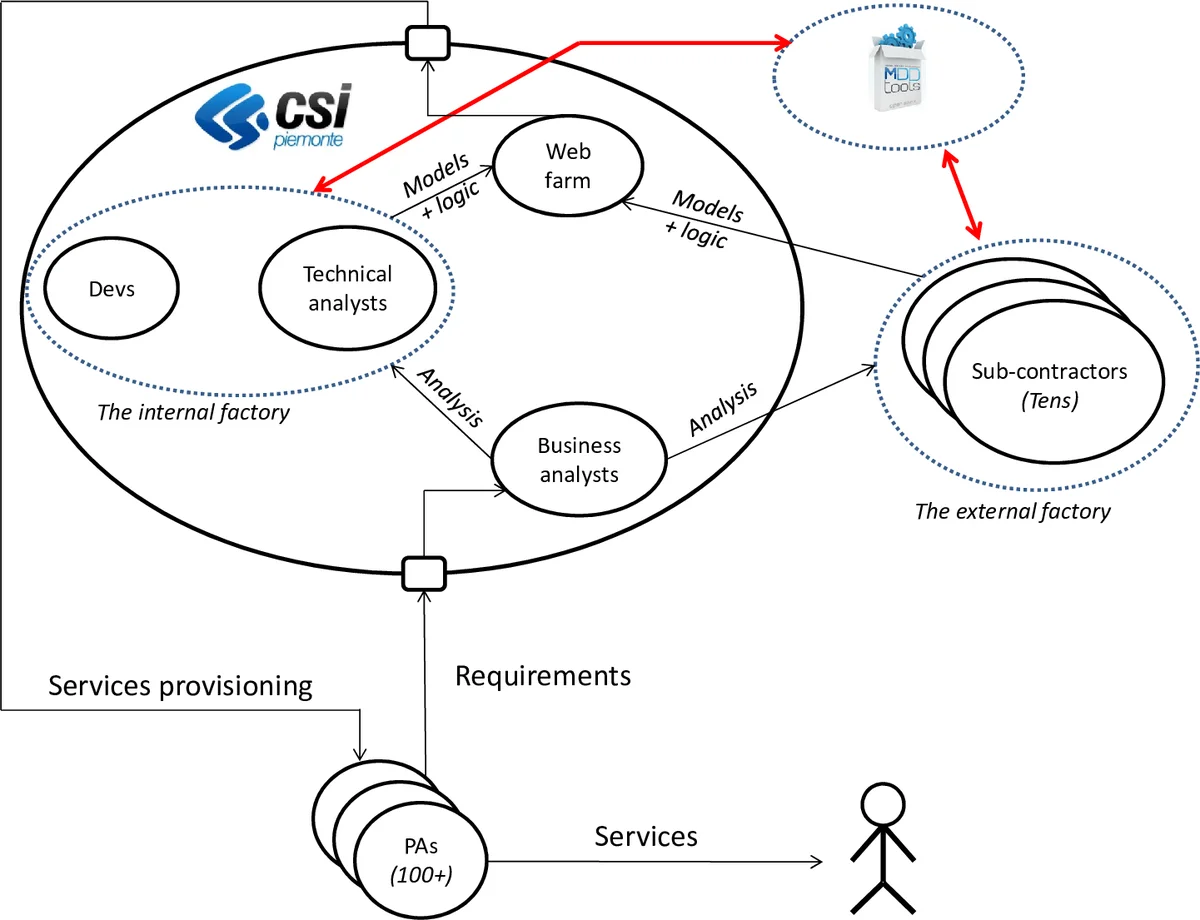
Initially, CSI’s ecosystem operated as a “software factory” governed by the Software Engineering Group (SEG), which imposed strict coding, graphical, and authentication standards on web applications developed for hundreds of public administrations (PAs) and millions of citizens. Development was split between internal staff and external subcontractors, with productivity measured at roughly 15–30 function points per person‑month.
The MDD journey is divided into five distinct eras:
-
Informal (Apr–Jun 2008) – A small group of developers created a prototype tool that automatically generated service skeletons, aiming to reduce copy‑and‑paste errors and speed up project start‑up.
-
Assessment (2008‑2009) – CSI management evaluated the feasibility of scaling MDD enterprise‑wide. Pilot projects were run, and a strategic decision was made to invest in the paradigm.
-
Investment (2010‑2011) – A dedicated model‑versioning infrastructure, IDE integration, documentation, and training programs were built. The tool suite was rolled out across internal development teams, leading to measurable productivity gains and the emergence of a standardized modeling process.
-
Maturity (2012‑2013) – The ecosystem expanded to include external subcontractors who began using the MDD tools for their contracts. A specialized support team was created, and the tool’s adoption became pervasive across the consortium’s many PAs.
-
Community (late 2013) – The MDD suite was released as open‑source software. Responsibility for maintenance, evolution, and community support shifted from the central CSI team to a broader community of subcontractors and third‑party developers, fostering regional MDD competence and reducing central overhead.
From this longitudinal narrative the authors abstract five “ecosystem evolution motifs”:
- Central Catalyst Vision – A strong, strategically aligned central organization (CSI) initiates and funds the paradigm shift.
- Stepwise Diffusion – A staged progression from informal pilot to formal assessment, investment, and enterprise‑wide adoption mitigates risk and builds buy‑in.
- Specialized Support Infrastructure – Dedicated tooling, versioning, and support teams are critical for sustaining adoption.
- Open‑Source Community Transfer – Transitioning ownership to a community creates self‑sustaining momentum and spreads expertise beyond the original organization.
- Sustainable Capability Building – Training, documentation, and the emergence of a local talent pool ensure long‑term viability.
The paper argues that these motifs are not merely descriptive of CSI‑Piemonte but constitute a set of potentially generalizable process areas for other software ecosystems undergoing technological transitions. Researchers can use them as analytical lenses for ongoing case studies, while practitioners can adopt them as practical guidelines for steering similar paradigm shifts. The study highlights the complexity of ecosystem dynamics—inter‑organizational relationships, conflicting goals, and external economic pressures—and underscores that technology alone is insufficient; coordinated governance, investment in people, and community engagement are equally essential for successful transformation.
Comments & Academic Discussion
Loading comments...
Leave a Comment