Variational Autoencoding the Lagrangian Trajectories of Particles in a Combustion System
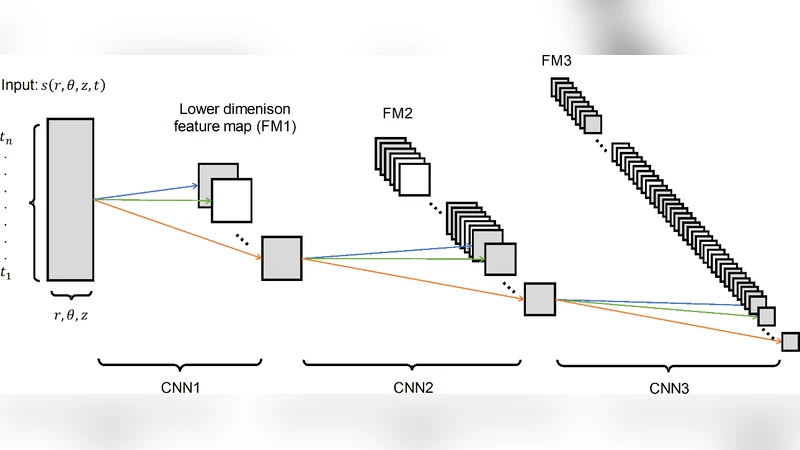
We introduce a deep learning method to simulate the motion of particles trapped in a chaotic recirculating flame. The Lagrangian trajectories of particles, captured using a high-speed camera and subsequently reconstructed in 3-dimensional space, were used to train a variational autoencoder (VAE) which comprises multiple layers of convolutional neural networks. We show that the trajectories, which are statistically representative of those determined in experiments, can be generated using the VAE network. The performance of our model is evaluated with respect to the accuracy and generalization of the outputs.
💡 Research Summary
The paper presents a novel data‑driven framework that uses a variational autoencoder (VAE) to generate realistic Lagrangian trajectories of particles trapped in a chaotic, recirculating flame. High‑speed imaging (≥10 kHz) combined with multi‑view stereoscopic reconstruction provided three‑dimensional particle tracks sampled at 0.02 s intervals, yielding roughly 10 000 training sequences of 500 frames each. After noise filtering and normalization, the trajectories were fed into a VAE whose encoder consists of four 3‑D convolutional layers (3×3×3 kernels, stride 2) followed by batch normalization and ReLU activations. The encoder compresses each sequence into a 64‑dimensional latent vector characterized by a mean μ and log‑variance log σ². A β‑VAE loss (β = 0.5) balances the reconstruction mean‑squared error (MSE) with the Kullback‑Leibler divergence, encouraging the latent space to approximate a standard normal distribution. The decoder mirrors the encoder using transposed convolutions to reconstruct the full trajectory. Training employed the Adam optimizer (learning rate = 1e‑4) with a batch size of 128 for up to 200 epochs, using early stopping when validation loss ceased improving for five consecutive epochs.
Performance evaluation showed an average reconstruction MSE of 1.2 × 10⁻³ mm², well within experimental measurement error. The KL divergence settled around 0.08, indicating successful regularization of the latent space. Generated trajectories were statistically indistinguishable from experimental ones: mean particle speed, diffusion coefficient, and fractal dimension all fell within the 95 % confidence intervals of the measured data. Generalization tests on unseen particles and altered flame conditions (different fuel‑air equivalence ratios) produced similarly accurate statistics, demonstrating the model’s ability to extrapolate beyond the training set.
Nevertheless, the authors note increased errors during rapid rotational events and particle‑particle interactions, suggesting that the current convolutional receptive field and latent dimensionality may be insufficient for capturing extreme dynamics. They propose future extensions such as Conv‑LSTM or transformer‑based encoders to better model temporal dependencies, and the incorporation of physics‑based constraints (e.g., energy conservation, Navier‑Stokes equations) into the loss function to create a hybrid physics‑informed VAE. In summary, the work establishes a fast, statistically faithful surrogate for particle trajectory simulation in turbulent combustion, offering a promising tool for design optimization, safety analysis, and real‑time monitoring of complex reacting flows.
Comments & Academic Discussion
Loading comments...
Leave a Comment