Adaptive Diffusion Processes of Time-Varying Local Information on Networks
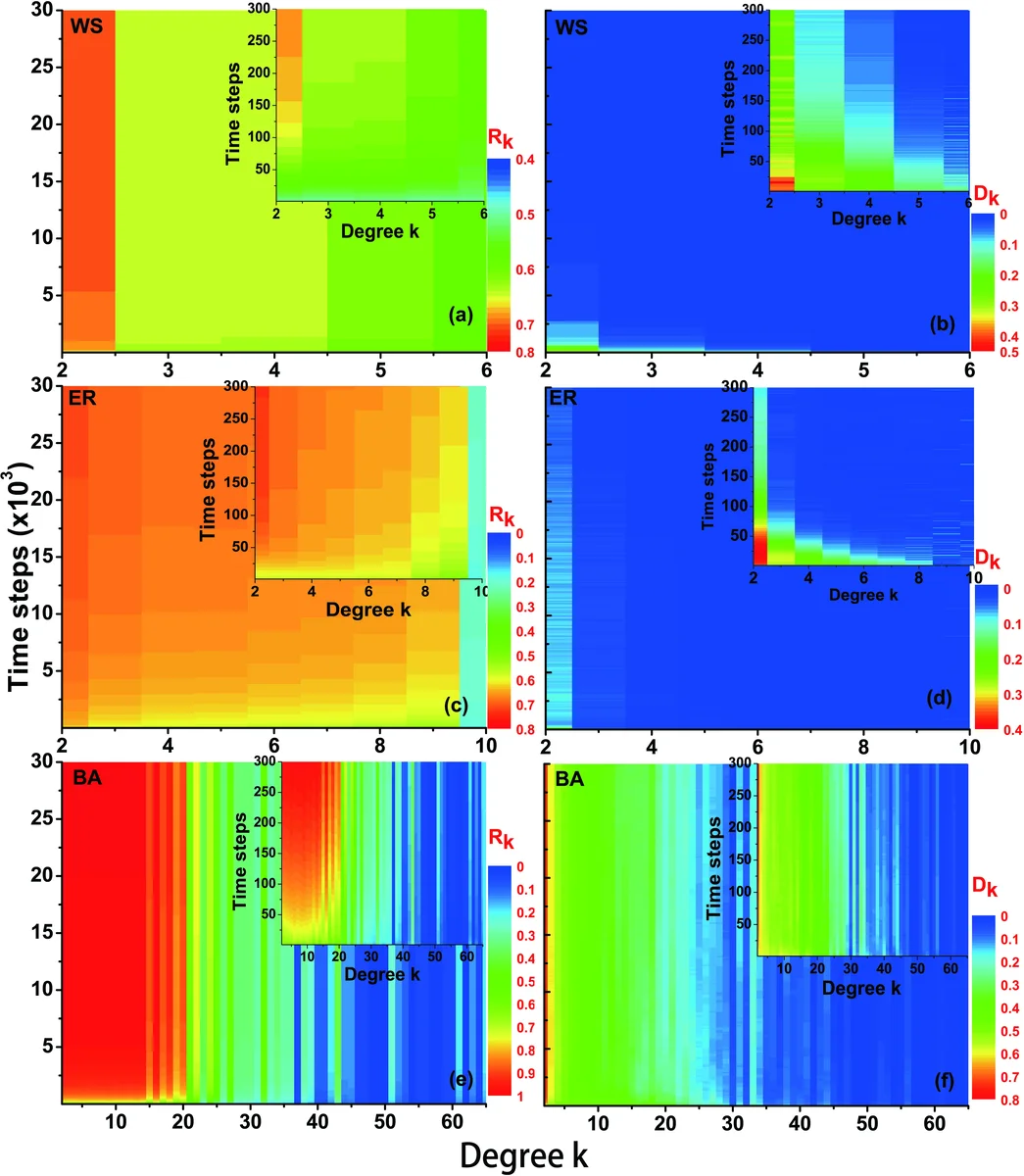
This paper mainly discusses the diffusion on complex networks with time-varying couplings. We propose a model to describe the adaptive diffusion process of local topological and dynamical information, and find that the Barabasi-Albert scale-free network (BA network) is beneficial to the diffusion and leads nodes to arrive at a larger state value than other networks do. The ability of diffusion for a node is related to its own degree. Specifically, nodes with smaller degrees are more likely to change their states and reach larger values, while those with larger degrees tend to stick to their original states. We introduce state entropy to analyze the thermodynamic mechanism of the diffusion process, and interestingly find that this kind of diffusion process is a minimization process of state entropy. We use the inequality constrained optimization method to reveal the restriction function of the minimization and find that it has the same form as the Gibbs free energy. The thermodynamical concept allows us to understand dynamical processes on complex networks from a brand-new perspective. The result provides a convenient means of optimizing relevant dynamical processes on practical circuits as well as related complex systems.
💡 Research Summary
The paper introduces an adaptive diffusion model on complex networks in which the coupling strength between nodes varies dynamically according to local topological and dynamical information. Each node i possesses a state variable x_i∈
Comments & Academic Discussion
Loading comments...
Leave a Comment