Tetris
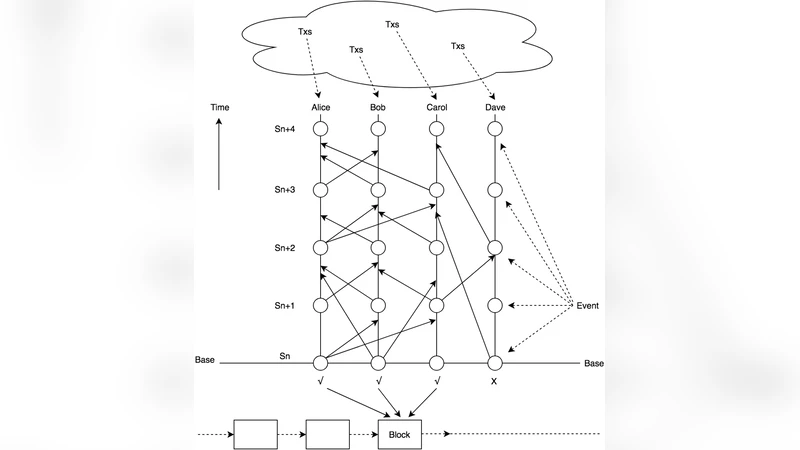
Tetris is an Asynchronous Byzantine Fault Tolerance consensus algorithm designed for next generation high-throughput permission and permissionless blockchain. The core concept of Tetris is derived from Reasoning About Knowledge, which we believe to be the most appropriate tools for revealing and analyzing the fundamental complexity of distributed systems. By analyzing the states of knowledge that each participant attained in an unreliable system, we can capture some of the basis underlying structure of the system, then help us designing effective & efficient protocols. Plus the adoption of Full Information Protocol (FIP) with the optimized message traffic model, Tetris has finally got high performance, with proved safety. Tetris achieve consensus finality in seconds, means transactions can be confirmed greatly faster than other scheme like Pow/Dpos. Tetris also achieve fairness, which is critically important in some areas such as stock market etc.
💡 Research Summary
The paper introduces “Tetris,” an asynchronous Byzantine Fault Tolerant (BFT) consensus protocol designed for high‑throughput permissioned and permissionless blockchains. Its novelty lies in grounding the design on formal reasoning about knowledge: each node’s local history is treated as its knowledge, and the protocol seeks to elevate this to various levels of group knowledge (distributed, common, and weaker variants) to achieve agreement. To make the knowledge‑centric approach practical, the authors adopt a Full‑Information Protocol (FIP) but mitigate the traditionally prohibitive bandwidth cost by compressing state information with hash chains and employing a push/pull traffic model. The system model assumes an asynchronous network with authenticated channels, eventual message delivery, and at most one‑third Byzantine nodes. The paper formally defines local states, actions, events, the “happens‑before” relation, and consistent cuts, then introduces epistemic operators (K_i, E_G, etc.) to describe knowledge propagation. The consensus algorithm targets binary Byzantine agreement, satisfying validity, agreement, and termination. A decision function consumes a node’s consistent local history and decides once a predefined epistemic condition (e.g., k‑level common knowledge) is met. For permissionless settings, node selection and rotation are delegated to an upper‑level “plug‑in” protocol, allowing the BFT core to remain unchanged. The authors claim seconds‑level finality and fairness in transaction ordering, positioning Tetris as faster than PoW or PoS‑based schemes. However, the manuscript lacks concrete protocol pseudocode, detailed message formats, and quantitative performance evaluation. The bandwidth reduction claim is not rigorously proved, and the impact of network adversaries that manipulate topology or delay messages is not thoroughly analyzed. In summary, while the knowledge‑based theoretical framework is compelling, the paper falls short on practical implementation details and empirical validation needed to assess Tetris’s real‑world viability.
Comments & Academic Discussion
Loading comments...
Leave a Comment