Randomness and Differentiability
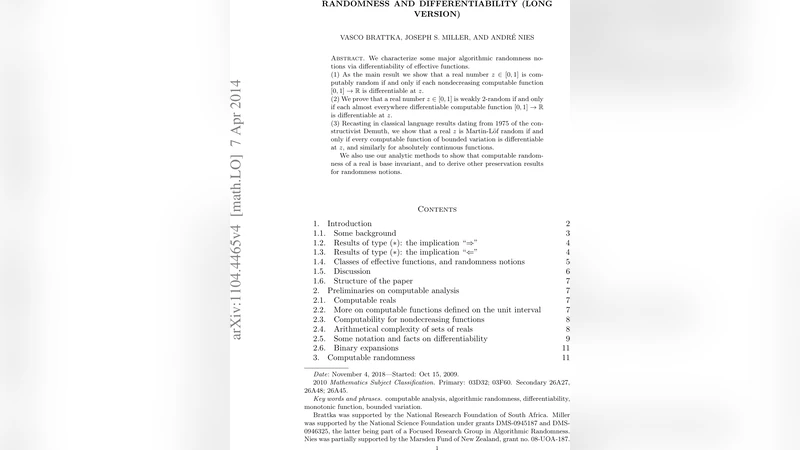
We characterize some major algorithmic randomness notions via differentiability of effective functions. (1) As the main result we show that a real number z in [0,1] is computably random if and only if each nondecreasing computable function [0,1]->R is differentiable at z. (2) We prove that a real number z in [0,1] is weakly 2-random if and only if each almost everywhere differentiable computable function [0,1]->R is differentiable at z. (3) Recasting in classical language results dating from 1975 of the constructivist Demuth, we show that a real z is ML random if and only if every computable function of bounded variation is differentiable at z, and similarly for absolutely continuous functions. We also use our analytic methods to show that computable randomness of a real is base invariant, and to derive other preservation results for randomness notions.
💡 Research Summary
This paper establishes a precise correspondence between major notions of algorithmic randomness and differentiability properties of effective real functions on the unit interval. The authors focus on four randomness notions—Martin‑Löf randomness, computable randomness, weak 2‑randomness, and Schnorr randomness—and identify natural classes of computable functions such that a real number z satisfies the randomness notion if and only if every function in the associated class is differentiable at z.
The main results are threefold. First, they prove that a real z ∈
Comments & Academic Discussion
Loading comments...
Leave a Comment