Peer-to-Peer Electricity Market Analysis: From Variational to Generalized Nash Equilibrium
We consider a network of prosumers involved in peer-to-peer energy exchanges, with differentiation price preferences on the trades with their neighbors, and we analyze two market designs: (i) a centralized market, used as a benchmark, where a global market operator optimizes the flows (trades) between the nodes, local demand and flexibility activation to maximize the system overall social welfare; (ii) a distributed peer-to-peer market design where prosumers in local energy communities optimize selfishly their trades, demand, and flexibility activation. We first characterizethe solution of the peer-to-peer market as a Variational Equilibrium and prove that the set of Variational Equilibria coincides with the set of social welfare optimal solutions of market design (i). We give several results that help understanding the structure of the trades at an equilibriumor at the optimum. We characterize the impact of preferences on the network line congestion and renewable energy waste under both designs. We provide a reduced example for which we give the set of all possible generalized equilibria, which enables to give an approximation of the price ofanarchy. We provide a more realistic example which relies on the IEEE 14-bus network, for which we can simulate the trades under different preference prices. Our analysis shows in particular that the preferences have a large impact on the structure of the trades, but that one equilibrium(variational) is optimal.
💡 Research Summary
The paper investigates two designs for electricity trading among prosumers: a centralized benchmark market that maximizes overall social welfare, and a decentralized peer‑to‑peer (P2P) market where each prosumer selfishly optimizes its own demand, flexibility activation, and bilateral trades. The authors first model the P2P market as a non‑cooperative game and introduce the concept of a Variational Equilibrium (VE), which assumes that all agents share the same valuation of bilateral trade prices. They prove that the set of VEs coincides exactly with the set of socially optimal solutions of the centralized market, meaning that when price preferences are homogeneous the decentralized market achieves the same efficiency as a fully coordinated system.
In realistic settings, agents have heterogeneous price preferences (captured by differentiation prices δ_nm) and may possess asymmetric information. Under these conditions the market may settle at a Generalized Nash Equilibrium (GNE), where each agent’s feasible set depends on the strategies of others through shared network constraints and price discrepancies. The paper characterizes the existence of GNEs, derives the KKT conditions, and shows how GNE outcomes can deviate from the VE, leading to efficiency loss. This loss is quantified by the Price of Anarchy (PoA), defined as the ratio between the worst‑case GNE social welfare and the optimal welfare.
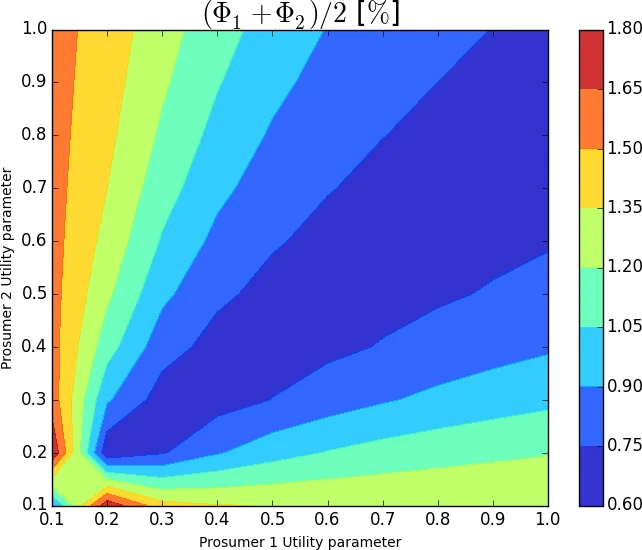
Analytical results reveal that higher differentiation prices drive agents to trade preferentially with nearby neighbors, reducing line congestion but potentially increasing renewable energy curtailment because excess generation cannot be transferred to distant nodes. The authors illustrate these effects with two case studies: a three‑node toy network, where all possible GNEs are enumerated and PoA is computed exactly, and the IEEE‑14‑bus system, where simulations under various δ_nm configurations show PoA values ranging from near‑unity up to 1.5, depending on the degree of preference heterogeneity.
The paper also addresses privacy concerns. When prosumers conceal their demand and renewable generation forecasts (modeled as stochastic errors with variances σ_D and σ_G), the information asymmetry limits the ability to achieve VE, resulting in a bounded reduction of social welfare. An analytical upper bound on this welfare loss is derived and validated on the toy network, showing a modest loss (≈5 %).
Overall, the work provides a rigorous game‑theoretic foundation linking decentralized P2P electricity markets to classical welfare‑maximizing optimization, quantifies the impact of heterogeneous price preferences and privacy on network congestion, renewable curtailment, and efficiency, and offers concrete metrics (VE, GNE, PoA) that can guide the design of future peer‑to‑peer energy trading platforms.
Comments & Academic Discussion
Loading comments...
Leave a Comment