Closing the gap between software engineering education and industrial needs
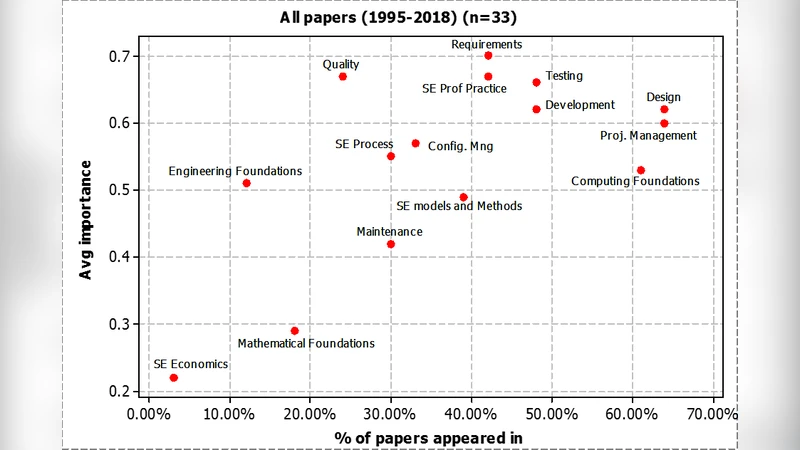
According to different reports, many recent software engineering graduates often face difficulties when beginning their professional careers, due to misalignment of the skills learnt in their university education with what is needed in industry. To address that need, many studies have been conducted to align software engineering education with industry needs. To synthesize that body of knowledge, we present in this paper a systematic literature review (SLR) which summarizes the findings of 33 studies in this area. By doing a meta-analysis of all those studies and using data from 12 countries and over 4,000 data points, this study will enable educators and hiring managers to adapt their education / hiring efforts to best prepare the software engineering workforce.
💡 Research Summary
This paper addresses the persistent mismatch between university‑taught software engineering competencies and the skills demanded by industry. By conducting a systematic literature review (SLR) of 33 peer‑reviewed studies spanning twelve countries and encompassing more than 4,000 individual data points, the authors provide a comprehensive meta‑analysis of the current state of software engineering education versus industrial needs.
The methodology follows established SLR protocols: a multi‑database search (IEEE Xplore, ACM Digital Library, Scopus, Web of Science, Google Scholar) using keywords such as “software engineering education,” “industry needs,” and “skill gap.” Inclusion criteria required empirical evidence (surveys, interviews, case studies) with a minimum sample size of 30, a focus on comparing educational outcomes with industry expectations, and publication after 2010. After duplicate removal and quality appraisal, 33 studies remained for analysis. Data extraction captured curriculum content, reported industry skill requirements, geographic context, and research methods.
A random‑effects meta‑analysis was performed on standardized importance scores for each competency. The results reveal three major patterns. First, technical competencies most frequently cited as lacking are data structures and algorithms, software design/architecture, and test automation/continuous integration‑continuous deployment (CI/CD). Notably, experience with modern cloud, container, and DevOps toolchains is consistently low among graduates. Second, soft‑skill deficits are pronounced: teamwork and agile process understanding, problem‑solving/critical‑thinking, and customer/ stakeholder communication are repeatedly reported as insufficiently covered in curricula. Third, regional differences emerge: North America and Western Europe prioritize advanced technology stacks (micro‑services, DevOps), whereas Asia‑Latin America regions emphasize foundational programming and project‑management abilities.
Based on these findings, the authors propose four actionable recommendations for educators and hiring managers. (1) Integrate industry‑linked, project‑based learning modules that expose students to real development pipelines and contemporary tools. (2) Offer dedicated soft‑skill workshops or simulations, with clear assessment rubrics, separate from core technical courses. (3) Establish continuous curriculum co‑development partnerships between universities and industry partners to keep course content aligned with evolving technology trends. (4) Design region‑specific educational roadmaps that balance global competency standards with local market demands.
The paper acknowledges limitations, including reliance on self‑reported survey data and under‑representation of certain regions (e.g., Africa, the Middle East), which may affect the generalizability of the conclusions. Future research directions include longitudinal studies linking educational interventions to actual hiring outcomes, the development of AI‑driven personalized learning platforms for skill‑gap mitigation, and policy‑focused investigations that evaluate the impact of curriculum reforms on workforce readiness.
In conclusion, the systematic synthesis demonstrates that while technical knowledge gaps persist, the most critical deficiencies lie in the integration of modern development practices and soft‑skill development. By adopting the proposed evidence‑based strategies, academic institutions and industry can collaboratively narrow the gap, improve early‑career performance of software engineers, and ultimately enhance the competitiveness of the global software development workforce.
Comments & Academic Discussion
Loading comments...
Leave a Comment