A-Optimal Sampling and Robust Reconstruction for Graph Signals via Truncated Neumann Series
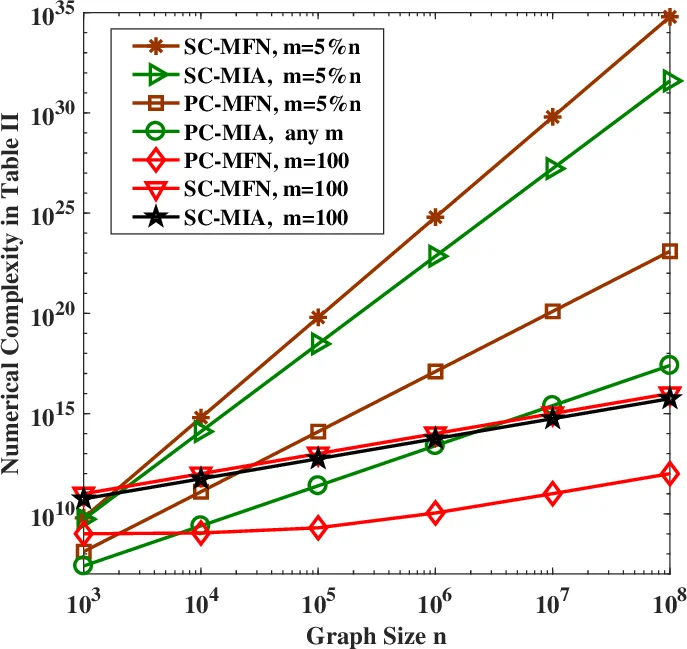
Graph signal processing (GSP) studies signals that live on irregular data kernels described by graphs. One fundamental problem in GSP is sampling—from which subset of graph nodes to collect samples in order to reconstruct a bandlimited graph signal in high fidelity. In this paper, we seek a sampling strategy that minimizes the mean square error (MSE) of the reconstructed bandlimited graph signals assuming an independent and identically distributed (iid) noise model—leading naturally to the A-optimal design criterion. To avoid matrix inversion, we first prove that the inverse of the information matrix in the A-optimal criterion is equivalent to a Neumann matrix series. We then transform the truncated Neumann series based sampling problem into an equivalent expression that replaces eigenvectors of the Laplacian operator with a sub-matrix of an ideal low-pass graph filter. Finally, we approximate the ideal filter using a Chebyshev matrix polynomial. We design a greedy algorithm to iteratively minimize the simplified objective. For signal reconstruction, we propose an accompanied signal reconstruction strategy that reuses the approximated filter sub-matrix and is provably more robust than conventional least square recovery. Simulation results show that our sampling strategy outperforms two previous strategies in MSE performance at comparable complexity.
💡 Research Summary
The paper addresses the fundamental problem of sampling graph‑structured data for the purpose of reconstructing band‑limited graph signals with high fidelity. While many existing works focus on random node selection, spectral proxies, or E‑optimal designs that minimize worst‑case error, none directly target the average mean‑square error (MSE) that arises under an independent and identically distributed (i.i.d.) noise model. The authors therefore adopt the A‑optimal design criterion, which is equivalent to minimizing the trace of the inverse information matrix and, under i.i.d. noise, coincides with the minimum‑MSE (MMSE) objective.
A direct implementation of the A‑optimal criterion would require computing the inverse of ((C V_K)^{!T} C V_K), where (C) is the sampling matrix and (V_K) contains the first (K) eigenvectors of the graph Laplacian. This inverse has cubic complexity in the number of vertices, making it impractical for large graphs. To circumvent this, the authors first prove that the inverse can be expressed as an infinite Neumann series: \
Comments & Academic Discussion
Loading comments...
Leave a Comment