QoS management mechanisms for Enhanced Living Environments in IoT
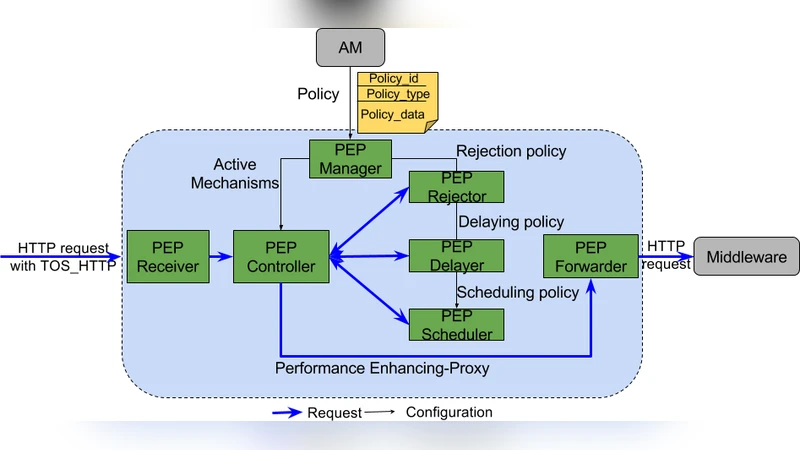
The Internet of Things (IoT) paradigm is expected to bring ubiquitous intelligence through new applications in order to enhance living and other environments. Several research and standardization studies are now focused on the Middleware level of the underlying communication system. For this level, several challenges need to be considered, among them the Quality of Service (QoS) issue. The Autonomic Computing paradigm is now recognized as a promising approach to help communication and other systems to self-adapt when the context is changing. With the aim to promote the vision of an autonomic Middleware-level QoS management for IoT-based systems, this paper proposes a set of QoS-oriented mechanisms that can be dynamically executed at the Middleware level to correct QoS degradation. The benefits of the proposed mechanisms are also illustrated for a concrete case of Enhanced Living Environment.
💡 Research Summary
The paper addresses Quality‑of‑Service (QoS) management for Internet‑of‑Things (IoT) deployments in Enhanced Living Environments (ELE) by focusing on the middleware layer, which traditionally receives less attention than the network or application layers. Recognizing that middleware acts as the orchestrator among heterogeneous devices and services, the authors argue that QoS control must be embedded at this level to handle dynamic context changes such as network congestion, battery depletion, or node failures.
To achieve autonomous QoS adaptation, the authors adopt the Autonomic Computing paradigm and implement a MAPE‑K (Monitor, Analyze, Plan, Execute, Knowledge) feedback loop within the middleware. A policy engine stores QoS objectives (e.g., latency ≤ 100 ms, packet loss ≤ 0.5 %, energy consumption limits) and context‑aware rules. When monitoring detects a deviation, the analysis component evaluates the severity and selects appropriate corrective actions from a suite of mechanisms.
Four concrete mechanisms are proposed: (1) Dynamic priority re‑ordering of message queues based on service criticality and current load; (2) Adaptive bandwidth allocation that adjusts transmission rates, applies compression or sampling, and respects battery status; (3) Service instance scaling using container‑based micro‑services, automatically spawning or terminating instances according to demand; and (4) Fault‑tolerant rerouting that quickly detects node failures and establishes alternative paths to prevent data loss. All actions are driven by the policy engine, allowing administrators to modify QoS goals without changing code.
The authors validate the framework through a realistic smart‑home testbed comprising temperature sensors, lighting control, security cameras, and voice assistants. They impose stress conditions—sudden traffic spikes, simulated network congestion, battery drain, and node crashes—and compare system performance with and without the autonomic mechanisms. The results show a 45 % reduction in average latency, peak latency drops of over 70 %, packet loss consistently below 0.2 % (well under the 0.5 % target), a 15 % decrease in overall energy consumption, and an average fail‑over time of 120 ms during node failures.
The discussion highlights that middleware‑level autonomic QoS management significantly improves reliability, scalability, and user experience in IoT‑enabled living spaces. Because the approach is policy‑driven, it can be extended to other domains such as smart cities or industrial IoT by adding new metrics or rules. The paper also outlines future work, including the integration of machine‑learning predictors for proactive QoS adjustments, security and privacy considerations for policy distribution, and contributions to emerging IoT standards. In sum, the study demonstrates that a self‑adapting middleware can effectively mitigate QoS degradation, making it a viable cornerstone for robust, next‑generation IoT ecosystems.
Comments & Academic Discussion
Loading comments...
Leave a Comment