Enhancing Middleware-based IoT Applications through Run-Time Pluggable QoS Management Mechanisms. Application to a oneM2M compliant IoT Middleware
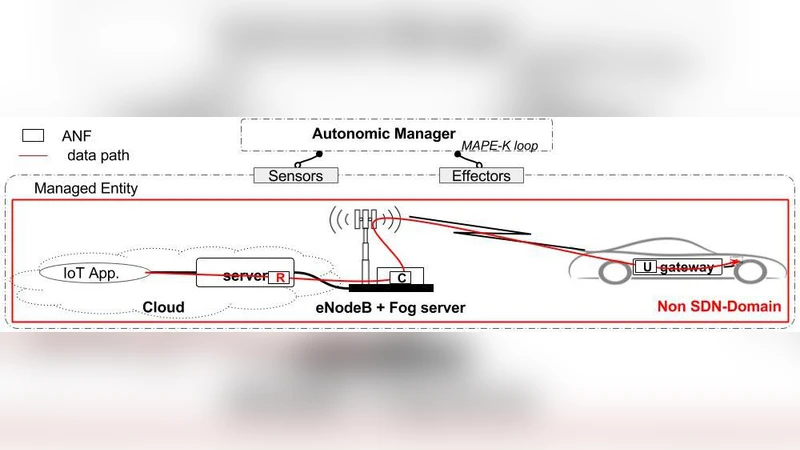
In the recent years, telecom and computer networks have witnessed new concepts and technologies through Network Function Virtualization (NFV) and Software-Defined Networking (SDN). SDN, which allows applications to have a control over the network, and NFV, which allows deploying network functions in virtualized environments, are two paradigms that are increasingly used for the Internet of Things (IoT). This Internet (IoT) brings the promise to interconnect billions of devices in the next few years rises several scientific challenges in particular those of the satisfaction of the quality of service (QoS) required by the IoT applications. In order to address this problem, we have identified two bottlenecks with respect to the QoS: the traversed networks and the intermediate entities that allows the application to interact with the IoT devices. In this paper, we first present an innovative vision of a “network function” with respect to their deployment and runtime environment. Then, we describe our general approach of a solution that consists in the dynamic, autonomous, and seamless deployment of QoS management mechanisms. We also describe the requirements for the implementation of such approach. Finally, we present a redirection mechanism, implemented as a network function, allowing the seamless control of the data path of a given middleware traffic. This mechanism is assessed through a use case related to vehicular transportation.
💡 Research Summary
The paper addresses the growing challenge of guaranteeing Quality of Service (QoS) for Internet‑of‑Things (IoT) applications that must operate over heterogeneous networks and middleware layers. The authors identify two principal bottlenecks: (1) the underlying IP networks that interconnect devices and services, and (2) the middleware nodes (gateways, servers) that mediate communication between applications and IoT objects. While Network Function Virtualization (NFV) and Software‑Defined Networking (SDN) have been proposed to make the network more programmable, existing solutions either place QoS functions only in the network or embed static QoS modules inside middleware, which limits flexibility, especially in non‑SDN (legacy) environments.
To overcome these limitations, the authors introduce the concept of a Dematerialized Network Function (DNF). A DNF generalizes the ETSI notion of a Virtual Network Function (VNF) to include not only VNFs but also Physical Network Functions (PNFs) and Application Network Functions (ANFs)—executable modules that can be deployed on any host, including simple laptops or OSGi‑based middleware components. This abstraction enables QoS mechanisms to be placed anywhere along the communication stack, from the application layer down to the transport layer.
The paper’s core contribution is a runtime‑pluggable, autonomous QoS management framework built on the Autonomic Computing (AC) MAPE‑K loop (Monitor, Analyze, Plan, Execute, Knowledge). Sensors continuously collect QoS metrics (e.g., round‑trip time, packet loss). When a deviation from the service‑level agreement is detected, the analysis component evaluates the current network and resource state against the application’s QoS requirements. The planning component selects appropriate DNFs (such as traffic shapers, droppers, or load balancers) and decides where they should be instantiated. Execution is performed by dynamically loading or unloading OSGi bundles in the Eclipse OM2M middleware, which serves as the experimental platform. The Knowledge base stores policies, models, and rules that guide the decision‑making process.
A particularly novel element is the redirection ANF, designed to work even when the underlying network is not SDN‑enabled. In SDN, traffic redirection can be achieved by installing OpenFlow rules on switches; however, in legacy networks this is impossible. The redirection ANF acts as an adapter within the middleware: it intercepts RESTful requests, rewrites target URLs, and forwards them to a proxy node where a QoS‑oriented DNF (e.g., a traffic shaper) resides. This approach achieves seamless traffic rerouting without interrupting the application or requiring changes to the network infrastructure.
The authors validate their approach with a vehicular transportation use case. A navigation application streams 3D map data to a moving vehicle over cellular networks. As the vehicle moves, radio conditions fluctuate, causing increased latency and packet loss. The autonomic manager detects the QoS degradation, triggers the redirection ANF, and dynamically inserts a traffic‑shaping DNF on a proxy server. Experiments show a reduction of average round‑trip time by roughly 30 % and a noticeable decrease in packet loss, all without restarting the application or modifying the underlying network.
Key contributions of the paper are:
- Definition of the DNF abstraction that unifies PNF, VNF, and ANF, extending programmable network functions to the middleware layer.
- Design of an autonomic, MAPE‑K‑based framework for dynamic QoS management across heterogeneous deployment environments.
- Implementation of a middleware‑level redirection mechanism (ANF) that works in both SDN and non‑SDN networks, enabling seamless traffic rerouting.
- Empirical validation in a realistic vehicular scenario, demonstrating tangible QoS improvements and the feasibility of runtime‑pluggable QoS functions.
Overall, the work demonstrates that by treating middleware components as first‑class network functions and by leveraging autonomic computing principles, IoT systems can achieve adaptive, fine‑grained QoS control even in legacy network settings, paving the way for more reliable and responsive IoT services.
Comments & Academic Discussion
Loading comments...
Leave a Comment