An Internet of Things Oriented Approach for Water Utility Monitoring and Control
This paper aims to propose a more efficient distributed monitoring and control approach for water utility in order to reduce the current water loss. This approach will help utilities operators improve water management systems, especially by exploiting the emerging technologies. The Internet of Things could prove to be one of the most important methods for developing more utility-proper systems and for making the consumption of water resources more efficient.
💡 Research Summary
The paper addresses the growing challenge of water loss and increasing demand in urban areas by proposing a distributed, Internet‑of‑Things (IoT) oriented architecture for water utility monitoring and control. It begins with a clear distinction between supply‑oriented and demand‑oriented strategies, emphasizing that, given the diminishing availability of water resources, a demand‑oriented approach—optimizing the use of existing supplies—is essential. The authors critique current SCADA‑based systems, noting that while they provide hierarchical control (field devices, process control, management, ERP), they suffer from severe interoperability problems due to proprietary protocols, heterogeneous hardware, and semi‑closed solutions.
To overcome these limitations, the authors integrate three enabling technologies: IoT, Radio‑Frequency Identification (RFID), and multi‑agent systems. IoT is defined as a global network of uniquely addressable “things” that can exchange data autonomously. The paper stresses the need for ubiquitous connectivity, global identification, and standardized communication protocols. RFID is presented as a low‑cost, power‑efficient method for uniquely identifying every physical asset in the water distribution network—pipes, valves, meters, and sensors. By attaching passive or semi‑passive RFID tags, the system can identify devices even in harsh environments without continuous power, and RFID‑sensor fusion expands the range of measurable parameters.
Multi‑agent technology is introduced to manage the massive, geographically dispersed set of devices. Each physical entity is mapped to a software agent capable of autonomous decision‑making, parallel execution, dynamic instantiation, and secure communication. This agent‑centric view provides high performance, flexibility, modularity, and resilience: a failed agent can be replaced without disrupting the whole system, and decentralized control reduces vulnerability to attacks.
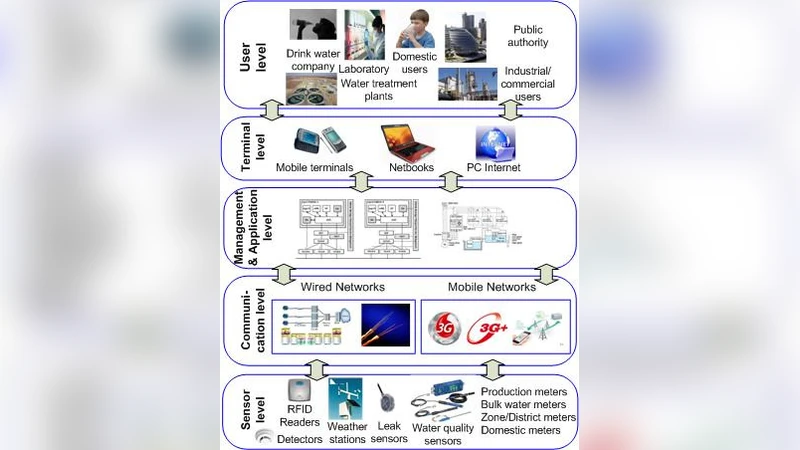
The proposed architecture is organized into five layers:
- Sensor Level – Field sensors and actuators, some equipped with embedded computing and communication capabilities. Local logic can trigger actions based on sensed conditions.
- Communication Level – Both wired (xDSL, optical fiber) and wireless (3G/4G, GPRS) links, with emphasis on encryption and privacy.
- Management & Application Level – Middleware, data storage, analytics, and water‑specific applications such as consumption estimation, leak detection, and billing. Multi‑agent frameworks operate here to coordinate data exchange and decision‑making.
- Terminal Level – Devices used by operators, technicians, and customer service staff (PCs, tablets, mobile phones).
- User Level – End‑users access real‑time consumption data, receive alerts, and participate in conservation programs via web or mobile portals.
A key innovation is the dual‑mode operation of “passive” (RFID‑only identification) and “active” (full Internet connectivity). Existing non‑connected meters can be retrofitted with RFID tags; gateway devices then read these tags and publish the data to the IoT platform, enabling a gradual migration toward full connectivity.
The paper also discusses extending the solution to sewer systems, particularly combined sewers that overflow during heavy rain. Real‑time capacity monitoring and citizen notifications can mitigate flooding and promote water‑saving behavior during droughts.
System requirements identified include real‑time response, scalability, continuous connectivity, support for dynamic environments, and robust security. The authors argue that the multi‑agent, IoT‑centric design satisfies these criteria while preserving compatibility with legacy SCADA components.
In conclusion, the study provides a comprehensive roadmap for modernizing water utilities: leveraging inexpensive RFID for unique asset identification, employing standardized IoT protocols for seamless data flow, and orchestrating autonomous agents for resilient, scalable control. This integrated approach promises reduced water loss, improved operational efficiency, and enhanced interaction with consumers, positioning IoT as a pivotal technology in the next generation of smart water management.
Comments & Academic Discussion
Loading comments...
Leave a Comment